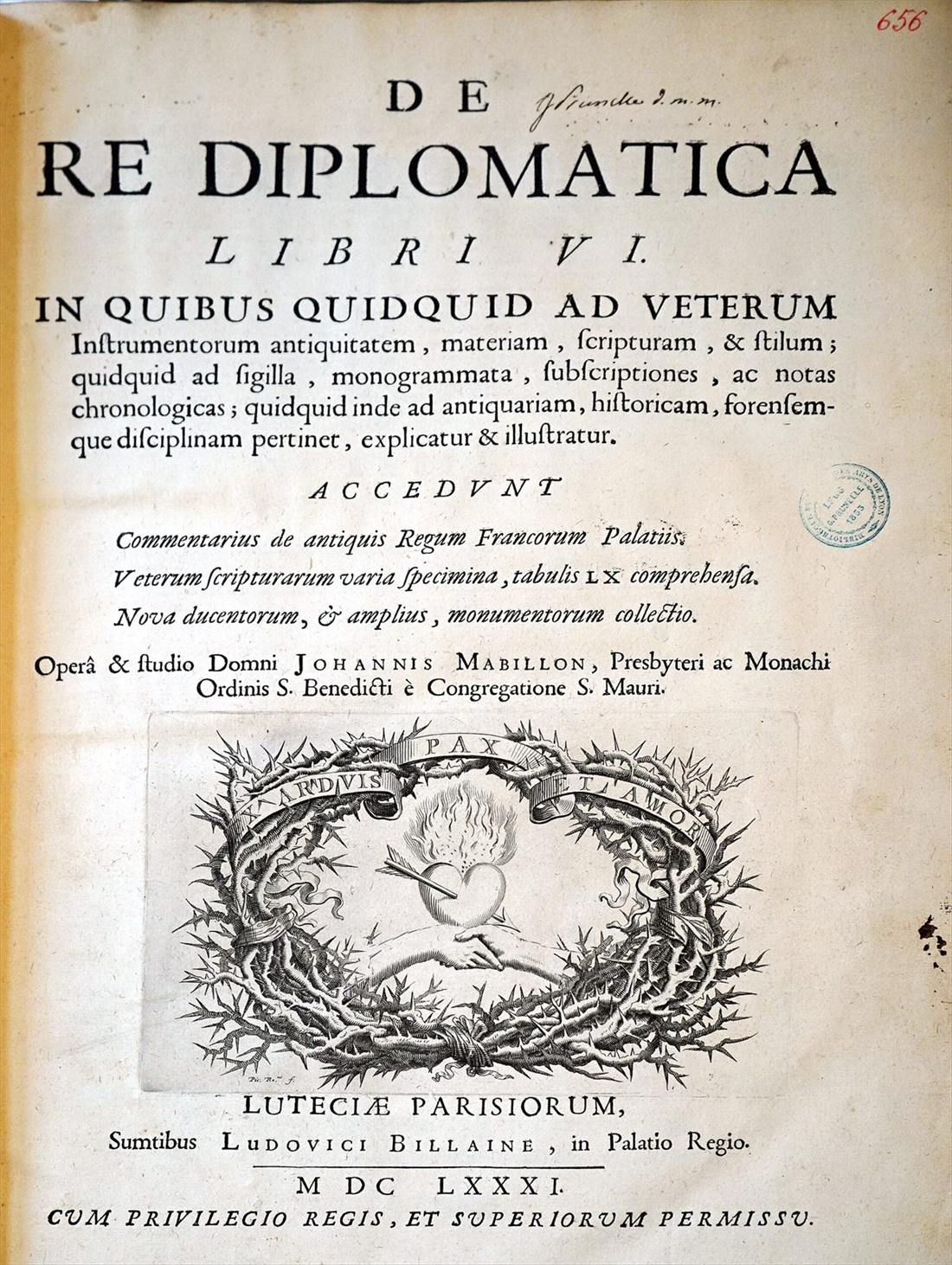
The founder of diplomatics. His De re diplomatica (1681) sets out the rules by which an authentic charter may be told from a forgery: script, formulae, seals, dating. In the Traité des études monastiques (1691) he defends, against the abbot de Rancé, the legitimacy of study in the cloister.
Dom Bernard de Montfaucon
1655-1741
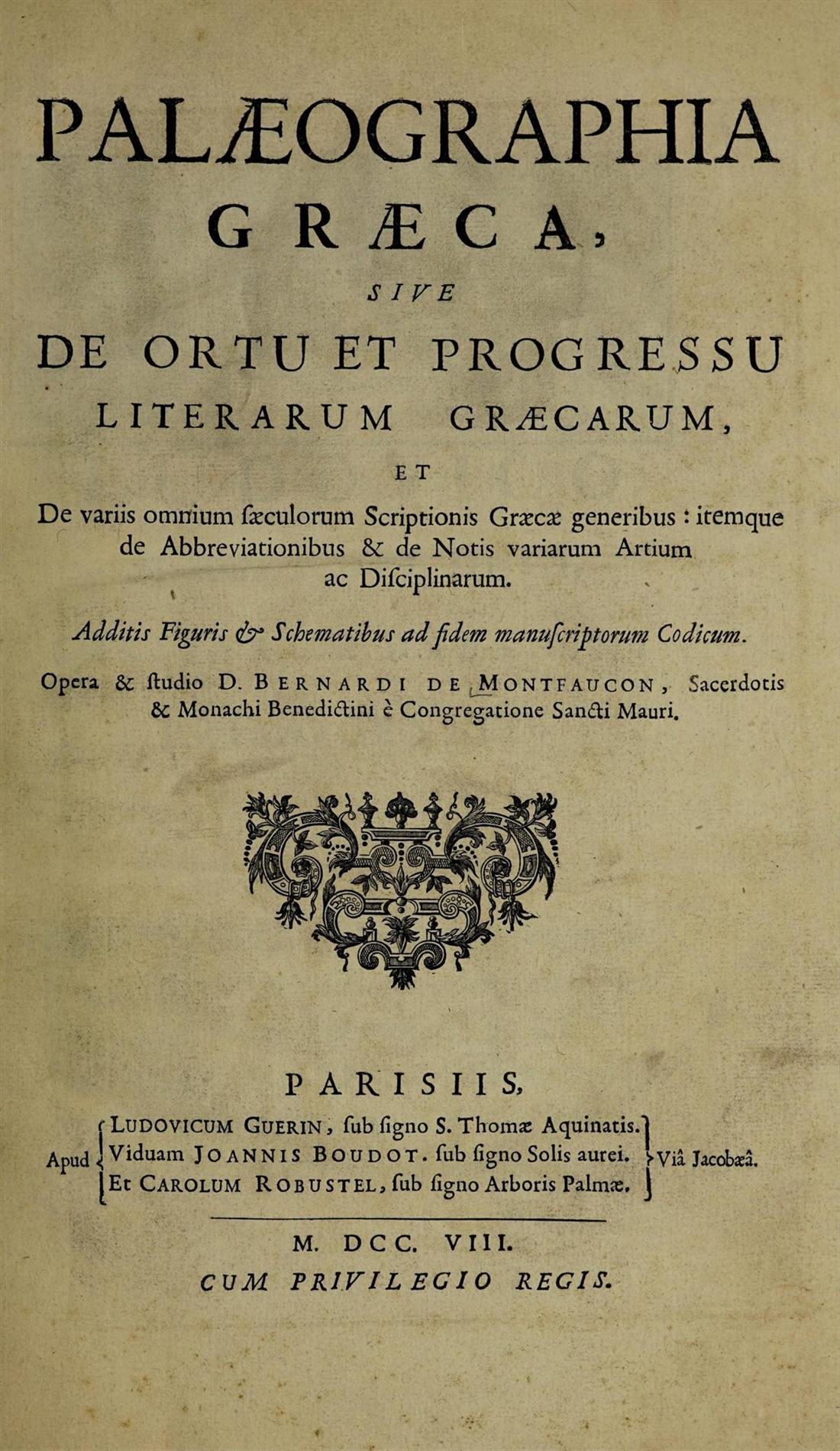
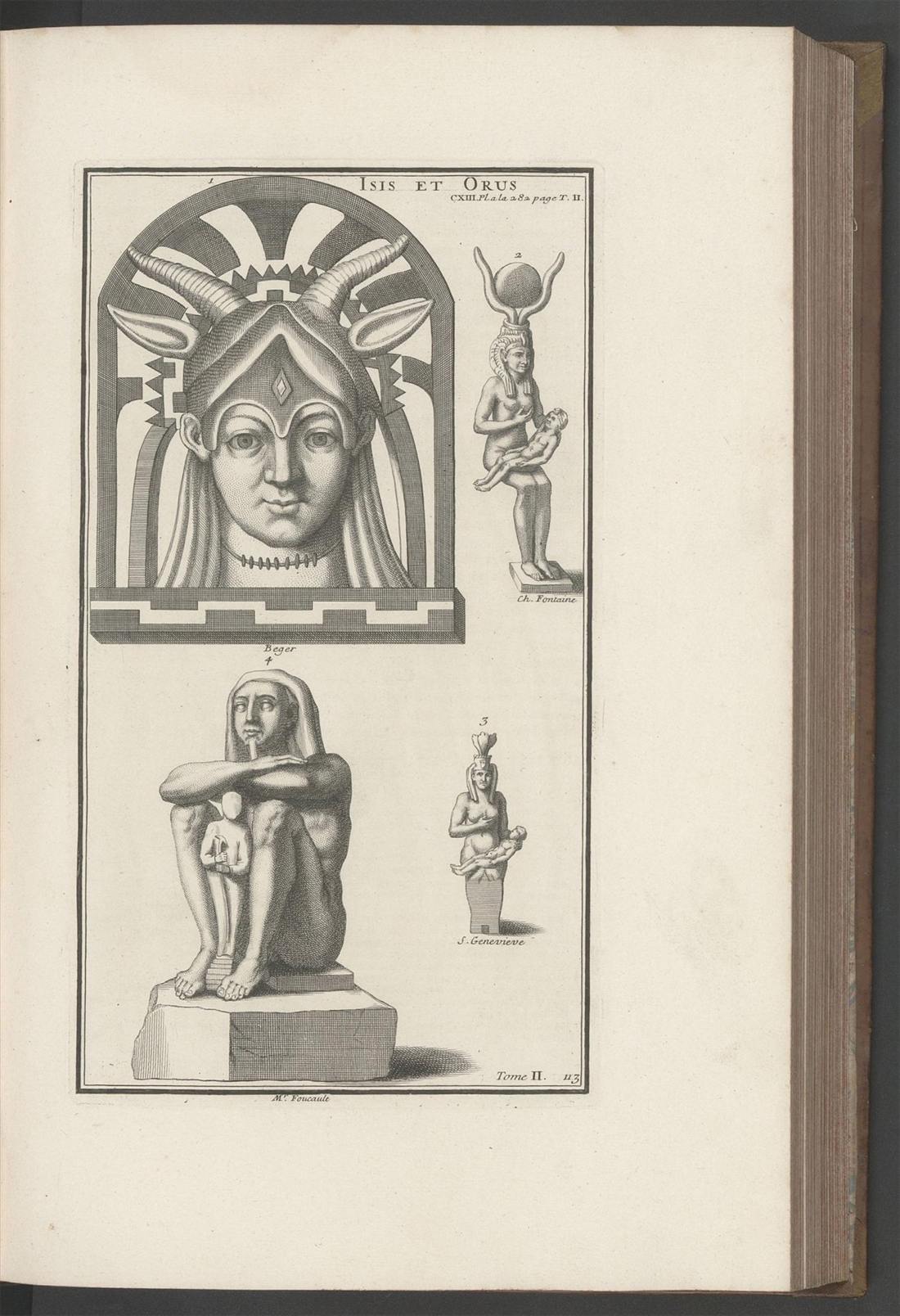
He created both the word and the science of palaeography with his Palaeographia graeca (1708), edited Saint Athanasius and Saint John Chrysostom, and gathered in L’Antiquité expliquée et représentée en figures (1719-1724) a great illustrated corpus of ancient monuments.
Title page of the De re diplomatica, Paris, 1681. The crown of thorns around the word PAX is the emblem of the Congregation.
The great enterprises
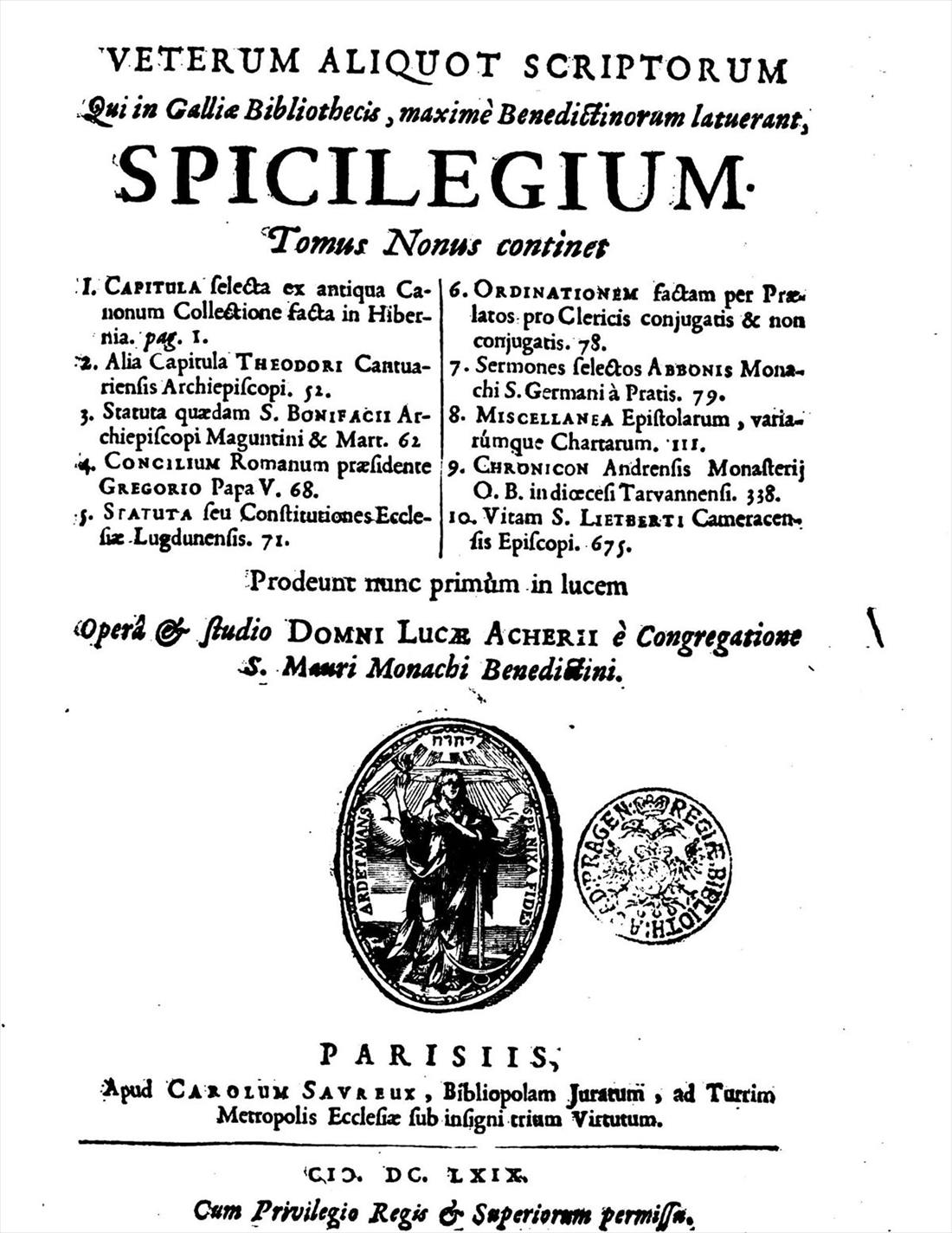
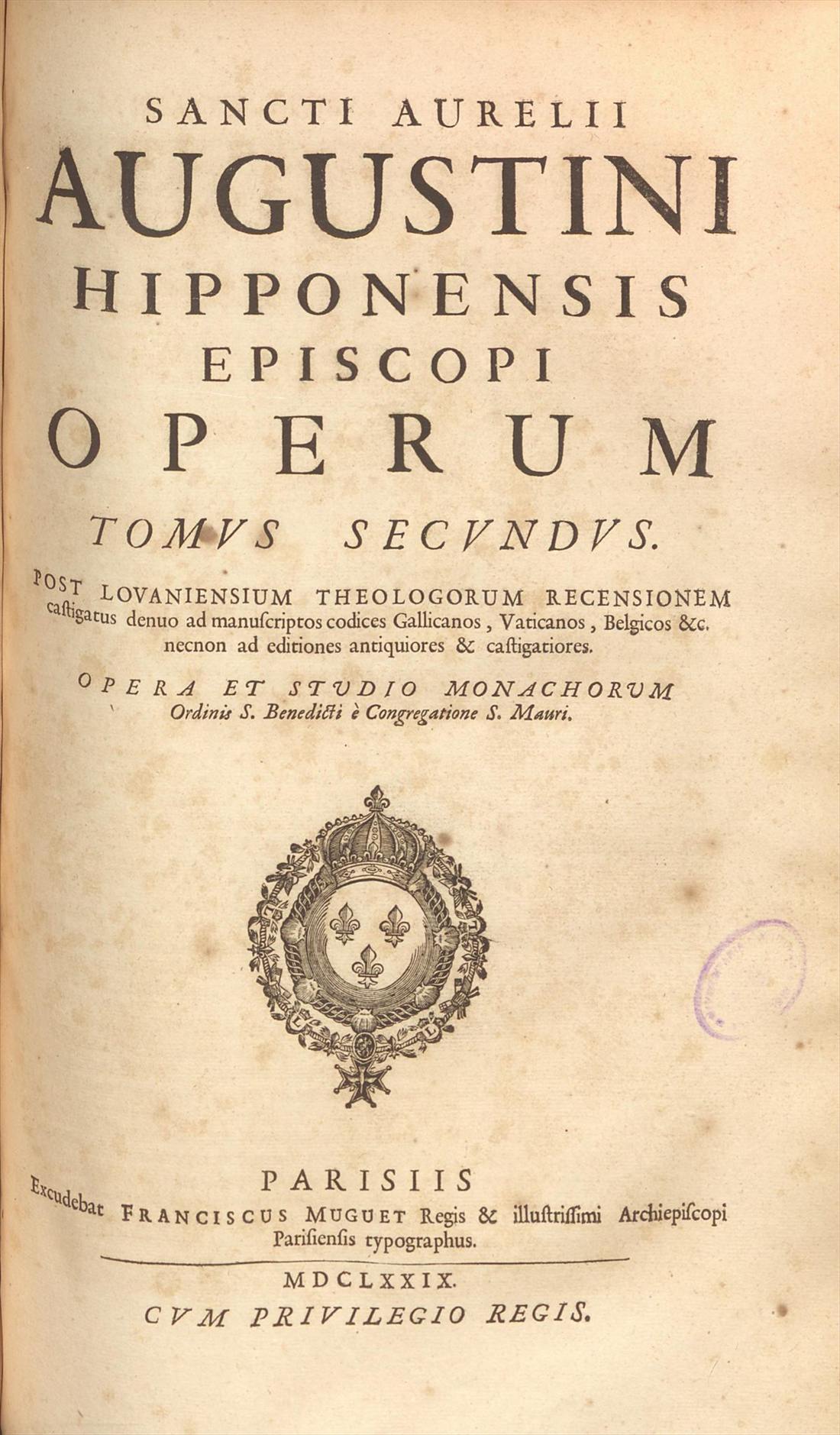
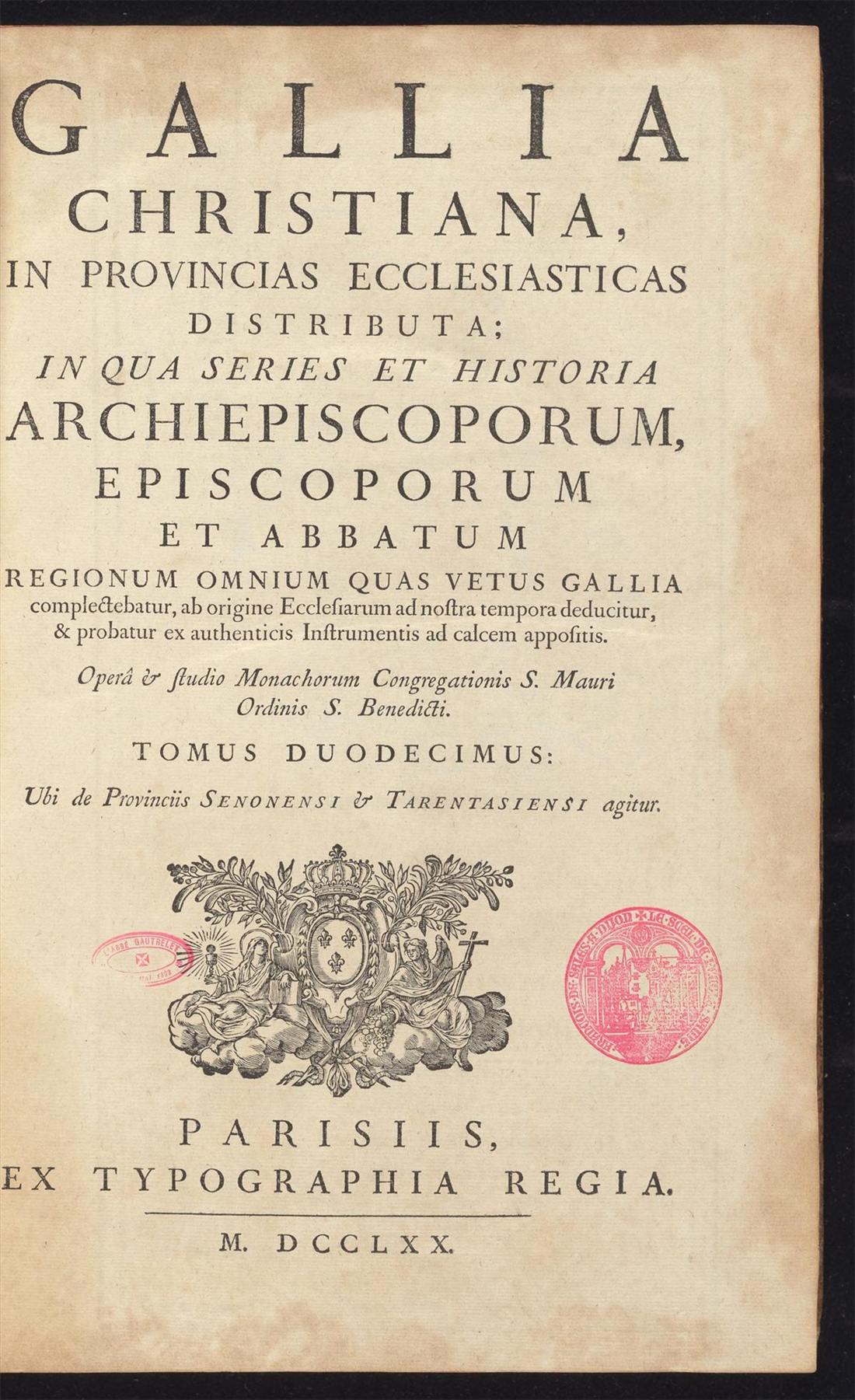
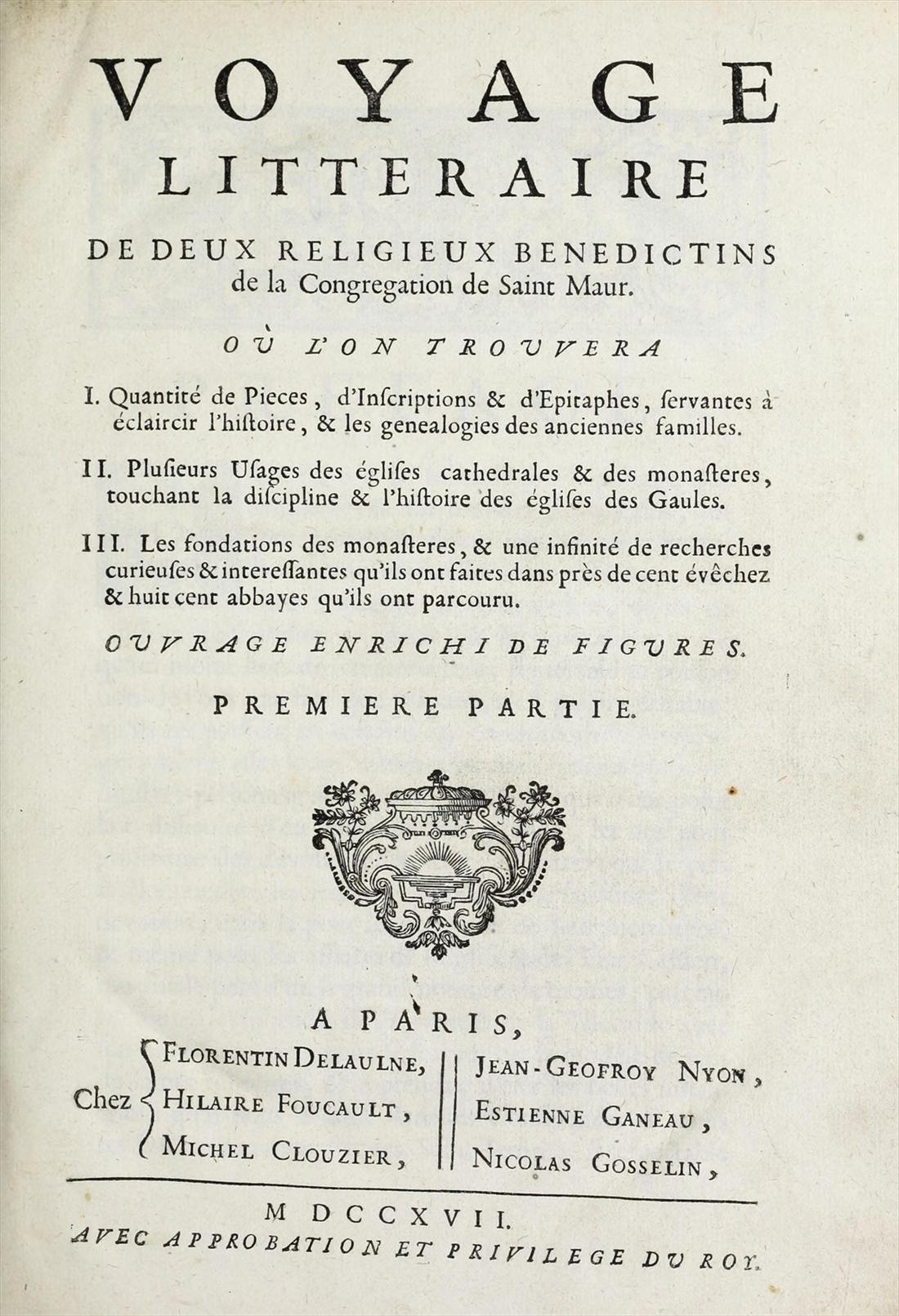
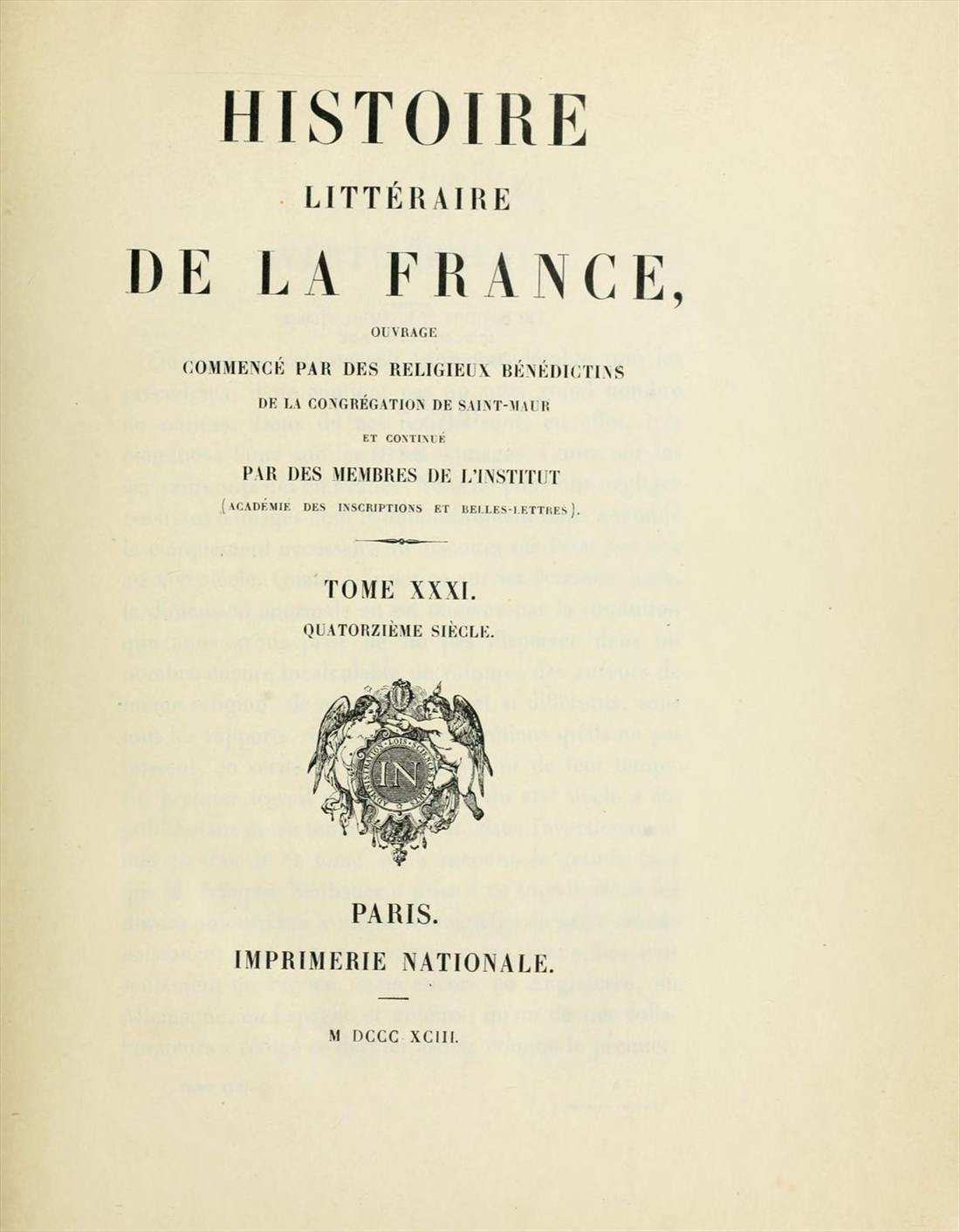
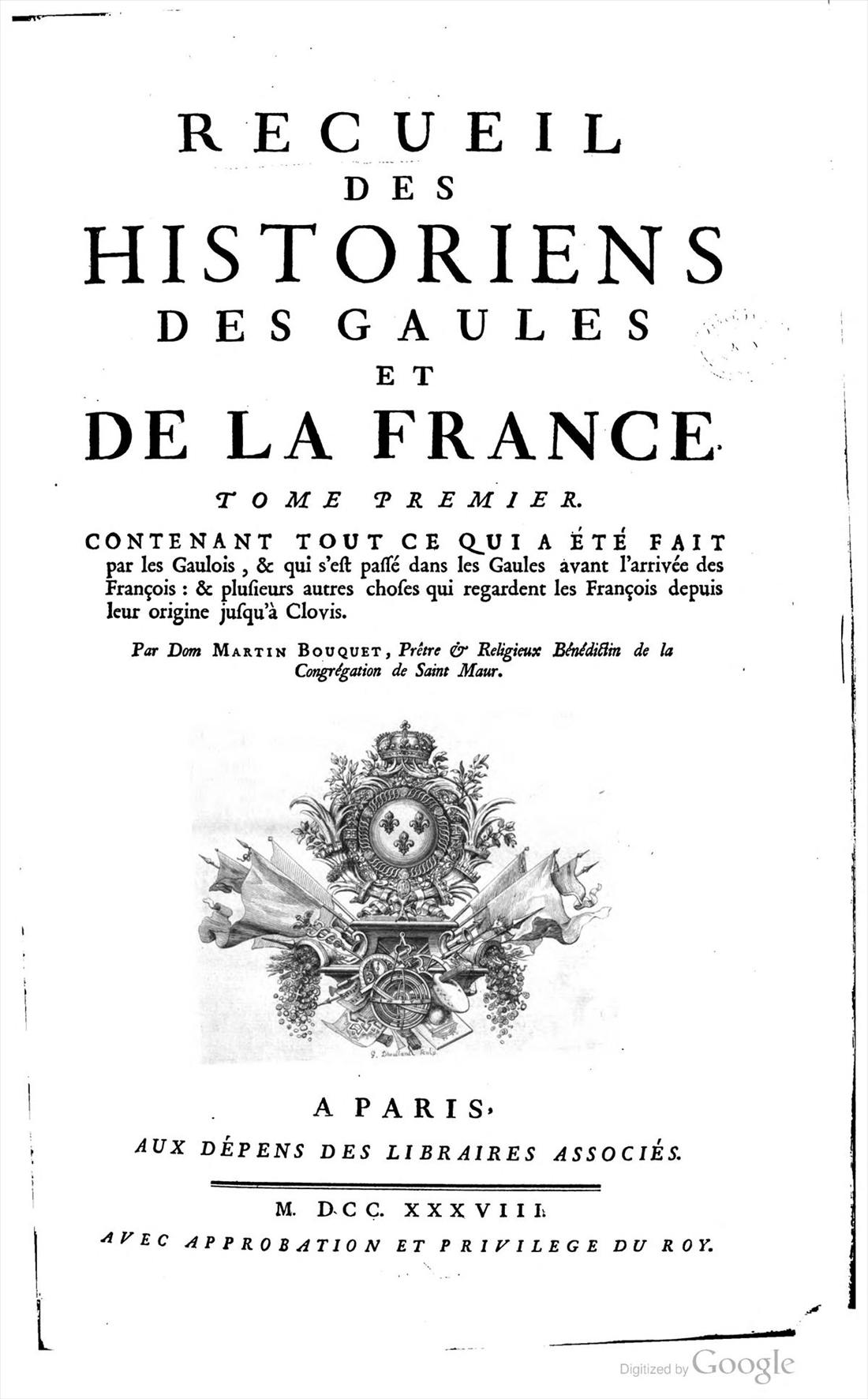
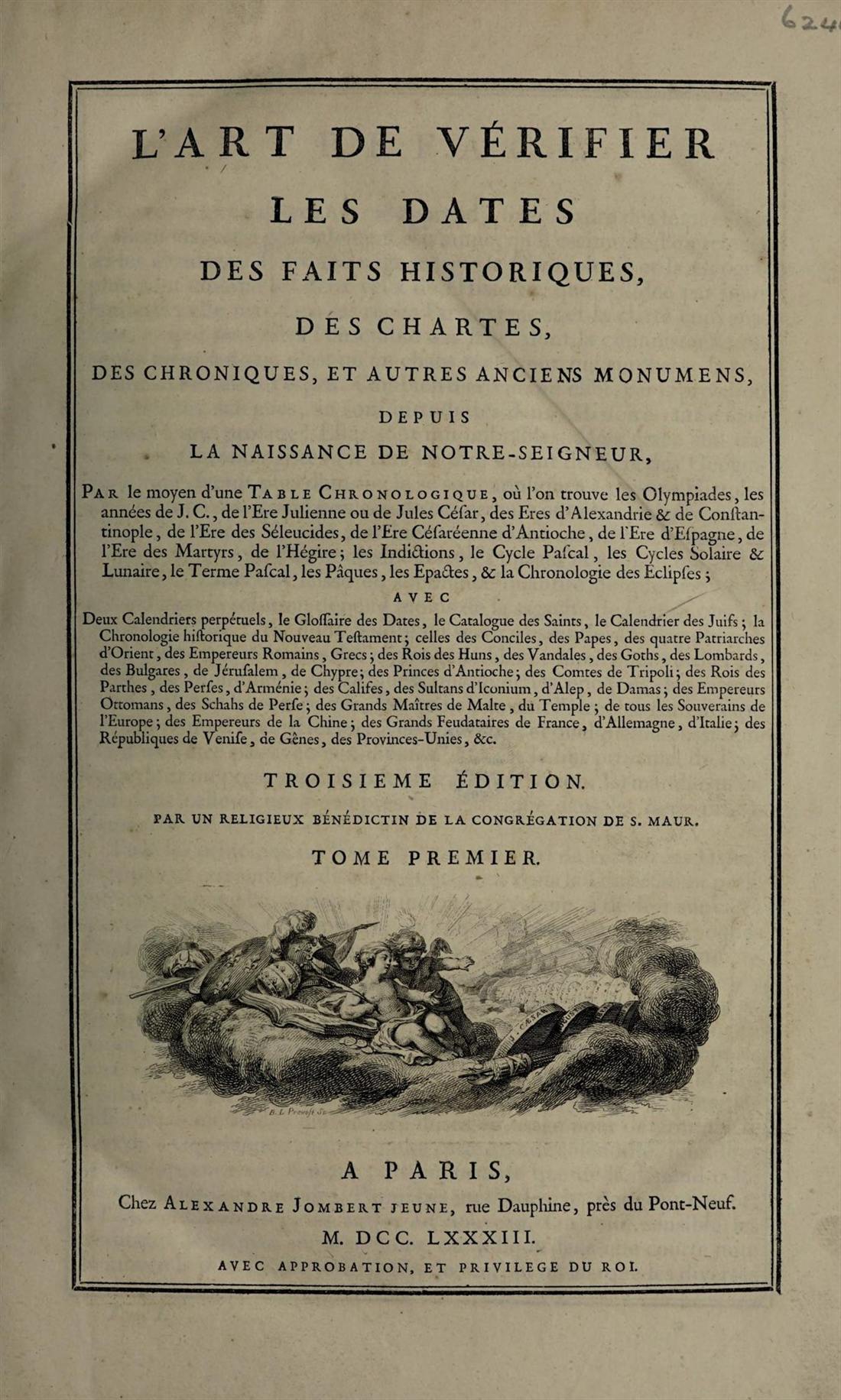
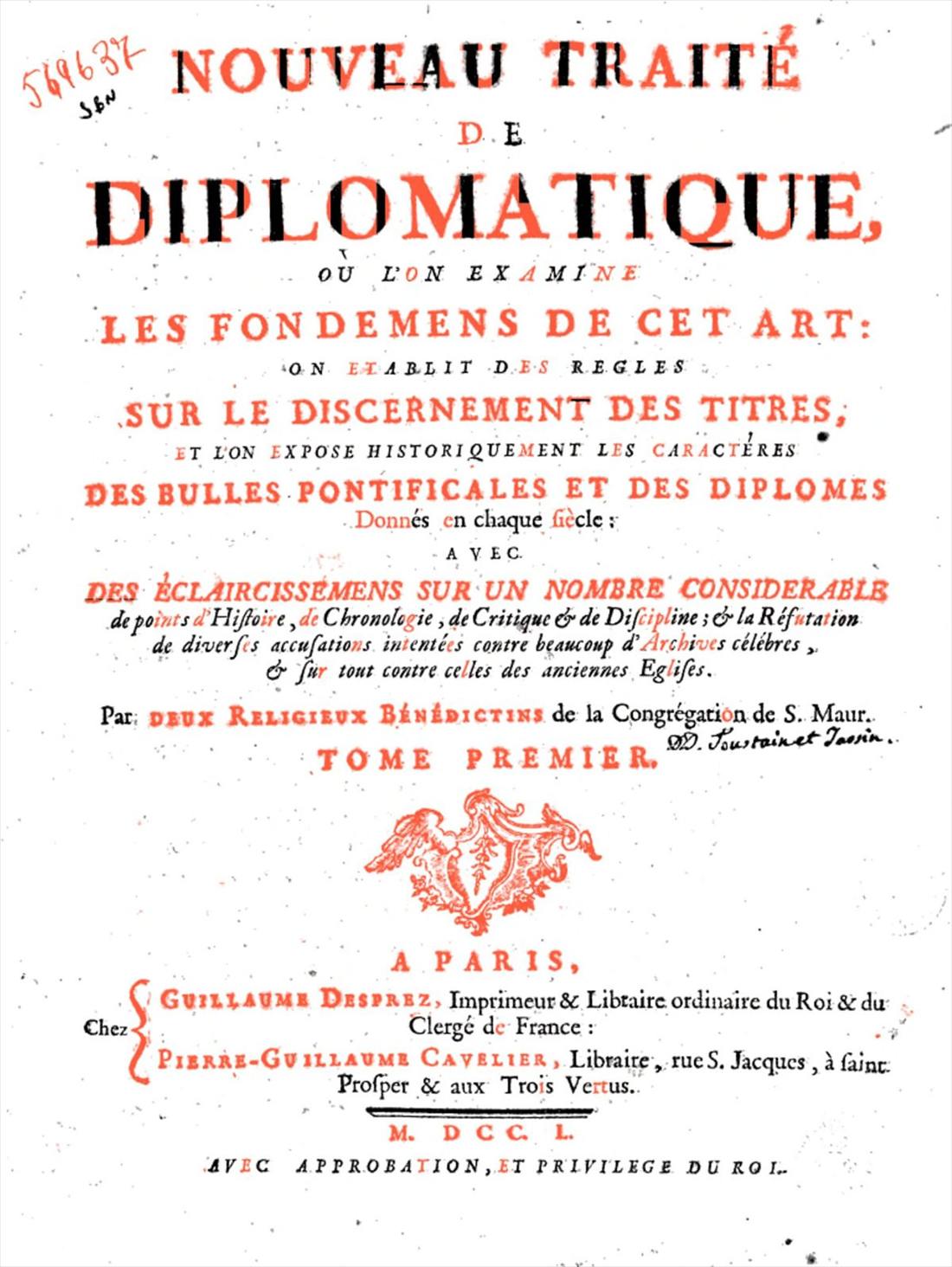
Twenty works, from 1655 to 1769, each with a page of its own: what it is, how it was made, what became of it, and the pages themselves — title pages, plates and engravings photographed from surviving copies.
The images are photographs of surviving copies, from the libraries that hold them; each page names the copy and its holder.
The breadth of the fields
A congregation of monks, bound to one Rule, left work in some twenty-five fields that a modern university would file under different faculties. The labels below are ours, not theirs: they did not divide knowledge as we do. Each entry names a person, a dated work and what the evidence actually supports.
I
The sciences of the document
Diplomaticsdom Jean Mabillon, De re diplomatica, 1681
How to tell an authentic charter from a forgery: script, formulae, seals, dating, the circumstances of production. A disciplined way of testing documentary evidence, worked out inside an existing scholarly quarrel and not in isolation.
Greek palaeographydom Bernard de Montfaucon, Palaeographia graeca, 1708
Dated witnesses compared, so that a Greek hand can be placed in time. The book gave the field both its name and its first systematic treatment.
ChronologyL’Art de vérifier les dates, 1750
Eclipses, Easter cycles and the concordance of calendars in tables. Prepared from dom Maur Dantine’s research and carried through by dom Clémencet and dom Durand.
Medieval Latin lexicographythe Maurist edition of Du Cange, 1733-1736
Du Cange was a layman, an avocat at the Parlement of Paris, and not a Maurist: the congregation’s achievement is the revised and greatly enlarged edition in six folio volumes, with dom Carpentier’s four-volume supplement of 1766.
II
Sacred letters
The Latin Bible before Jeromedom Pierre Sabatier, Bibliorum sacrorum Latinae versiones antiquae, 1743-1749
Thirty years gathering the Old Latin versions from manuscripts, patristic quotations and liturgical books, printed beside the Vulgate. The Beuron Vetus Latina, begun in 1949, is expressly its successor.
Origen’s Hexapladom Bernard de Montfaucon, Hexaplorum Origenis quae supersunt, 1713
What survives of Origen’s six-column comparison, collected from citations and marginal readings. The original was already lost; this is a gathering of fragments, not a recovery.
PatristicsAthanasius, Paris, 1698
Prepared at Saint-Germain-des-Prés by dom Jacques Loppin, dom Montfaucon and dom Antoine Pouget — a team, over years, of the kind these editions always required.
Hagiographydom Thierry Ruinart, Acta primorum martyrum sincera et selecta, 1689
Sincera records an editor’s critical judgement on which martyr narratives deserve credit — a judgement later scholarship has revisited.
Canon lawdom Pierre Coustant, Epistolae Romanorum pontificum, 1721
The letters of the popes and those addressed to them, from AD 67 to 440. Coustant died the year it appeared and only this first volume was ever printed.
Liturgy and chantdom Pierre-Benoît de Jumilhac, La science et la pratique du plain-chant, 1673
Chant treated as a measurable thing — consonances and ratios — before it is treated as a taste. With dom Martène’s work on ancient rites, the Maurist witness to how worship was actually performed.
III
Languages
Hebrew and Biblical Aramaicdom Pierre Guarin, 1724-1726 and 1746
Professor of Greek and Hebrew, then librarian of Saint-Germain-des-Prés. His Grammatica hebraica et chaldaica appeared in his lifetime; the lexicon, carried only as far as the letter mem, was finished by his brethren and printed in 1746.
Bretondom Louis Le Pelletier, Dictionnaire de la langue bretonne, 1752
Born at Le Mans, he learned Breton as an adult and spent his last thirty years at Landévennec. The printed text is an abridged and reworked posthumous edition by his confrère dom Taillandier, paid for by the Estates of Brittany.
IV
Philosophy and the ordering of knowledge
Philosophydom François Lamy, De la connaissance de soi-même, 1694-1698
A Maurist who took up Cartesian philosophy, and whose book drew Malebranche into a public controversy over the disinterested love of God. Not to be confused with Bernard Lamy, of the Oratory.
Encyclopedismthe unfinished dictionary of arts, crafts and sciences, c. 1743-1755
Begun at Saint-Germain-des-Prés as an enlarged translation of Christian Wolff’s mathematical lexicon, then recast as an encyclopaedic dictionary, and abandoned unpublished. Traditionally attributed to dom Antoine-Joseph Pernety and dom François de Brézillac — the manuscripts are unsigned, and the hands point to further compilers still unidentified. Some 1,400 folio leaves survive at the Bibliothèque nationale de France.Studied by Linn Holmberg, The Maurists’ Unfinished Encyclopedia, Voltaire Foundation, 2017
V
Measure, mechanism and nature
Mechanics and horologydom Jacques Alexandre, 1726 and 1734
Cellarer of Bonne-Nouvelle and inventor of the equation clock: a treatise on the tides, then a general treatise on clocks closing with a catalogue of earlier writers. His tidal explanation is of historical interest and scientifically superseded.
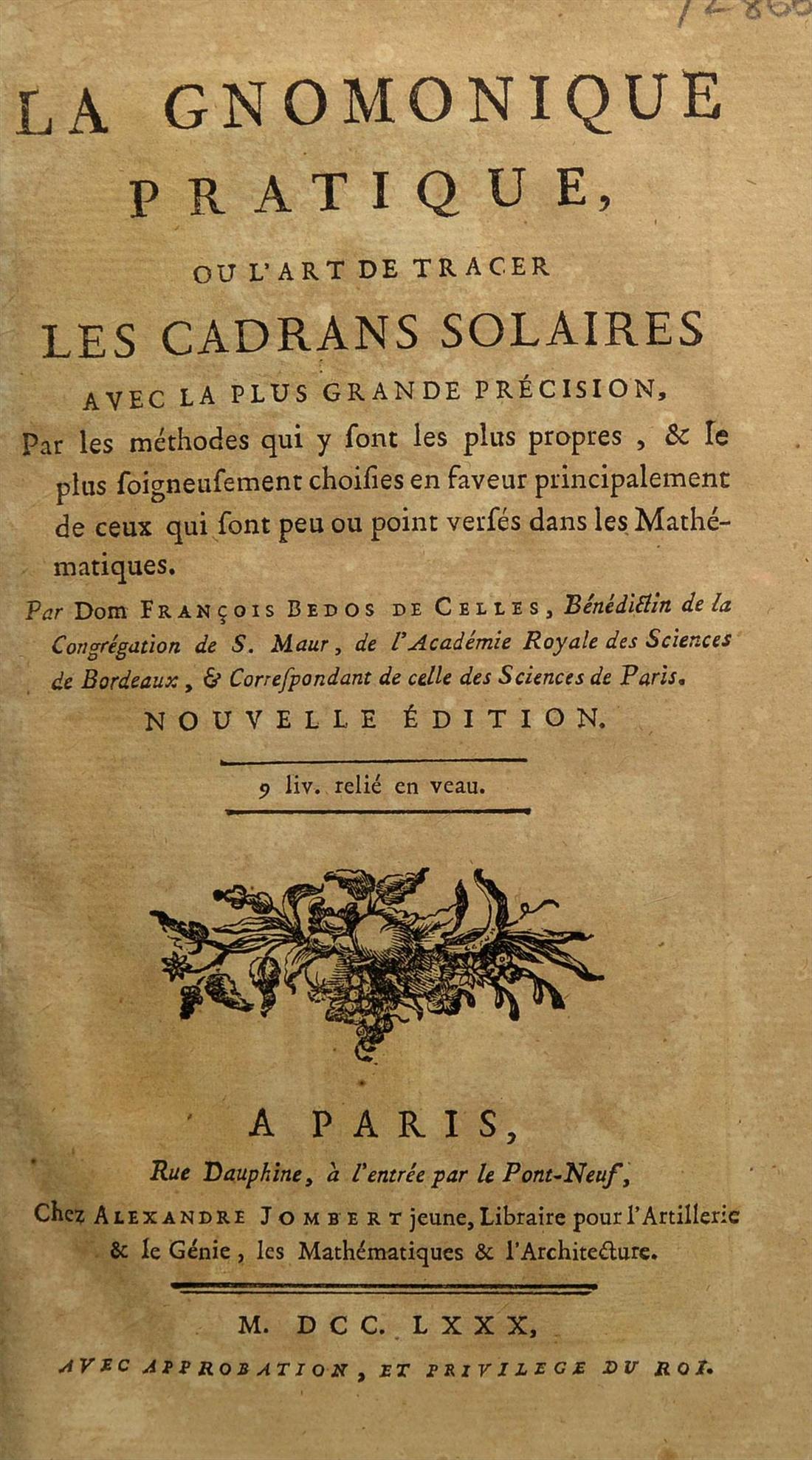
Gnomonicsdom François Bédos de Celles, La Gnomonique pratique, 1760
How to trace a sundial exactly: geometry and solar time brought together in a usable instrument. Applied mathematics, not a new astronomical law.
Organ buildingdom François Bédos de Celles, L’Art du facteur d’orgues, 1766-1778
Wind, pipe alloys, proportions, workshop tools, plate after plate, for the Académie’s Description des arts et métiers. A complex craft made explicit and transmissible — still the reference for restoring a classical organ.
Medicine and pharmacydom Nicolas Alexandre, 1714 and 1716
Two anonymous compilations — La médecine et la chirurgie des pauvres and a Dictionnaire botanique et pharmaceutique — reprinted and enlarged into the nineteenth century. Works of compilation for practical use; he held no medical qualification.
Natural history and traveldom Antoine-Joseph Pernety, Journal historique, 1769
Chaplain and naturalist on Bougainville’s voyage to the Malouines in 1763-1764, and not on the later circumnavigation. Plants, birds, and one of the earliest known published descriptions of the boulder fields now called stone runs.
Agriculturethe Le Mans bureau of the Société royale d’agriculture, 1766-1776
Dom de La Bezardais, prior of La Couture, and dom de Gennes, last librarian of Saint-Vincent du Mans, both directed it. Diseased ears of wheat shown in 1766, a report on sowing rye in 1773, three horses killed by yew described in 1776: observations shared in a learned network, not controlled trials.
VI
The arts and the eye
The vocabulary of artdom Antoine-Joseph Pernety, Dictionnaire portatif de peinture, sculpture et gravure, 1757
Artistic practice treated as a subject for systematic explanation. Its title page presents him as a Benedictine of the Congregation of Saint-Maur, which he left later in life.
Sculpture in marbleJacques Bourlet, Saint Margaret, eighteenth century
The French heritage inventory names Bourlet, a lay brother of the abbey of Saint-Germain-des-Prés, as the author of this life-size marble, classified as a historic object in 1905. The record gives a century, not a year.base Palissy, PM75001754
Work in bronzeJean Thibaut, relief on the monument of Jean Casimir, seventeenth century
The same inventory attributes the bronze relief at the base of the king’s monument to Thibaut, likewise a lay brother of the abbey. The marble above it is given to the Marsy brothers.base Palissy, PM75001748
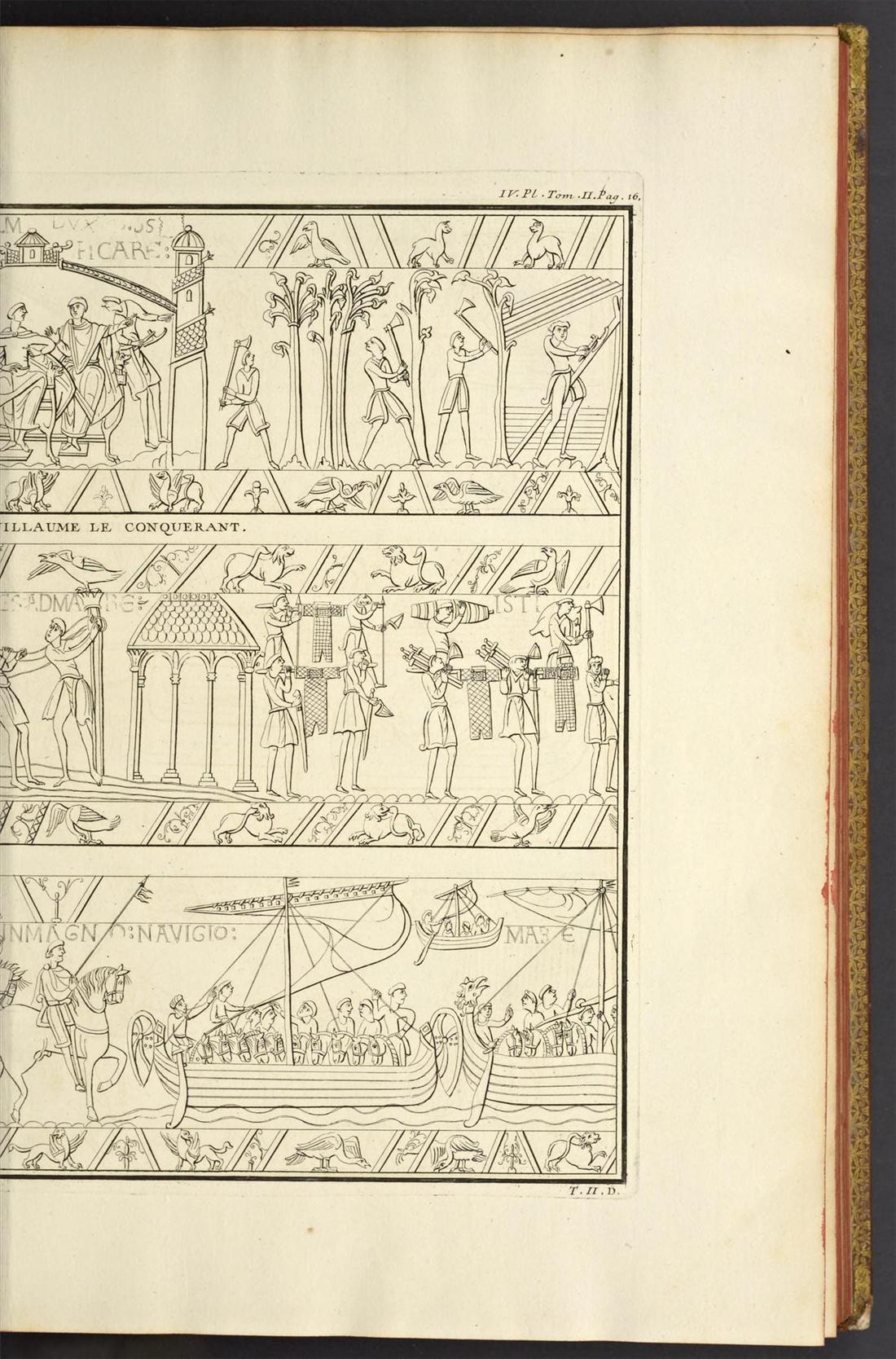
Antiquities and art historydom Bernard de Montfaucon, Les Monumens de la monarchie françoise, 1729-1733
Its first two volumes carry an engraved reproduction of the whole Bayeux Tapestry, the 1730 plates engraved after drawings Montfaucon commissioned from Antoine Benoît. Drawn in the taste of their century rather than as a facsimile — but a record of the embroidery long before photography and before the nineteenth-century repairs.
Architecture and surveythe brother architects, seventeenth and eighteenth centuries
About a dozen religious architects in the seventeenth century alone. Plans were surveyed on the spot and drawn twice — one copy for approval at Saint-Germain-des-Prés, one kept in the house. That practice is why the plans of this abbey survive at all.
Views and landscapeMonasticon Gallicanum, associated with dom Michel Germain
A rich visual record of the Congregation’s monasteries, their buildings, gardens and precincts — and, equally, of how each community wished its house to be seen. Some views show what was intended rather than what stood.
Five kinds of contribution are mixed here and worth distinguishing: a method devised, an edition or reference tool produced, an observation recorded, a craft practised, and a collection formed or taught. An influential compilation is an achievement without being an original discovery — and this list does not claim that the congregation founded every modern discipline it touches.
Measure, mechanism and the land
The Congregation is remembered for its folios. The same discipline — measure, verify, describe — was turned as well on instruments, on the crafts, and on the estates the monasteries lived from. Six examples, less celebrated than the great collections, and all of them documented.
An organ described like a machinedom François Bédos de Celles · 1709-1779
A member of the Académie royale des sciences, belles-lettres et arts of Bordeaux from 1759, and a corresponding member of the Académie royale des sciences in Paris from 1767 until his death. For the Académie’s Description des arts et métiers he made the four parts of L’Art du facteur d’orgues (1766-1778): the wind, the alloys of the pipes, the proportions, the tools of the workshop, plate after plate. It remains the reference for anyone restoring a classical organ. Six years earlier, La Gnomonique pratique (1760) had set out how to trace a sundial exactly — astronomy brought down onto a wall.
Clocks, a pendulum and the tidesdom Jacques Alexandre · 1653-1734
He passed his life at the priory of Bonne-Nouvelle and gave his free hours to mathematics, physics and mechanics: a Traité du flux et du reflux de la mer (1726) on the tides, then the Traité général des horloges (1734), whose last quarter — some eighty-nine pages — is an annotated catalogue of the authors who had written on clocks, with extracts and observations: an early bibliography of horological literature. He also wrote a sixth part for Huygens’ Horologium oscillatorium, describing a pendulum of his own.
A naturalist under saildom Antoine-Joseph Pernety · 1716-1796
A monk of Saint-Germain-des-Prés, he sailed with Bougainville for the Malouines in 1763 as chaplain and naturalist — not on the later circumnavigation. His Journal historique d’un voyage fait aux îles Malouines en 1763 et 1764 (1769) describes the plants, the birds and the boulder fields of the islands: one of the earliest known published descriptions of those rivers of rock. He left the Congregation shortly after his return.
Time made calculableL’Art de vérifier les dates · 1750
Not a chronicle but an instrument: eclipses, Easter cycles and the concordance of calendars reduced to tables, so that the date of a document could be tested instead of believed. Calendar concordances gave historians the means to test a date and to spot inconsistencies.
The mathematics of sounddom Pierre-Benoît de Jumilhac · 1673
The full title of his treatise states the programme: La science et la pratique du plain-chant, where everything belonging to practice is established by the principles of science. Chant is treated as a measurable thing — consonances and ratios, the diapason, the diapente, the diatessaron — before it is treated as a taste. It remains one of the fullest seventeenth-century sources on how these melodies were actually sung.
A congregation of surveyorsthe brother architects · seventeenth and eighteenth centuries
The Congregation built with its own men: about a dozen religious architects in the seventeenth century alone. Dom Denys Plouvier (c. 1601-1669) left some forty plans drawn between 1640 and 1667, and worked sparingly — keeping sound medieval fabric and adapting it rather than pulling it down. Brother Guillaume de La Tremblaye (1644-1715), sculptor as well as architect, is credited with the plans for the conventual buildings of Saint-Étienne at Caen, begun in 1704 and carried on after his death by dom Miserey; the abbey church beside them is six centuries older and not his work. The method was fixed: survey on the spot, then draw the scheme twice — one copy to Saint-Germain-des-Prés for approval, one kept in the house.
The abbey as a working estate
The Congregation left no treatise on husbandry, and it would be false to claim one. What it did leave is more exact. Where the reform arrived its first labour was temporal: accounts put in order, the scattered estate reassembled, the farm buildings and the water put back into service — a monastery of this size fed itself, and had to be made to do so again.
Their observations did not always stay inside the house. In the Le Mans bureau of the Société royale d’agriculture de la généralité de Tours, set up in 1761, Maurists were among the most active members: dom Pierre-Jacques de La Bezardais, prior of La Couture, elected in 1764 and director in 1769, and dom Jean-Baptiste-Marie de Gennes, last librarian of Saint-Vincent du Mans and director in 1774, who presented diseased ears of wheat in 1766, argued in a report of 1773 for sowing rye in winter rather than late in the spring, and in April 1776 described the sudden death of three horses at Marmoutier that had eaten yew leaves. Observations and reports, not controlled trials — but evidence that monks took part in the learned networks of agriculture.
The one vine the Maurists are remembered by is not their own doing but their neighbour’s. Dom Thierry Ruinart (1657-1709), who entered at Saint-Remi of Reims and became Mabillon’s companion in the Acta sanctorum, kept an interest in the wine of his province; the house founded in 1729 by his nephew Nicolas, the oldest in Champagne, traces its beginning to that monk’s familiarity with sparkling wine. The Congregation’s own vineyards, orchards and fishponds left no literature at all — only accounts, leases, and plans.
The plans are what survive here. At Mas-Garnier the monastery was drawn floor by floor in 1661 by brother Robert Plouvier, and in 1679 brother Christophle Lachezelle drew the whole enclosure at about 1:860: the ditches, the paths, the garden parterres, the plantations, the river and its pebble island. That sheet records the arrangement of the gardens, the paths, the water and the parts of the enclosure; what actually grew there, and what it yielded, has to come from other sources.
Three things. Source criticism as a discipline, which all modern scholarship has taken up. The patience of long enterprises, designed to outlive their authors. And the equal dignity of study and craft: the same order that published Saint Augustine described, plate after plate, how an organ pipe is made. The Conservatoire’s programme follows from these three lessons.