
Saint-Maur · 1760
La Gnomonique pratique
dom François Bédos de Celles · Paris, Briasson, Despilly and Hardy · one octavo volume, thirty-five folded plates
Sundials existed in prodigious numbers, Bédos writes, and very few of them were any good — a thing everyone complained of and no author had yet ventured to say. This book is his remedy: ten chapters, thirty-five folded plates and tables he recomputed himself, addressed to readers with no mathematics at all. It was still being reprinted thirty years later.
A book for readers without mathematics
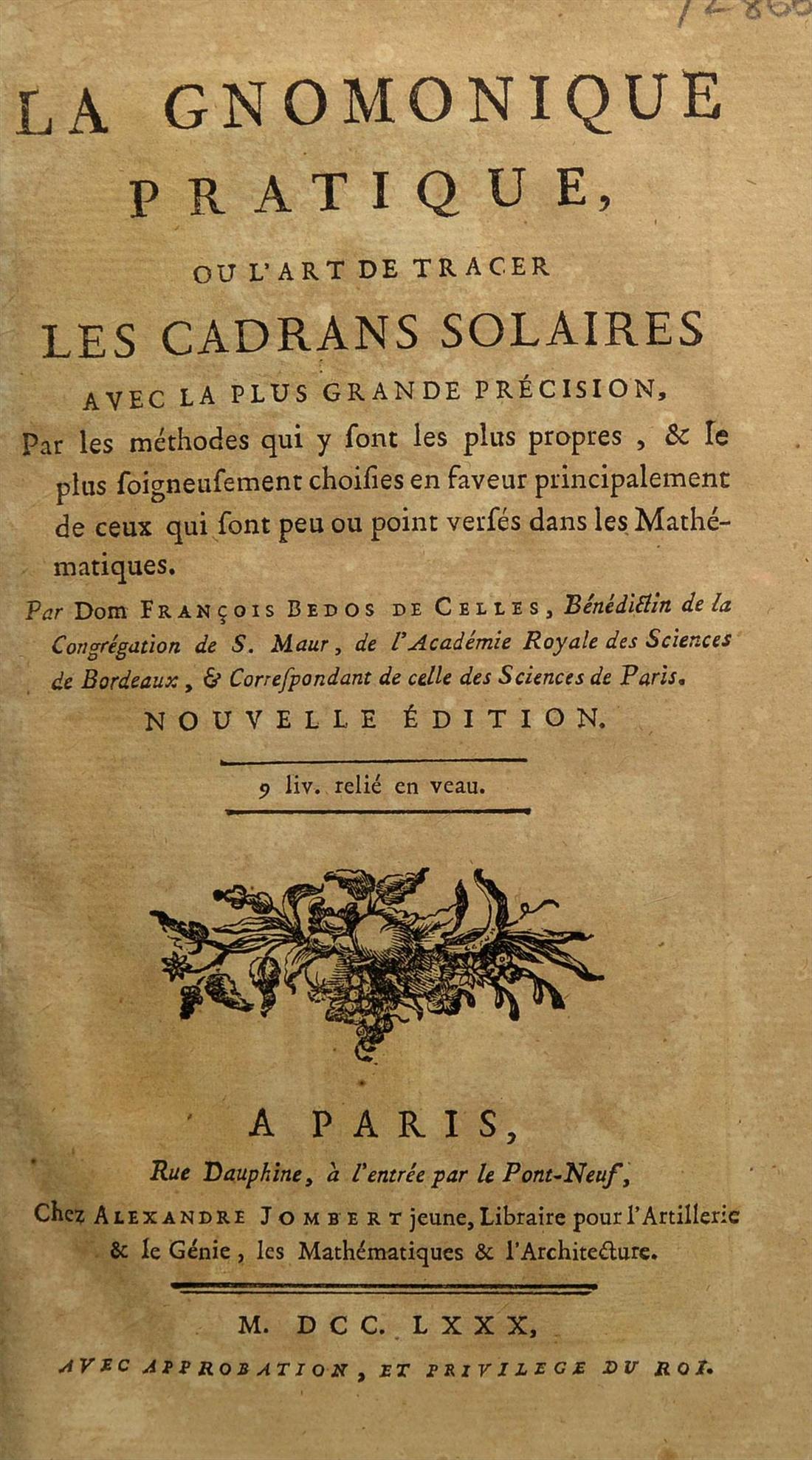
The 1780 title page states the audience outright: these are the methods chosen en faveur principalement de ceux qui sont peu ou point versés dans les Mathématiques — chiefly for people with little or no mathematics. Knowing how to read and write, and the first three or four rules of arithmetic, is all Bédos asks of anyone who means to put the art into practice and follow his rules exactly. The book itself was not cheap: six livres in sheets and seven bound in 1760, the same in the provinces as in Paris — nine livres, bound in calf, by 1780.
Ten chapters, and the tables under them
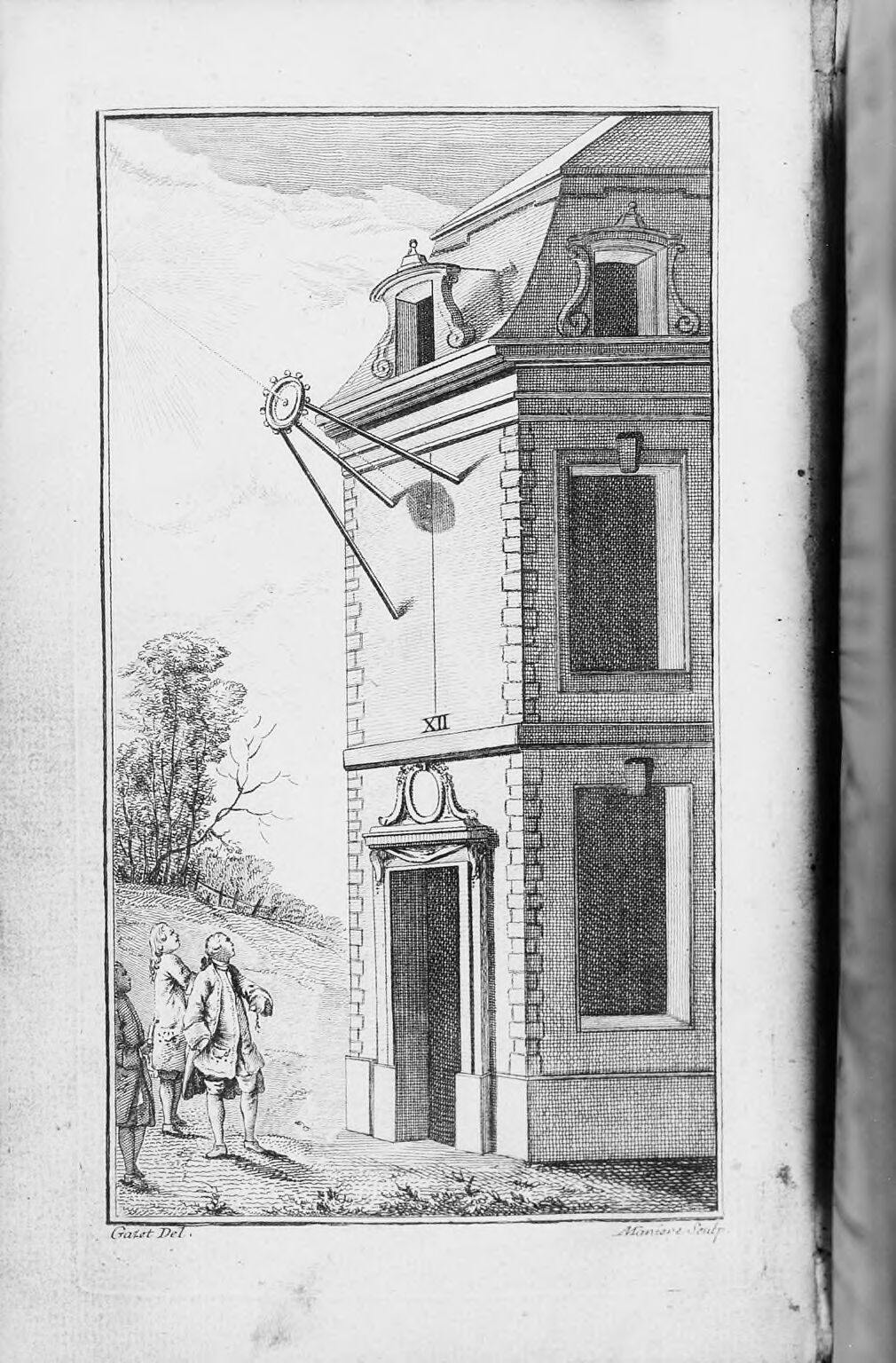
The ten chapters run from the circles of the sphere and the instruments needed, through the calculation, to horizontal dials, regular dials, vertical declining dials, vertical dials without a centre, inclined dials, meridian lines and portable dials. Bédos had a map of France drawn and engraved expressly for the book — the work of Rigobert Bonne — so that a reader in a village missing from the table of latitudes could still read off his own. He printed the sun’s height hour by hour for the latitudes France spans, and a table of the equation of time. He had recomputed them: the gnomonic tables then in use were built, he says, on an obliquity of the ecliptic of 23° 28′ 30″ and are faulty for it; his own are set on 23° 28′ 20″.
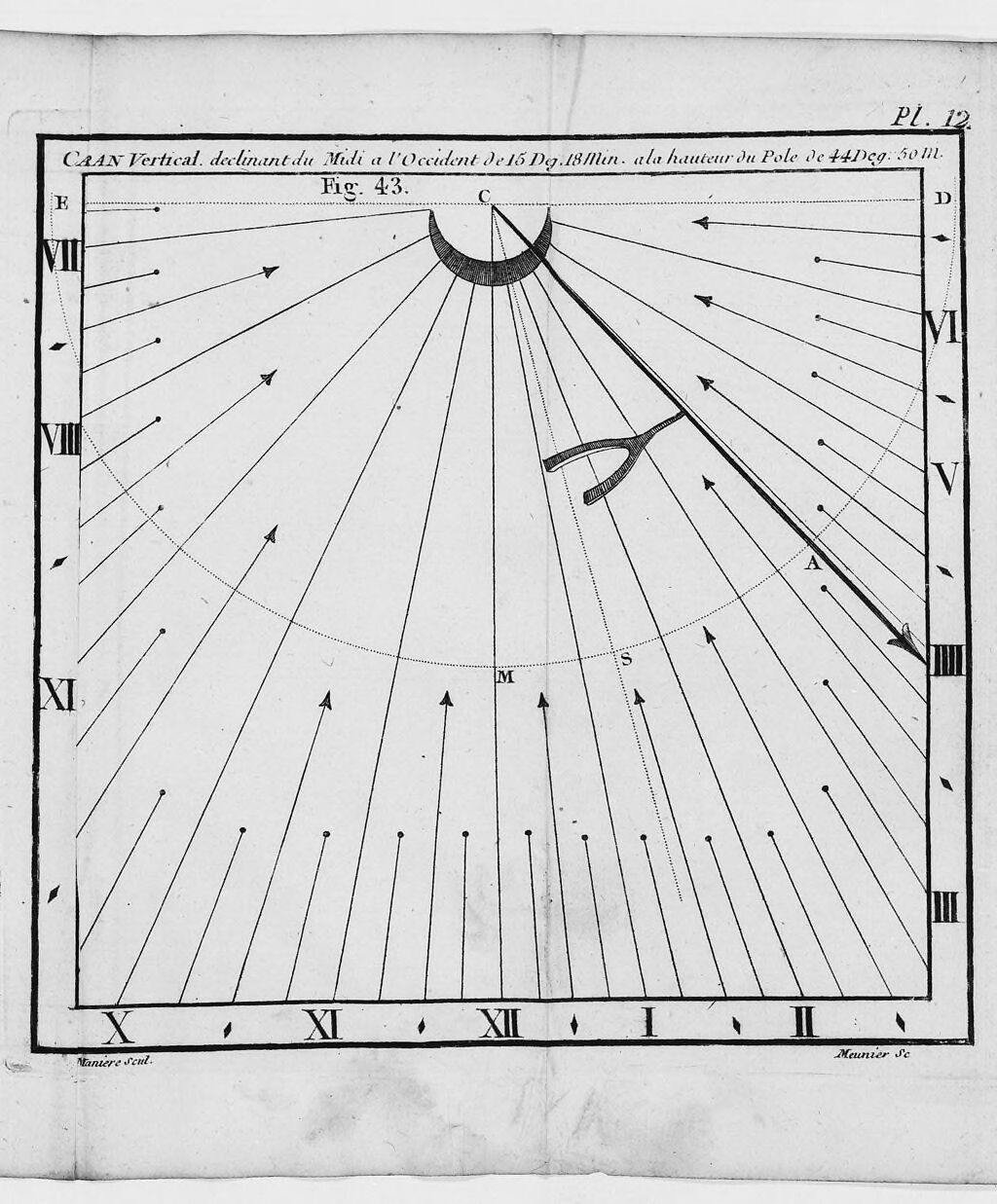
Chapter nine answers the other half of the 1760 title, the regulating of clocks. Taste had lately declared itself for meridian lines, Bédos notes, and the one for mean time invented by Jean-Paul Grandjean de Fouchy, perpetual secretary of the Paris academy of sciences, a pris beaucoup de faveur.
Bordeaux, and what became of the book
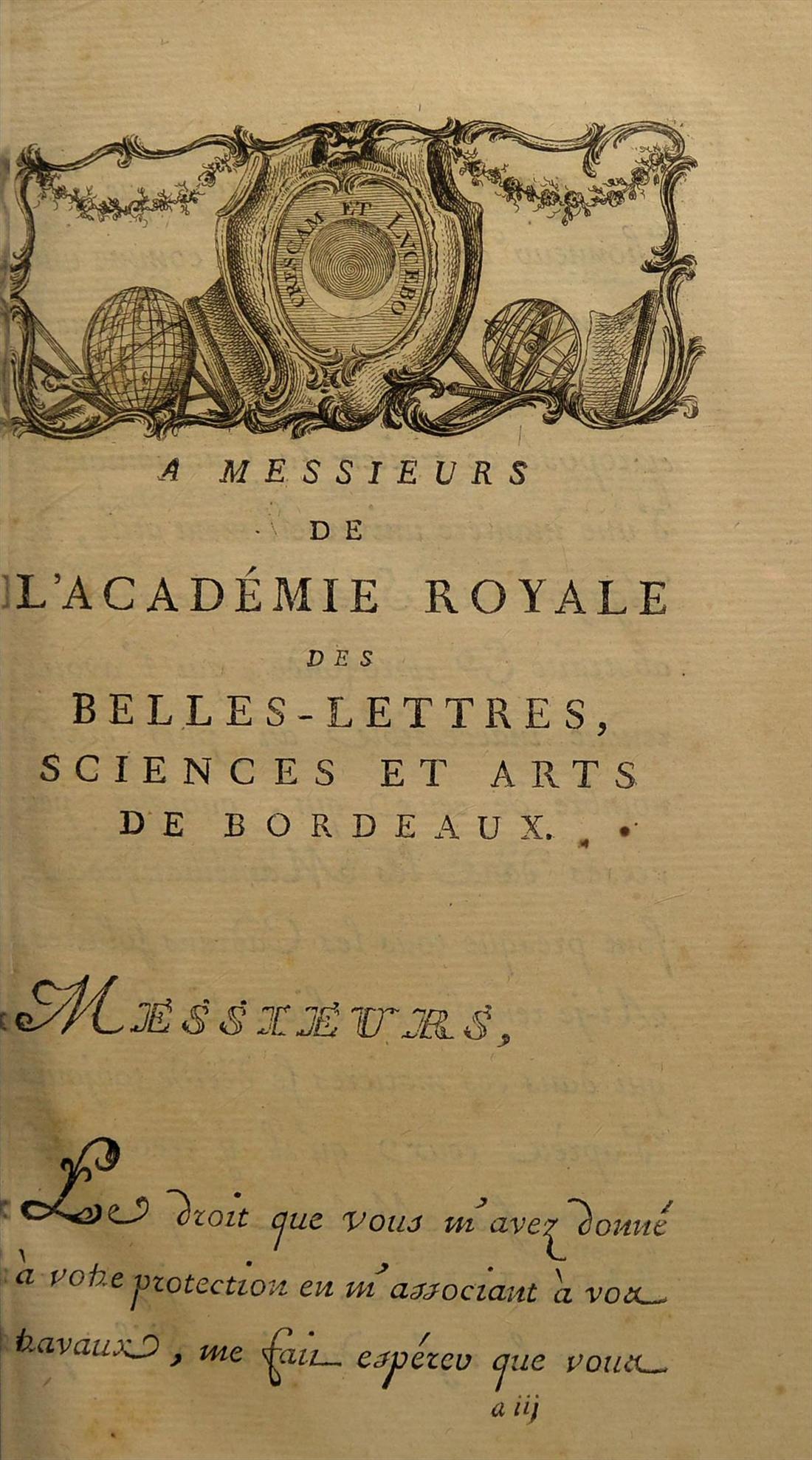
The dedication is to the academy of Bordeaux, named in full over its opening page: l’Académie royale des belles-lettres, sciences et arts de Bordeaux. Bédos was a member, and in 1760 the title page claimed nothing more. By 1780 it also called him a corresponding member of the Paris academy of sciences. When he was elected there is disputed — the CTHS prosopography of that academy gives 1767, other accounts 1758 — and we have not settled it.
The book outlived its author. Delalain reissued it at Paris in 1774, enlarged to 510 pages and thirty-eight plates; whether Bédos revised it himself is not known. Those same sheets were put on sale again in 1780 under a new title page for Alexandre Jombert jeune, bookseller for the artillery and the engineers — the 1774 printer’s line still standing at the back. F. Didot printed it once more in 1790.
Copies of the 1760 book are in the Bibliothèque nationale de France and in the Wellcome Collection in London, whose copy has been digitised; the ETH library in Zurich holds the 1780 issue; the copy scanned for the Internet Archive came from John Adams’s library, now in the Boston Public Library. Bédos is better remembered for the organ he built at Sainte-Croix in Bordeaux between 1744 and 1748, and for L’Art du facteur d’orgues, published between 1766 and 1778 in the Académie des sciences’ Description des arts et métiers. The sundial book came first, out of the same habit of mind — a Maurist measuring a craft and writing it down.
Why it is here
The Conservatoire teaches crafts to people who arrive without the theory, and this is the Maurist book that does the same: it takes a skilled trade apart, writes down what can be measured, and hands it to a reader who has only arithmetic. The workshops proceed the same way with stone, lime and timber, and the courses keep the same order, the demonstration before the doctrine. It also stands for the side of Maurist learning least remembered — not the charters and the chronicles, but the measurable crafts. The rest are in the list of works.
SourcesThe title page and the opening of the dedication reproduced here are from a digitised copy of the 1780 nouvelle édition, Paris, Alexandre Jombert jeune, in the public domain. The frontispiece and plate 12 belong to the Gallica album of illustrations to the 1760 edition, ark btv1b2600231j, Bibliothèque nationale de France, published on Wikimedia Commons. The chapter list, the preface, the passage on the map and the tables, and the sentence on Grandjean de Fouchy have been read in the full text of the 1760 edition digitised from the Wellcome Collection copy, which may be read at the Internet Archive. The catalogue collations differ: the Wellcome copy is described as xxii, 404 pages with thirty-five folded plates, while the Bibliothèque nationale de France records the same edition as XVII-406 pages, thirty-four plates and a map.