
Saint-Maur · 1750-1765
Nouveau traité de diplomatique
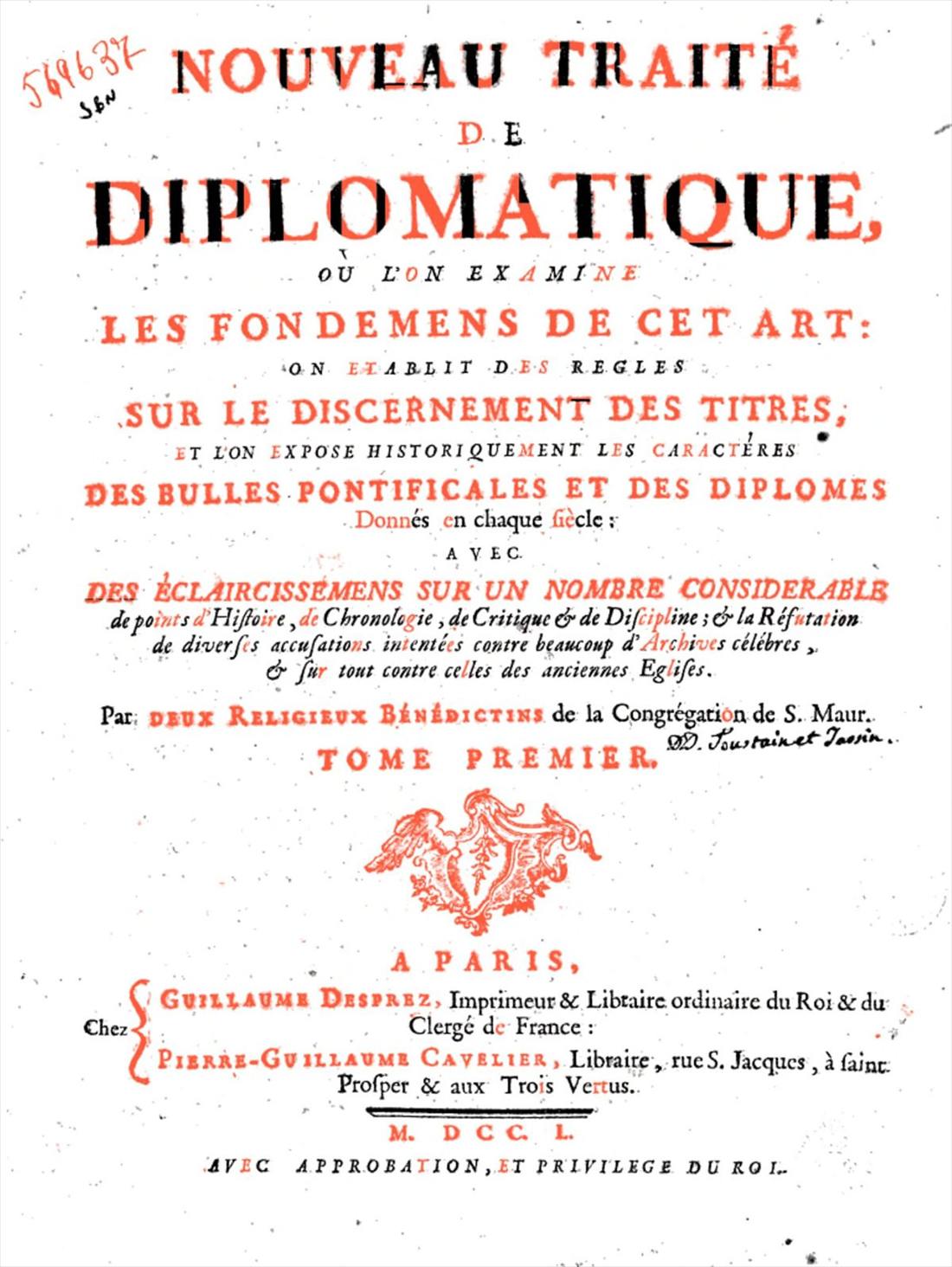
dom Charles-François Toustain and dom René-Prosper Tassin · Paris, Guillaume Desprez and Pierre-Guillaume Cavelier · six quarto volumes
Six quarto volumes, fifteen years in the printing, meant to teach a reader how to judge an old document: the material it was written on, the instruments that wrote it, the hands of every century, the formulas of popes, emperors and kings. It opens without ceremony — La Diplomatique est la science ou l’art de juger sainement des anciens Titres. It was written in French, and it taught by the eye.
Anonymous on the title page
The title page of 1750 names no author: the work is par deux religieux bénédictins de la Congrégation de S. Maur, and among its promises is the refutation of diverses accusations intentées contre beaucoup d’Archives célèbres. The two Benedictines were dom Charles-François Toustain and dom René-Prosper Tassin. Both had professed at the abbey of Jumièges in 1718; both lived at the abbey of Rouen until 1747, when their superior general summoned them to Saint-Germain-des-Prés in Paris. The 1911 Encyclopaedia Britannica traces the undertaking to a dispute over the origins of the abbey of Saint-Victor-en-Caux and the authenticity of its archives.
Toustain died at the abbey of Saint-Denis on 1 July 1754 — before the second volume was entirely printed, according to the Catholic Encyclopedia, though other accounts place only the last four volumes after his death. Tassin carried the rest through the press and kept his friend’s name on every volume; the Catalogue collectif de France records dom Jean-Baptiste Baussonnet as his collaborator on volumes III and VI. A cession signed in Paris on 31 October 1749, a fortnight after the royal privilege was granted at Fontainebleau, excepts from its transfer le Nouveau Traité de Diplomatique, 5. vol. in 4°. The sixth volume appeared sixteen years after the first.
A hundred plates
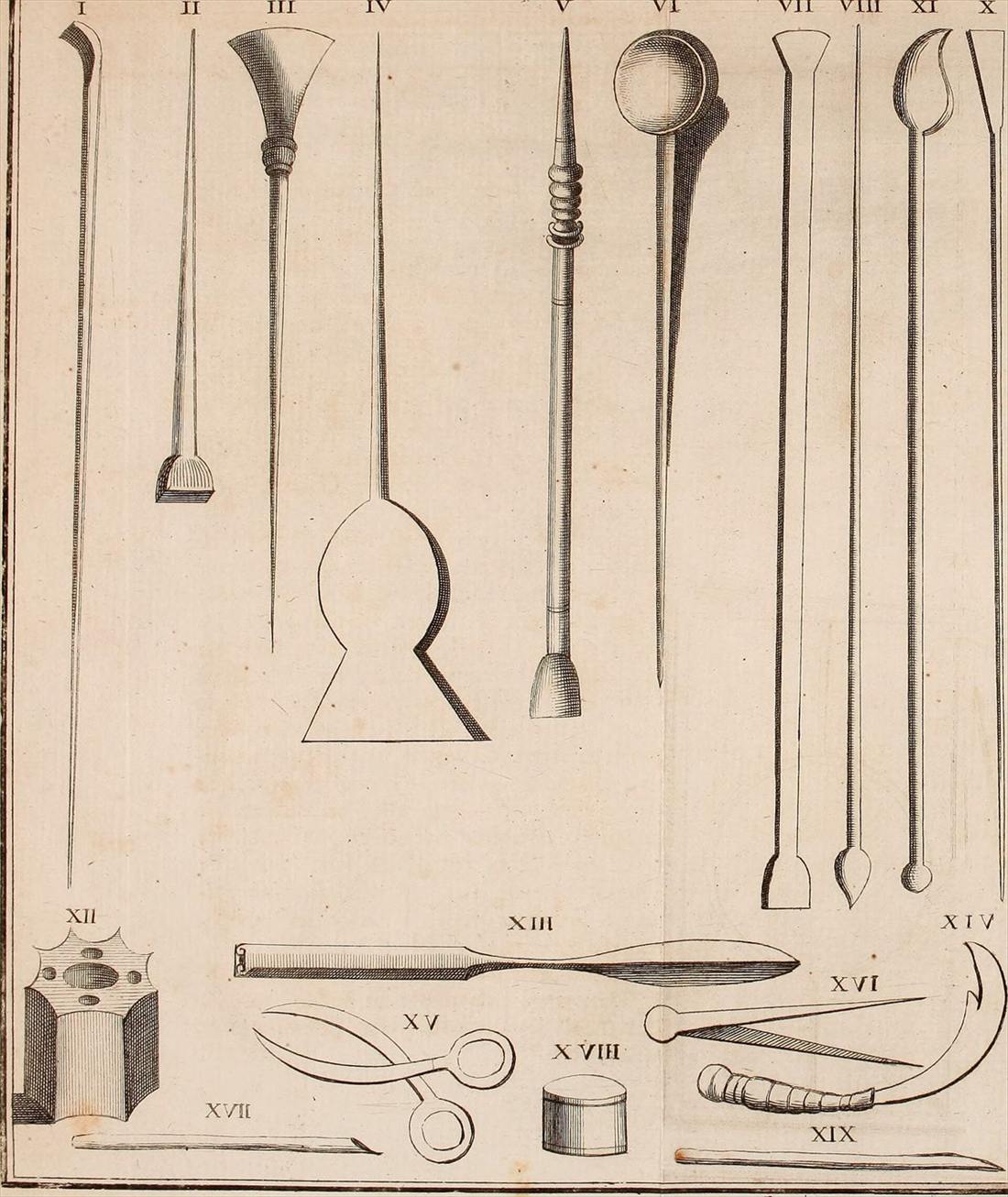
Mabillon had founded the discipline in Latin, at this same congregation, with the De re diplomatica of 1681. Toustain and Tassin wrote in French and extended the enquiry well past charters — to inscriptions, to papyrus, to the hands of every century. What carries the teaching is the engraving. Plate IV of the first volume lays out nineteen writing instruments facing chapter X, Instrumens dont on s’est servi, pour écrire, at page 535: rule and compass, lead, shears, penknife, whetstone, sponge, stylus, brush, quill or reed, inkhorn and powder box.
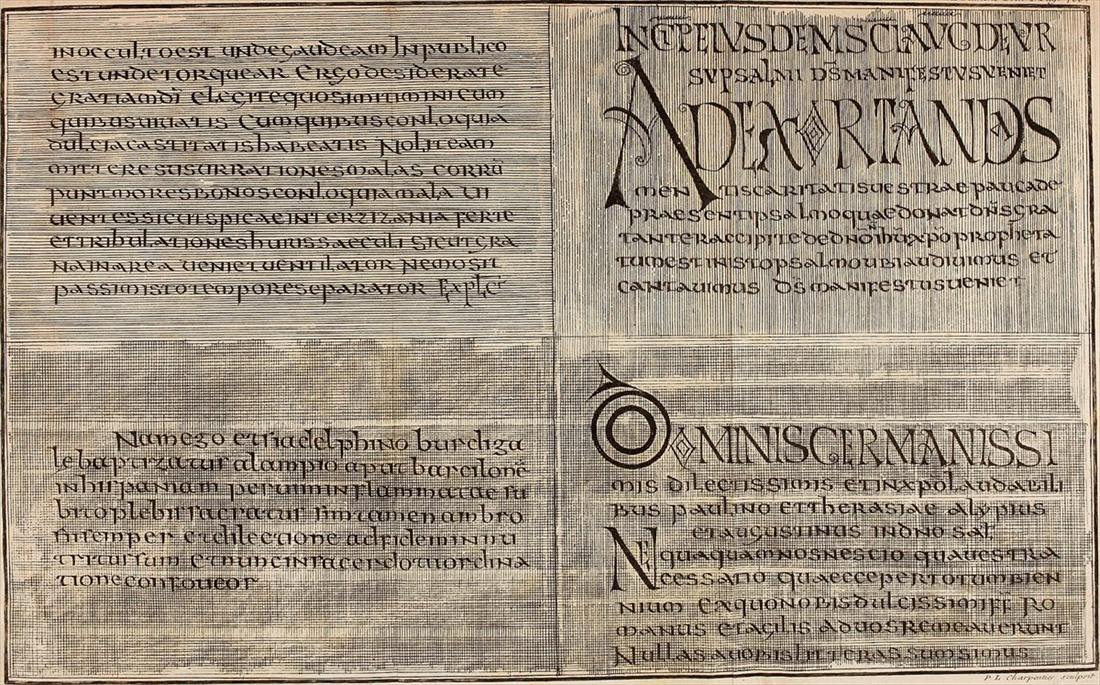
There are a hundred such leaves across the six volumes, many of them folding, and the Internet Archive’s copy of volume three alone records thirty-eight foldouts. The work counts them itself. The sixth volume opens with an alphabetical catalogue of everyone who had written on diplomatics, and on its last leaf — page lxviij, which faces the first page of the text — sends the reader to les cent Planches de ce nouveau Traité de Diplomatique as the way to learn the age and character of the inscriptions and manuscripts of each century.
What became of it
The book travelled. A German version, Neues Lehrgebäude der Diplomatik, came out at Erfurt from the press of Johann Friedrich Weber in nine volumes between 1759 and 1769, its first volume appearing while the French sixth was still unwritten; its title page names no translator. Later scholars were not indulgent. The 1911 Encyclopaedia Britannica granted that the compilers had gathered a mass of detail with great industry, but judged the arrangement faulty and the text broken into so many divisions and subdivisions as to be “tediously minute” — while allowing that the wider scope gave the Nouveau traité an advantage over Mabillon, and that later compilations had drawn largely upon it.
Their other long labour came to nothing in print: an edition of the Byzantine monk Theodore the Studite, pursued over some twenty years, was never published. Tassin brought out his Histoire littéraire de la congrégation de Saint-Maur in 1770 and died in Paris on 10 September 1777.
Why it is here
On page 532 of the first volume, denying that any single test will date a charter, the two monks ask for public archives abondamment pourvues de pièces originales de tous les siècles & de tous les païs — well supplied with originals of every century and every country, so that comparison has something to work on. That is a request for an institution rather than a method, and it is the part of their programme this abbey can take up: the plans, leases and accounts that survive from its own Maurist century are the material of the archive, the research programme and the workshops.
SourcesThe title page above comes from a digitised copy of the 1750 first volume whose holding library we have not been able to identify. The two plates are from the copy digitised by the Boston Public Library for the Internet Archive and published on Wikimedia Commons, in the public domain. The first sentence of volume one, chapter X and pages 532-533, and the last leaf of the sixth volume’s catalogue of authors were read from photographs of the copies in the Bibliothèque municipale de Reims (MM 556 and MM 561) on the same site. The judgement quoted is from the article ‘Diplomatic’ in the 1911 Encyclopaedia Britannica. The engraved headpiece of each of the six volumes is described by Utpictura18, and the whole of volume one may be turned page by page at the Internet Archive.