
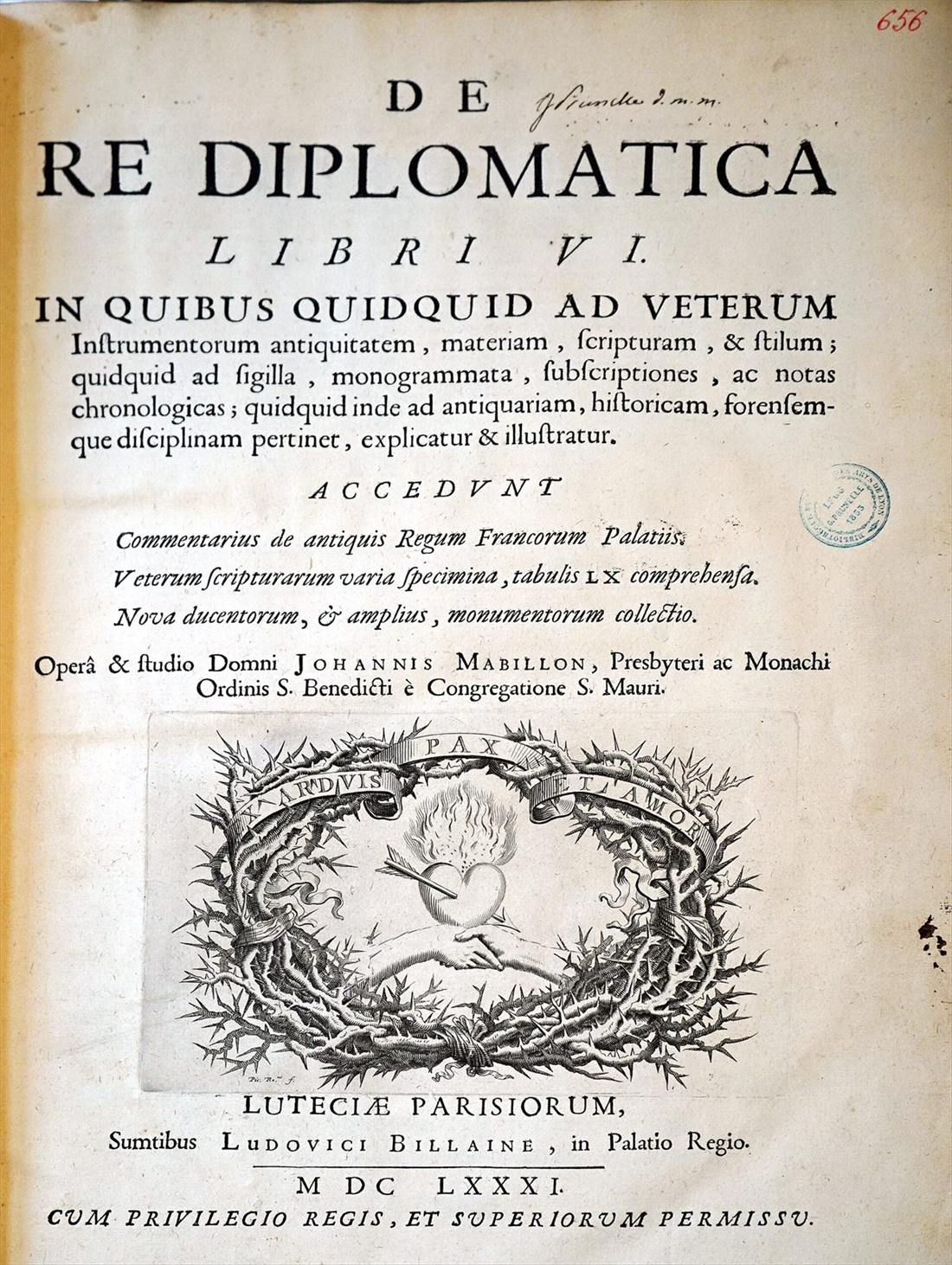
Saint-Maur · 1681
De re diplomatica
dom Jean Mabillon · Paris, Louis Billaine · one folio volume, six books
The book that taught Europe how to tell a genuine medieval charter from a forged one. Nothing in it is a manifesto: it is parchment, ink, script, formula, seal and date, examined in order, until the test can be repeated by anyone. The discipline has been called diplomatics after its title ever since.
A quarrel about charters
In 1675 the Jesuit Daniel Papebroch, working on the Acta Sanctorum at Antwerp, prefixed to his second April volume a short treatise on telling true parchments from false. Applied strictly, his tests condemned as forgeries a long series of Merovingian charters, among them charters of Saint-Denis — and, with them, the title deeds of a good part of Benedictine France. The Congregation of Saint-Maur answered by putting the question to its best-trained mind. Six years separate the Jesuit’s rules from the Maurist’s reply.
Mabillon was then living at Saint-Germain-des-Prés, where he had come in 1664 to work on the lives of the Benedictine saints. He was forty-nine when the book appeared. He did not answer with a pamphlet.
Six books, and fifty-eight tables
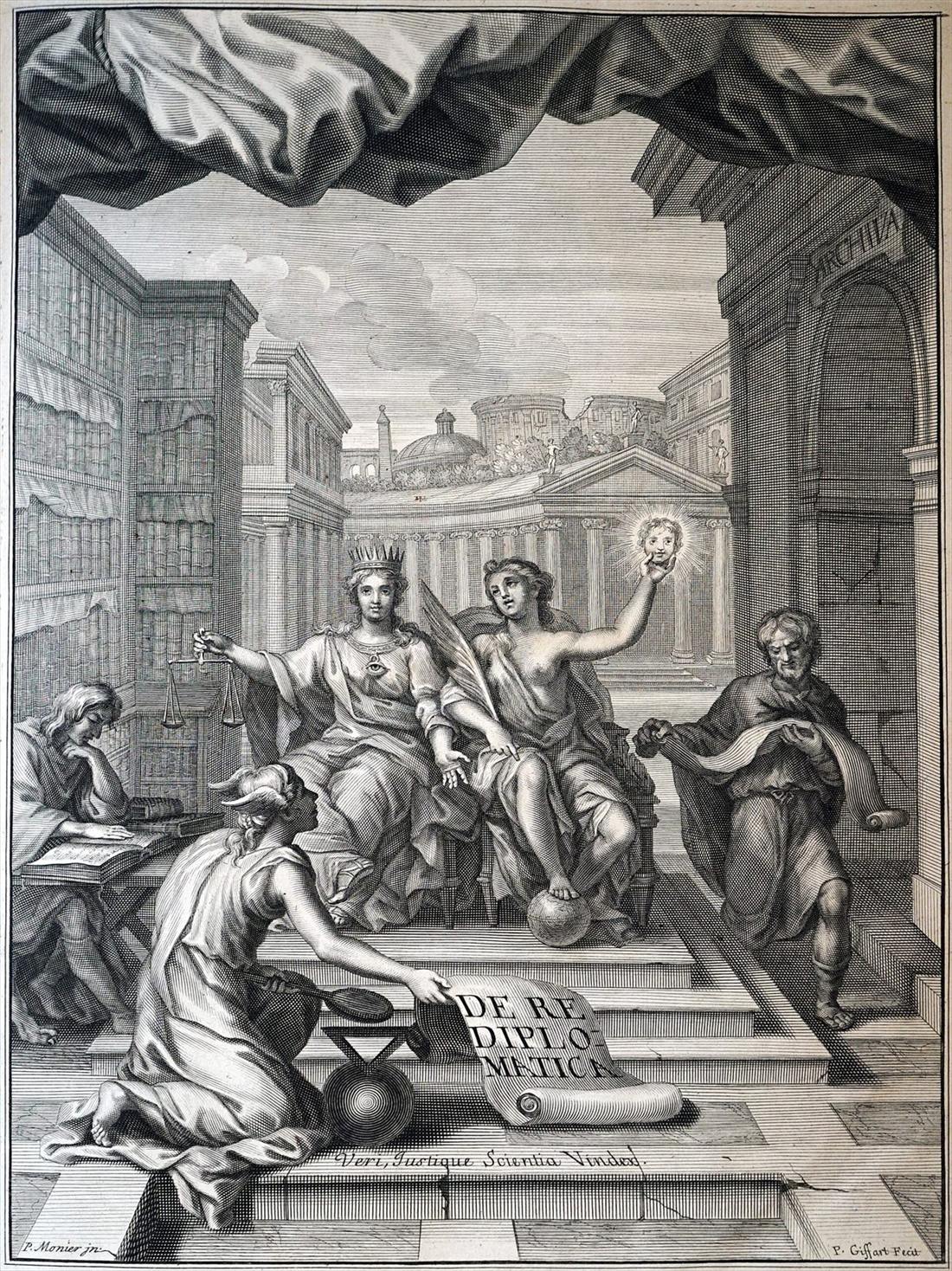
The six books move from the object to the judgement. The material first — parchment, ink, the shape and fold of the sheet; then the scripts, set out century by century as far as the fifteenth, each with its alphabet: Roman, Frankish, Lombard, Saxon, Gothic. Then the chancery: its formulas, its subscriptions, its seals and monograms, its ways of stating a date. Then the disputed cases. Book V carries the evidence itself — facsimiles of royal diplomas from Dagobert I to Saint Louis and of papal bulls, engraved on copper by Pierre Giffart, most of them drawn from the Saint-Denis originals by one of Mabillon’s own brethren. The book announces sixty tables on its title page; the preamble to Book V counts fifty-eight.
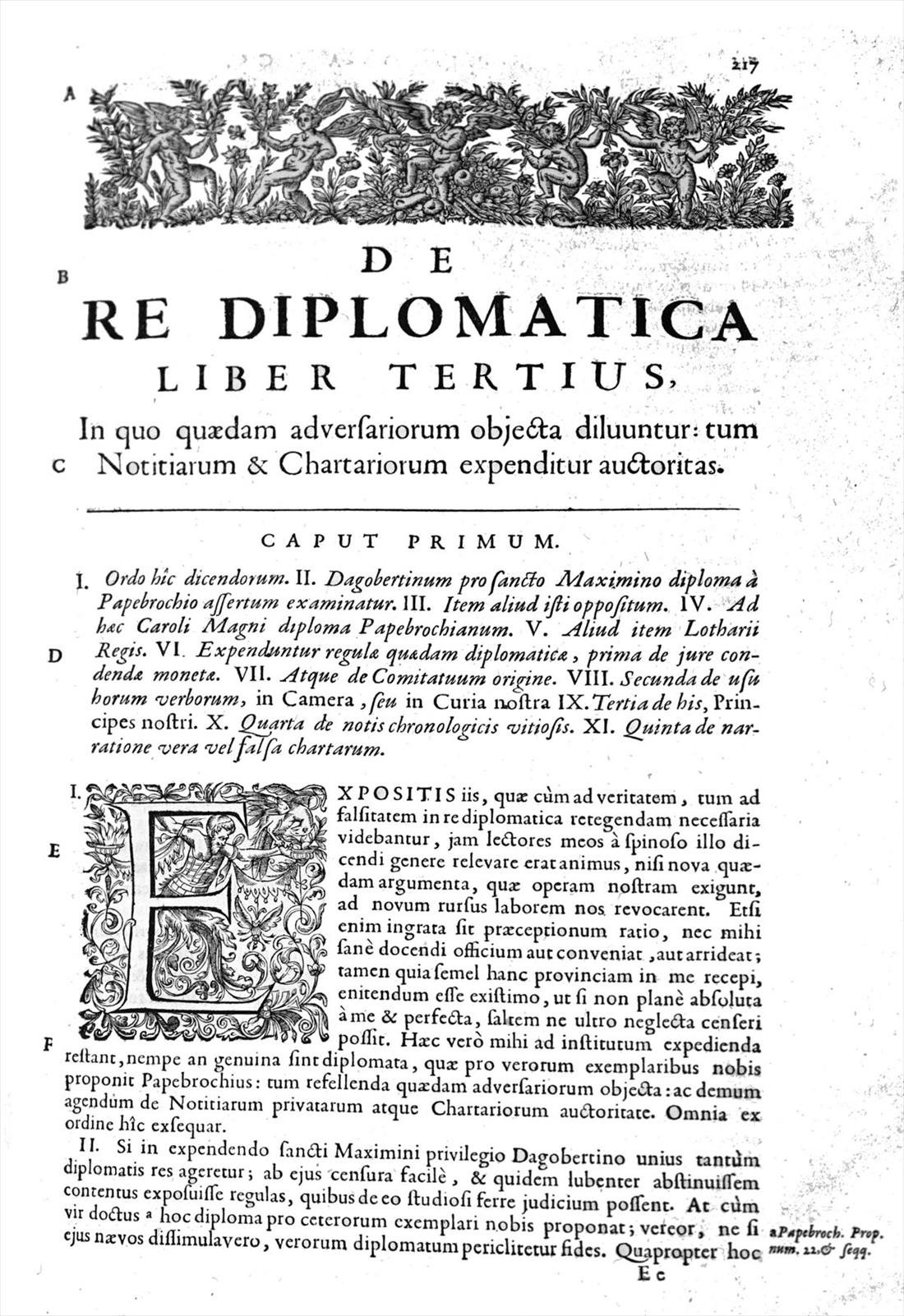
What made the method usable was its restraint. The argument of the very first chapter names duo extrema vitanda, two extremes to be avoided: neither swallow every parchment, nor throw out a whole class of them. Book III turns that rule on Papebroch’s own exemplar, a diploma of Dagobert for Saint-Maximin of Trier, and says plainly that to conceal its blemishes would endanger the credit of the true diplomas. The margins cite the Jesuit paragraph by paragraph.
What followed
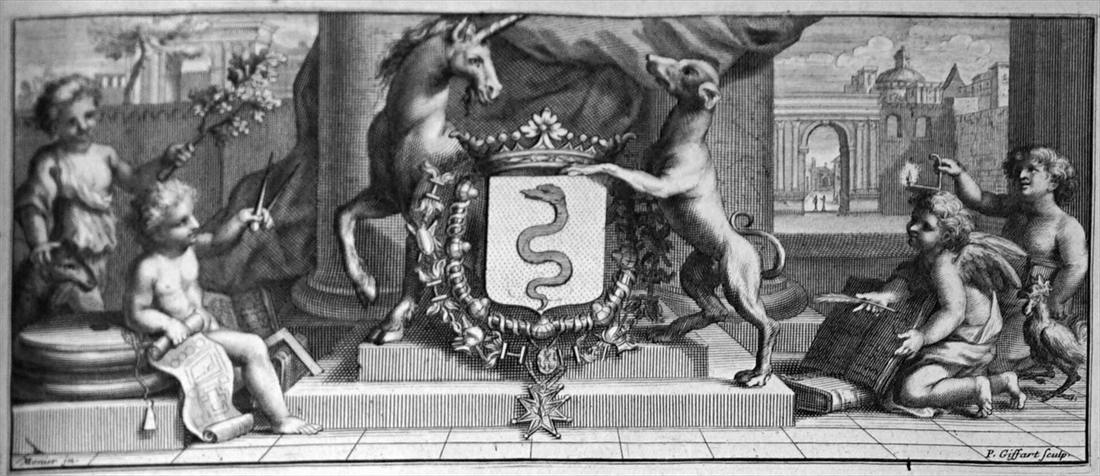
Papebroch conceded. His often-quoted sentence — that his only satisfaction in having written on the subject was to have provoked so complete a work — circulates without a date, and we give it as the tradition gives it. Colbert, to whom the book is dedicated, offered its author a pension of two thousand livres; Mabillon declined it and asked instead that the minister protect his monastery. The following year he was sent into Burgundy to search archives on the crown’s behalf.
Praise was not universal. In 1684 Adrien de Valois attacked the fourth book, the survey of the palaces of the Frankish kings compiled by dom Michel Germain. From 1703 the Jesuit Barthélemy Germon published against the whole. Mabillon answered with a Supplementum in 1704; dom Thierry Ruinart saw a revised second edition through the press in 1709, two years after his death; a third appeared at Naples in 1789.
A detail worth a second look
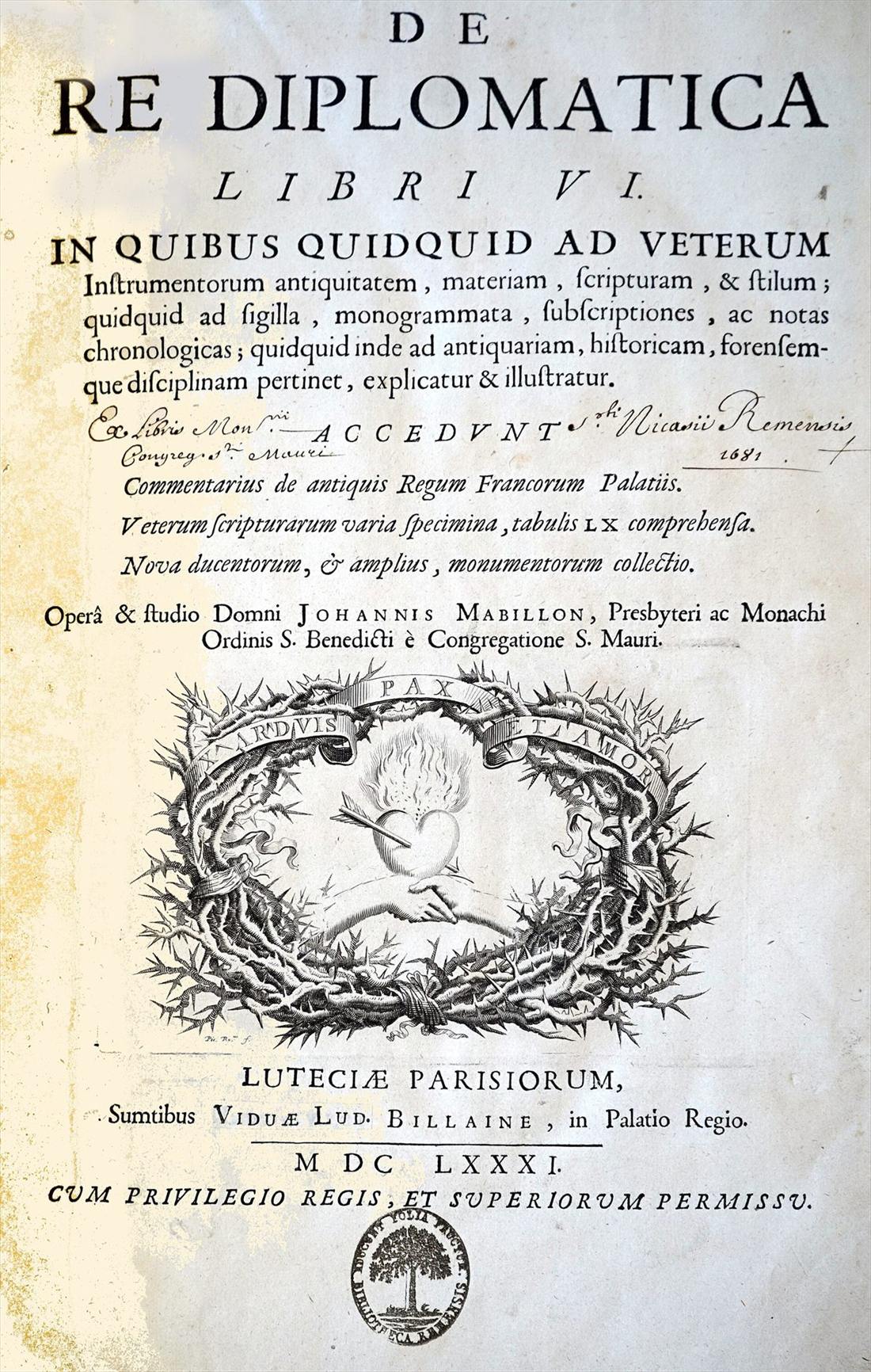
Louis Billaine, who paid for the book, died on 25 August 1681, the year it came out. Surviving copies therefore carry the imprint in two states: Sumtibus Ludovici Billaine, and Sumtibus Viduae Lud. Billaine — at the widow’s expense. The copy below, in the second state, was inscribed the same year for the library of the Maurist abbey of Saint-Nicaise at Reims. Two hundred and forty years later both copies are a few shelves apart in the municipal library of that city.
Why it is here
Because the Conservatoire works by this rule and no other: nothing is asserted that a document does not support, and the document is named. What Mabillon did for charters, the research programme attempts for the archives of this abbey — beginning with the plans, the leases and the accounts that survive from its own Maurist century.
SourcesThe title pages, the frontispiece, the Colbert headpiece and the opening of Book III reproduced here are photographs of two copies of the 1681 edition in the Bibliothèque municipale de Reims (XGG 12 and CHGG 31), published on Wikimedia Commons and in the public domain. The plate count follows the preamble to Book V. The full text of the 1709 second edition may be read at the Internet Archive.