
Saint-Maur · 1679-1700
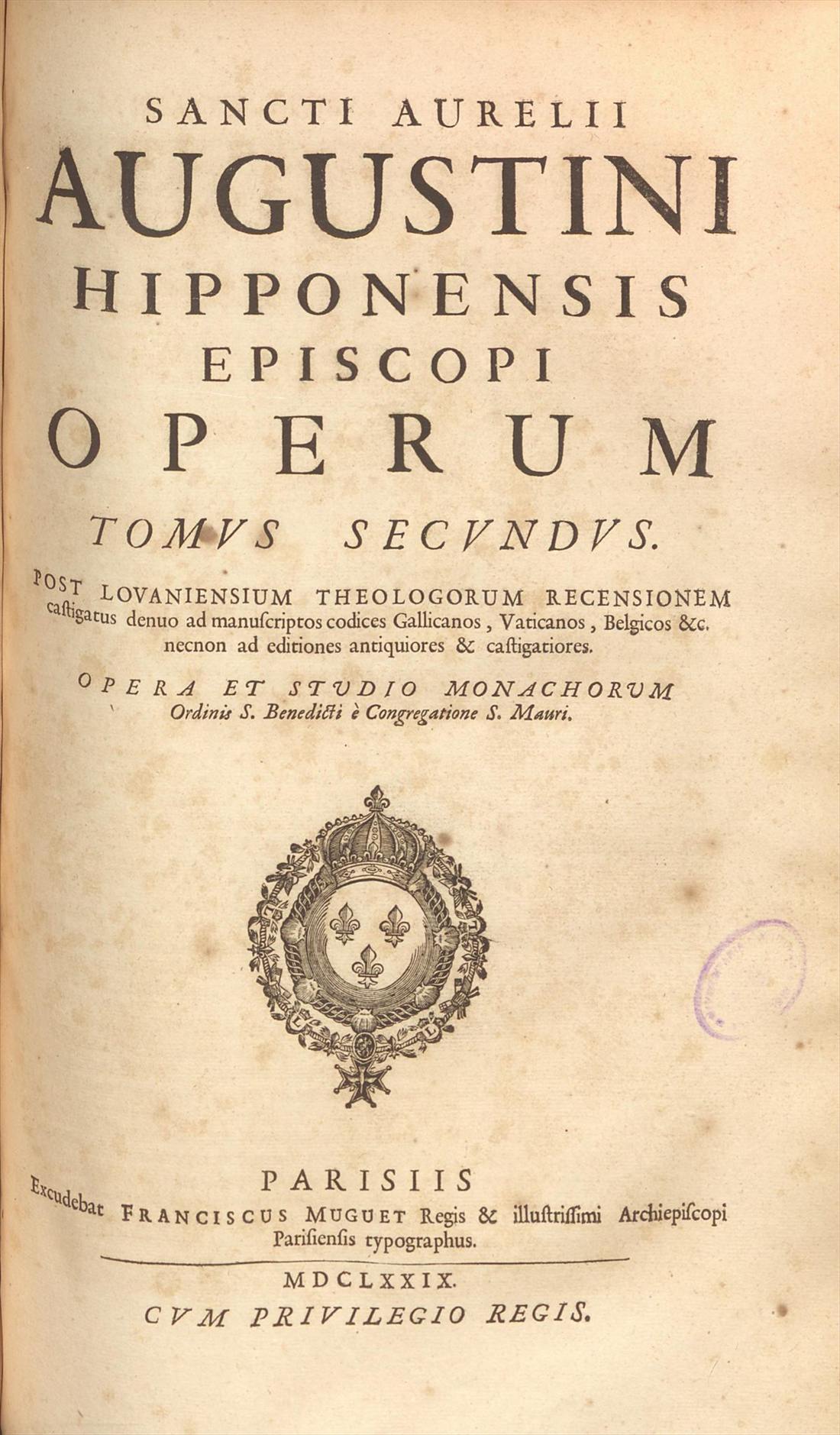
Sancti Aurelii Augustini Opera
monks of the Congregation of Saint-Maur · Paris, François Muguet · eleven folio tomes
Eleven folio tomes, printed in two columns, in which monks of the Congregation of Saint-Maur edited the whole of Augustine afresh against manuscripts their title pages call Gallican, Vatican, English and Belgian. The numbering they gave his sermons is still the numbering by which those sermons are cited.
Seven monks, and two lettres de cachet
In 1670 the congregation put dom François Delfau (1637-1676) at the head of the edition with six colleagues, among them dom Robert Guérard (1641-1715). Clement X sent codices from the Vatican library. On 18 September 1675 two lettres de cachet banished both men from Paris, following L’abbé commendataire, a book Delfau had printed at Cologne in 1673 against abbots holding in commendam. Exiled to Landévennec in Brittany, he drowned on 13 October 1676 crossing to Brest, aged thirty-eight. The direction passed to dom Blampin, Thomas in most accounts, Théodore in the Dictionnaire de théologie catholique. Dom Pierre Coustant came to Saint-Germain-des-Prés in 1681 to assist him and gave years to separating the genuine writings from the false; dom Claude Guesnié compiled the general table.
What the preface promises
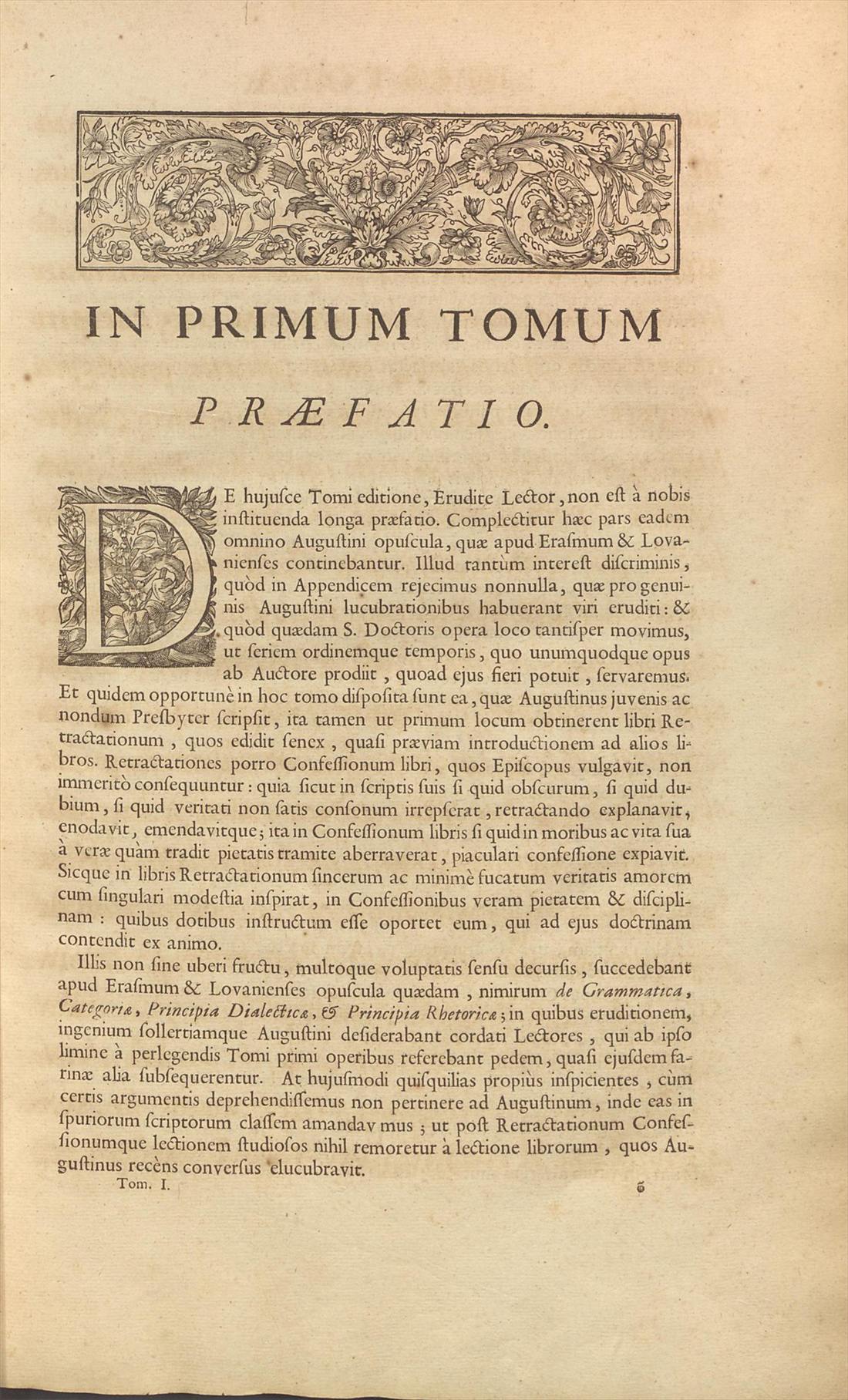
The plan is set out on that first page. The volumes hold the works Erasmus and the Louvain theologians had printed, except that pieces held for Augustine’s are thrown into an appendix as not genuine, and the rest stand in the order he wrote them. The Retractationes, written in old age, come first, as a preliminary introduction to the others, the Confessions after. The grammar, the Categoriae and the handbooks of dialectic and rhetoric, which in Erasmus and in Louvain had followed at that point, are called trifles and sent to the spurious class, so that nothing should delay a reader passing from the Confessions to the books Augustine wrote as a new convert.
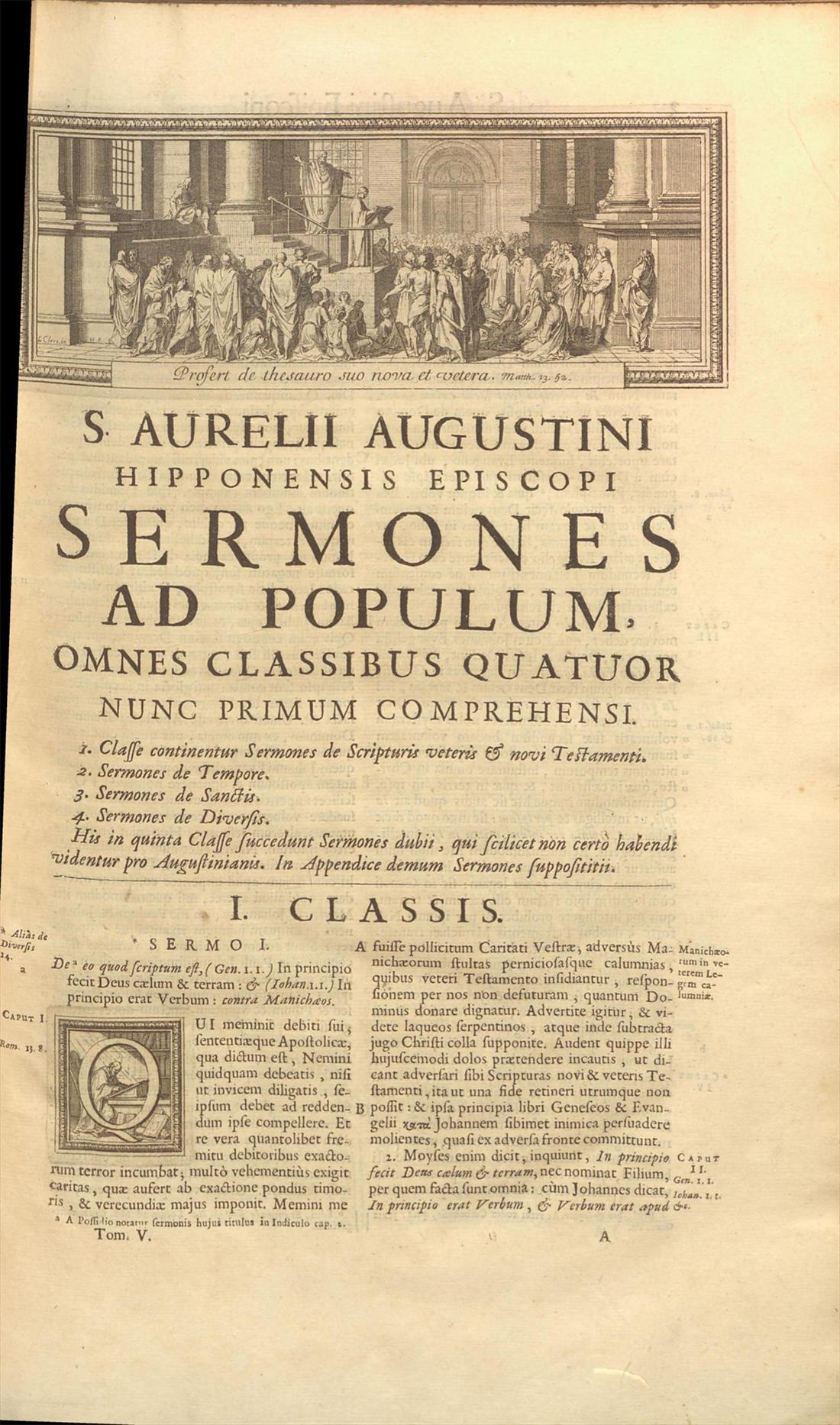
The sermons fill tome five, 1683: 1,536 columns, then 532 more of sermons the editors would not own. Its half-title announces them as now for the first time gathered into four classes — on Scripture, on the seasons of the year, on the saints, on various matters — with a fifth for the doubtful. A table in the front matter sets the old numbering against the new, the rejected sermons in italic. The new numbering held: the Corpus Christianorum volumes published at Turnhout keep what a reviewer calls the now canonical Maurist sequence, fitting into it the sermons found since.
Dates that do not agree
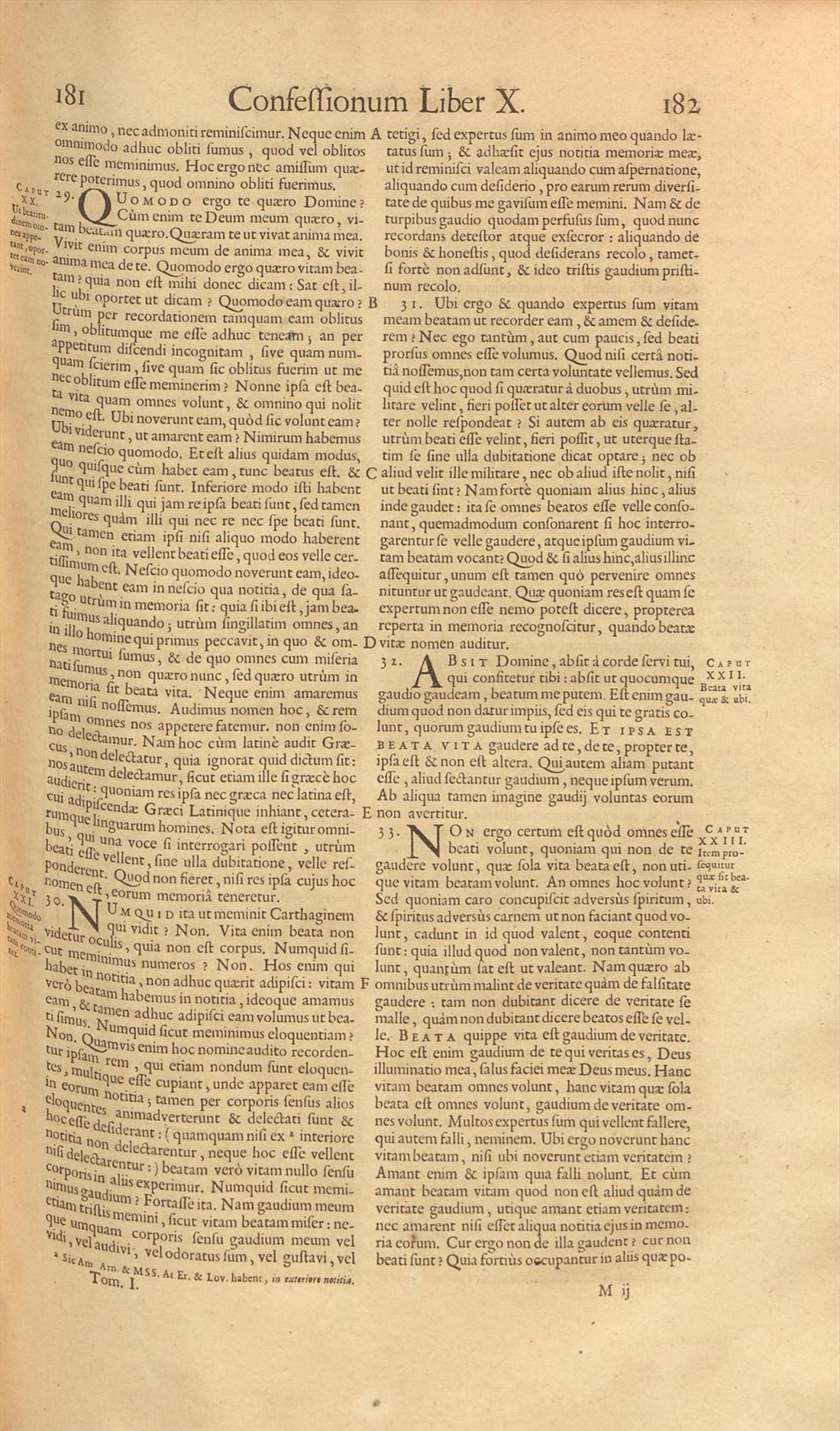
The imprint dates run from 1679 to 1700, but they are not the order of publication, and the sources disagree. The Dictionnaire de théologie catholique has the edition opening with tome IV in 1681 and places tomes I and II in 1687, the 1679 on their title pages notwithstanding; it adds that in 1689 those two tomes were reprinted under that same date, with many errors left in them without Blampin’s knowledge. Tome XI is dated 1700 on that authority alone: no digitised copy of it has been found here, and no account of its contents. The correction formula shifts as well — tome I names Gallican, Vatican, English and Belgian codices, tome V Gallican and Roman, tome X Gallican and Vatican.
Tome X, the writings against the Pelagians, came out in 1690 behind sixty-six pages of preliminaries, and drew the fire. Some copies carry an analysis of the De correptione et gratia by Arnauld — the record gives no first name — suppressed at the order of François de Harlay, archbishop of Paris. Jesuits accused the monks of favouring Jansenism, and dom Denis de Sainte-Marthe answered in 1699 with two pamphlets. The congregation was dissolved in 1790 and its last superior general killed in Paris in 1792. The edition outlived it, reprinted at Antwerp, Venice and Bassano, and carried into Migne’s Patrologia Latina, where Augustine fills volumes 32 to 47.
Why it is here
The Conservatoire is not editing Augustine. What it takes from these tomes is a habit of work: name the copy, print what you reject instead of suppressing it, and leave a reader able to check. The research programme applies that to much smaller material — the plans, the leases and the accounts that survive from this abbey’s own Maurist century — and the other works in this series show what else the same congregation had in hand in those years.
SourcesThe four leaves reproduced here come from the Seville copies of the Paris edition — tome I, 1679, which carries the gilt arms of the library of the Duke of Osuna, and tome V, 1683 — digitised by the Biblioteca de la Universidad de Sevilla for the Internet Archive and in the public domain. The disagreement over the order of publication and the reprint of 1689 follow the Dictionnaire de théologie catholique; the note on the Maurist sequence follows Daniel Hadas’s review of Corpus Christianorum Series Latina XLI Bb (Brepols, Turnhout, 2016). Tome I may be read at the Internet Archive.