
Saint-Maur · 1750–1787
L’Art de vérifier les dates
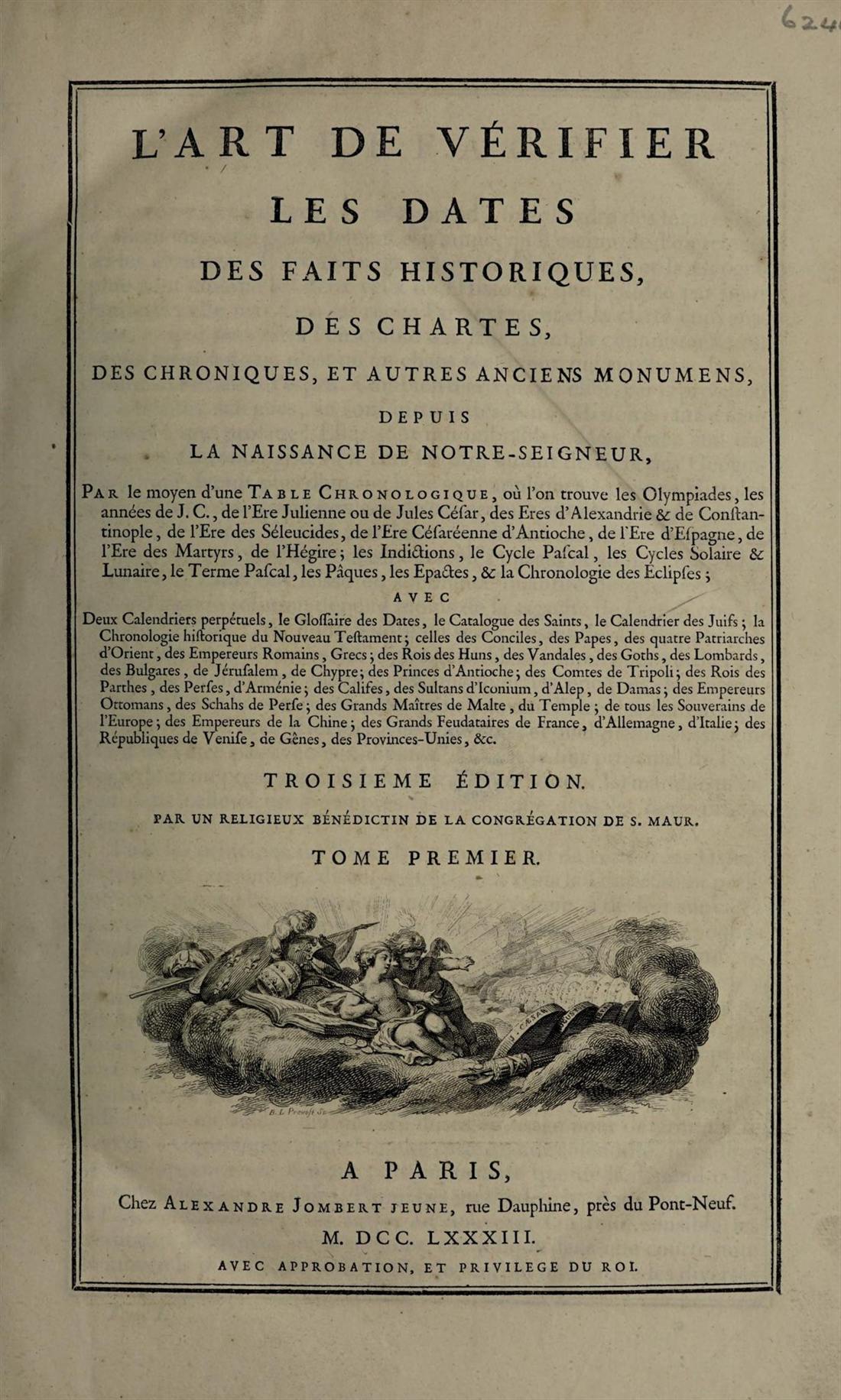
dom Dantine, dom Clémencet, dom Durand, dom Clément · Paris, Desprez then Jombert jeune · one quarto volume, later three folios
A handbook for reading the date at the foot of a document. Charters count in indictions, epacts and concurrents, in the era of Spain or of the Martyrs; this book sets those reckonings beside the years of Christ so that one may be checked against another. Four Benedictines made it; none put his name on the title page.
The question after Mabillon’s
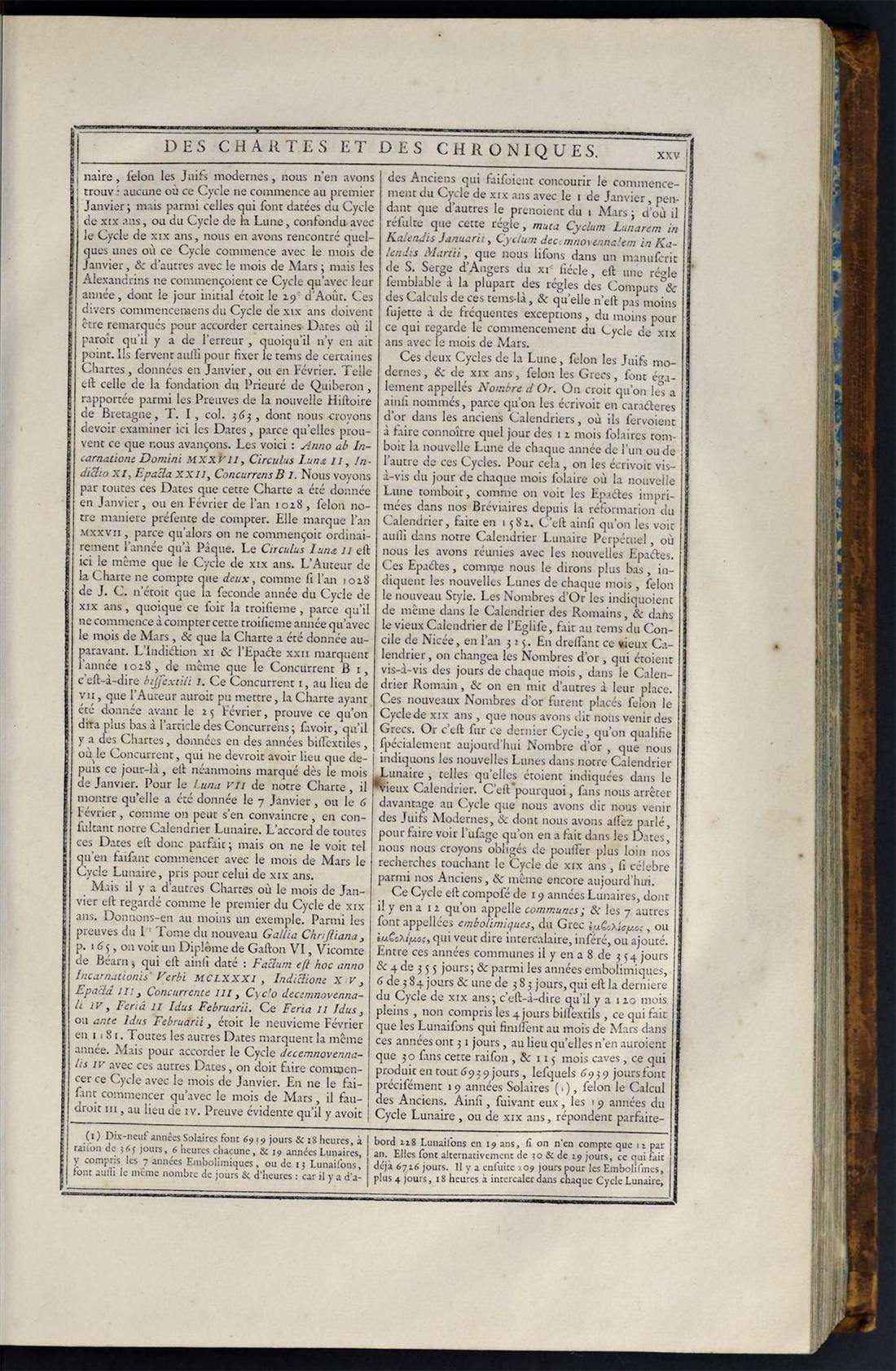
Jean Mabillon, of the same congregation, had shown in De re diplomatica (1681) how to tell a genuine charter from a forged one. This book takes up the next question: once the parchment is accepted, what does the date at its foot mean? A foundation charter for the priory of Quiberon reads Anno ab Incarnatione Domini MXXVII, and then gives lunar cycle II, indiction XI, epact XXII, concurrent B I. The preliminary discourse sets those four reckonings against one another and places the act in January or February 1028. A diploma of Gaston VI, viscount of Béarn, dated the same way, comes down on the same page to 9 February 1181.
Dom Maur-François Dantine, born at Gonrieux near Namur in 1688, drew up the plan and did the greater part of the preparatory work; illness stopped him, and he died at the Blancs-Manteaux in Paris on 3 November 1746 without seeing it finished. Dom Charles Clémencet and dom Ursin Durand completed it — Durand had searched, with Edmond Martène, the archives of more than eight hundred abbeys and a hundred cathedral churches. It appeared in Paris in 1750, printed for Guillaume Desprez and Pierre-Guillaume Cavelier: two parts in a single quarto volume, ending at page 714 as the Bibliothèque nationale collates it.
Tables instead of narrative
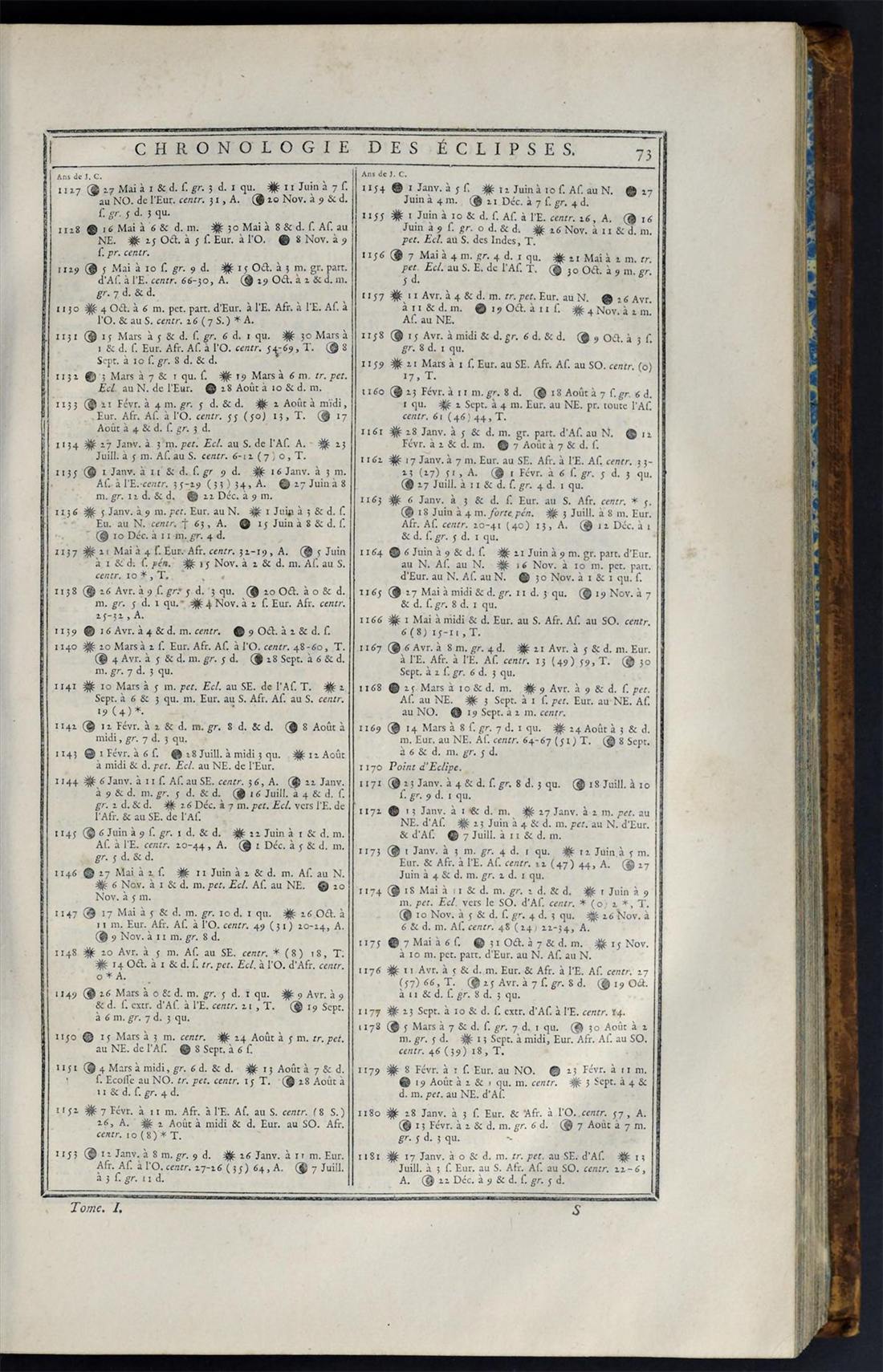
The method was to tabulate rather than narrate, and the third edition shows the finished apparatus. A chronological table sets the years of Christ beside the Olympiads, the Julian era, the eras of Alexandria and Constantinople, of the Seleucids, of Antioch, of Spain, of the Martyrs, and the Hegira. Two perpetual calendars give, day by day, the golden number, the dominical letter and the epact; then a glossary of dates, a catalogue of saints, a Jewish calendar, a chronology of eclipses. The saints are there, the preface says, because ancient acts often marked the day only by the feast that fell on it.
Dom François Clément, born at Bèze in 1714, took the work over. He brought out a revised folio for Desprez in 1770, and then a third edition which, the Catholic Encyclopedia states, cost him more than ten years: three folio volumes from Alexandre Jombert jeune, dated 1783, 1784 and 1787, each title page carrying the same engraved vignette signed B. L. Prevost. It now took in the emperors of China, left out of the earlier editions, the preface explains, because the matter had not been thought sufficiently cleared up.
What the preface admits
The preface of 1783 is plain about what the book cannot do. The form of type chosen left no room to cite authorities in the margin; the compilers could therefore undertake only that they had fixed no date they were not able to justify from an accredited writer, and they asked their critics to weigh authorities against one another rather than produce one historian who had said otherwise. Then they name the fallible, and the names are large: the abbé Fleury, often inexact in his dates; the celebrated critic who corrected Baronius, considerably mistaken himself; Petau’s Rationarium; Tillemont; Mabillon; Muratori, quoted in a footnote to the effect that no writer is proof against blunders.
The congregation was suppressed in 1790 and Clément died in Paris in 1793, so the sequels are lay work. Nicolas Viton de Saint-Allais reissued the third edition in eighteen octavo volumes with a nineteenth of tables, 1818–1819; a part covering the years before the Christian era, printed from manuscripts Clément had left, appeared in 1819 and again in 1820. The chevalier de Courcelles and the marquis de Fortia d’Urban carried a continuation from the year 1770 down to 1844.
Why it is here
Every document that reaches this abbey has to be dated before it can be used, and the rule these Maurists set themselves is the one the research programme works to and the courses teach first: fix no date you cannot justify from a named authority, and say where you cannot. Whether later handbooks have overtaken this one as a working instrument, we have found no assessment that settles the question. What it still sets out is the shape of the problem — a date is not read off a document, it is reconstructed from several reckonings that have to agree.
SourcesThe three leaves reproduced here are from the Getty Research Institute’s copy of the third edition, volume one (Paris, Alexandre Jombert jeune, 1783), digitised on the Internet Archive and in the public domain. The quotations from the preface and the preliminary discourse are from that volume; they are evidence for 1783, not for 1750. The collation of the 1750 quarto and the record of the 1770 folio come from the catalogue of the Bibliothèque nationale de France; we have inspected neither book. The whole of volume one, 1,024 leaves, may be read at the Internet Archive, where the library keeps its working reference.