
Saint-Maur · from 1738
Recueil des historiens des Gaules et de la France
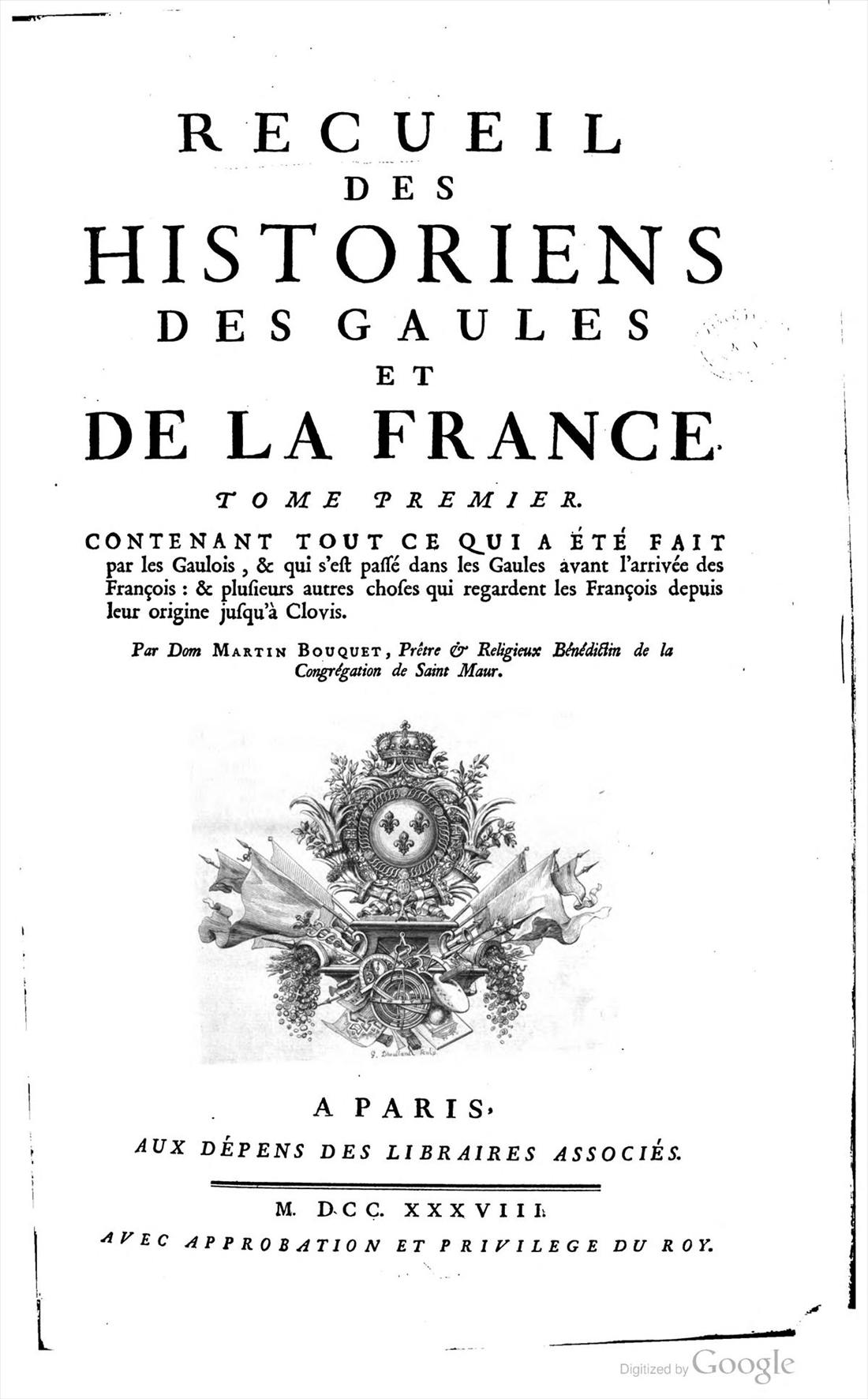
dom Martin Bouquet and his continuators · Paris, aux dépens des Libraires associés · twenty-four folio volumes
The written sources of French history, gathered, collated and printed in grand folio. Dom Martin Bouquet brought out eight volumes between 1738 and 1752, carrying the collection down to the year 987; the twenty-fourth came from the press in 1904, a hundred and sixty-six years after the first. What lies between those two dates is one long exercise in handing work on.
Three attempts before this one
Bouquet’s preface runs in two columns, French on the left and Latin on the right, and opens by naming the men who had failed at the same thing. Pierre Pithou set out at the end of the sixteenth century to bring together the historians of France, printed and manuscript, and the years 1588 and 1596 saw what came of it. André Duchesne published the plan of a new collection in 1635. The Oratorian Jacques Le Long was still assembling pieces when he died in 1721. The preface also records that Mabillon had been pressed to take the burden and steadily refused; it does not name the prelate who pressed him.
Chancellor d’Aguesseau put the collection to the learned, and in 1723 dom Denis de Sainte-Marthe, superior general of Saint-Maur, took up a project that looked abandoned and, in the preface’s words, cast his eyes on the Congregation to carry it out. The man it fell to had charge of the library of Saint-Germain-des-Prés, some sixty thousand books and eight thousand manuscripts. Fifteen years separate that decision from the printed volume.
Cited by page and letter
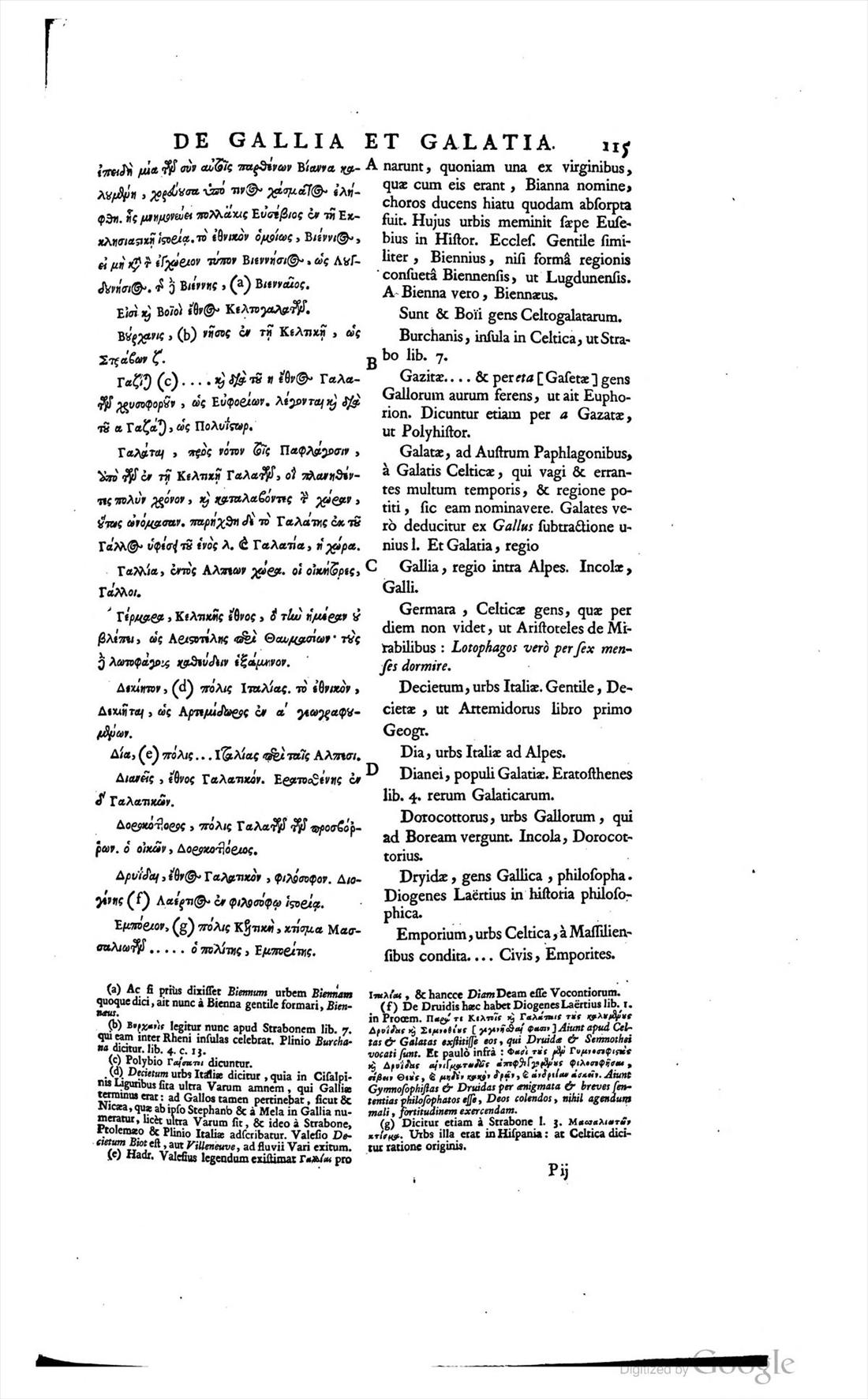
The method is visible on any opening. On page 115, under the running head De Gallia et Galatia, a Greek text stands in the left column with a Latin version facing it, and the letters A, B, C and D are set down the margin. They are there so that a phrase can be cited by page and by letter and found again by someone else: the Index chronologicus at the front of the volume, French and Latin year by year, refers to passages in exactly that form — 559. d. At the foot of the page the notes argue with Strabo, Pliny, Polybius, Diogenes Laërtius and Hadrianus Valesius. The page does not name the Greek author it excerpts, and neither will we.
What that machinery carries is ordinary and particular. At the head of page 111 a Roman road is totalled in one line — Burdigala to Arellate, three hundred and seventy-one miles, thirty relays, eleven halts — and the stages then run on down the page from Arles: Avignon, Orange, Valence, Briançon, up to the Mont Genèvre, which a footnote identifies as the Mons Matrona.
Handed on
Bouquet did not die in the house whose library he kept. He had been banished to the monastery of Saint-Jean at Laon for refusing a formulary of submission imposed by Cardinal de Bissy, and it took d’Aguesseau, in 1735, to have him brought back — to Argenteuil, then to the Blancs-Manteaux in Paris, where he died on 6 April 1754. Five more volumes followed between 1757 and 1786 under a succession of Maurists, the last of them dom Brial. Then the Revolution stopped the press and dissolved the Congregation.
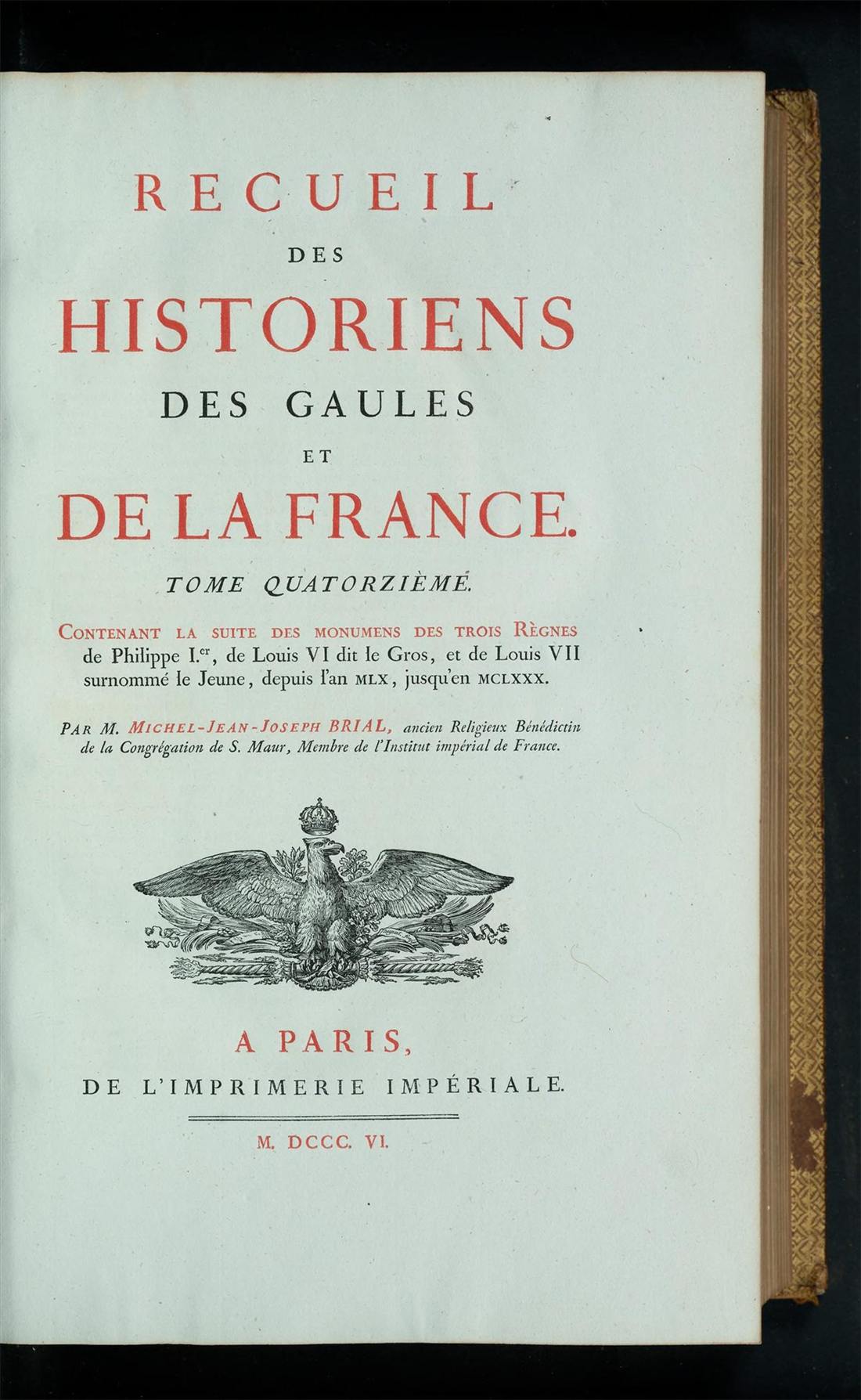
What came next is the volume at the head of this page: tome quatorzième, Paris, Imprimerie impériale, 1806, containing the reigns of Philippe I, Louis VI and Louis VII from 1060 to 1180, and signed Par M. Michel-Jean-Joseph Brial, ancien Religieux Bénédictin de la Congrégation de S. Maur, Membre de l’Institut impérial de France. Ancien: the order was gone, the work was not. Brial kept at it until his death in 1828.
From 1840 the Académie des inscriptions et belles-lettres took charge, and the collection passed through the hands of Pierre Daunou, Joseph Naudet, Joseph-Daniel Guigniaut, Natalis de Wailly and Léopold Delisle. Volumes one to nineteen were reissued by Victor Palmé between 1869 and 1880. The twenty-fourth volume, on the reign of Saint Louis, came from the Imprimerie nationale in 1904; it was issued in parts, and catalogues differ on how many physical volumes a complete set makes. The title outlasted the narrative series: the Académie carries three documentary series under the name Recueil des historiens de la France — Documents financiers, Obituaires, Pouillés — the Obituaires in a new series opened in 1985.
Why it is here
No one who began this collection saw it finished, and it was built for that: numbered volumes, a fixed way of citing, an index that still works when the hands change. The same assumption governs the research programme at this abbey and the library and archive being assembled in it — that a document described carefully enough can be picked up by someone who never met the person who described it. The Congregation that undertook the work is set out on the page for Saint-Maur.
SourcesThe title page of volume one and page 115 reproduced here come from the Google-digitised copy of the 1738 volume on the Internet Archive (item uploaded by Arlima), in the public domain; the readings of the preface, of the Index chronologicus and of page 111 are taken from that same copy. The photograph at the head of the page shows the title page of volume fourteen, Paris, Imprimerie impériale, 1806, and reached our files without a record of the copy photographed, so no holder is named for it. The format, 445 by 300 millimetres, is that of a set of the first eleven volumes, 1738 to 1767, described in a bookseller’s catalogue. Volume one may be read at the Internet Archive.