
Saint-Maur · 1708-1724
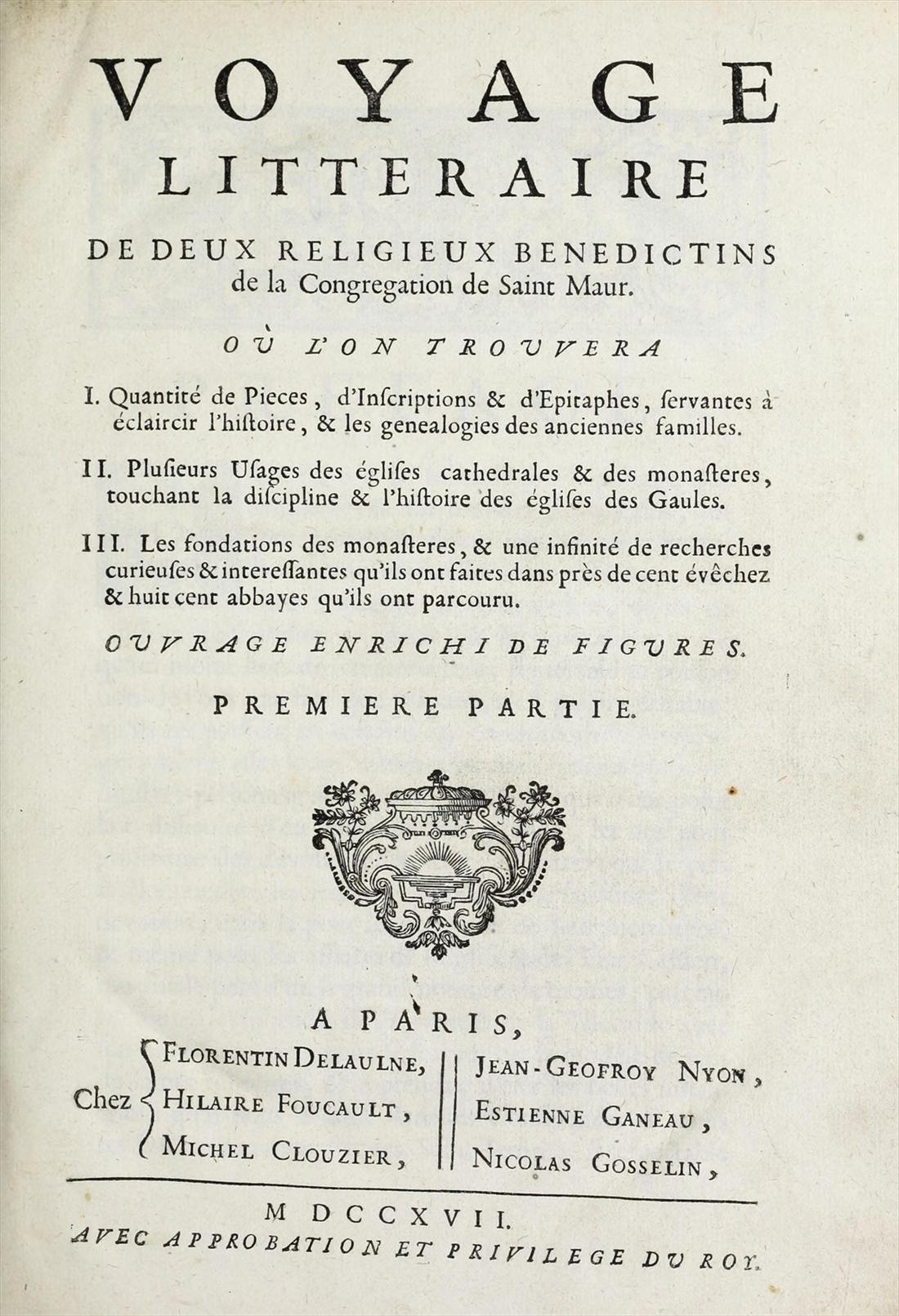
Voyage littéraire de deux religieux bénédictins
dom Edmond Martène and dom Ursin Durand · Paris, six booksellers · one quarto volume in two parts; a second in 1724
Two Benedictines rode out in 1708 to find the documents a new Gallia christiana would need, and printed the journal of the search: tombs copied on the spot, a Roman stone dug out of the ground, buildings described that no longer stand.
Sent out for the proofs
In 1717 a quarto came out of six Paris shops — Delaulne, Foucault, Clouzier, Nyon, Ganeau, Gosselin — its title page naming no author. The two were dom Edmond Martène, born at Saint-Jean-de-Losne in 1654, and dom Ursin Durand, born at Tours in 1682 and professed at Marmoutier at nineteen. Their general chapter had sent them out to gather what the new Gallia christiana would need. Martène left in 1708, Durand joined him in April 1709, and both were back in 1713.
The preface counts the harvest: six years on the road, “près de cent évêchez, & plus de huit cent abbayes”, nearly three hundred bishops unknown to Claude Robert and to the brothers Sainte-Marthe, more than two thousand documents to serve as proofs. Anyone hoping for a story was warned: the relation is written “d’une manière simple & naïve, telle qu’il convient à des solitaires, dont on ne doit pas attendre un stile fleuri”.
After Easter, on horseback
Daniel-Odon Hurel, who edited the text critically as a doctoral thesis in 1991, describes the routine. They rode in their habits, leaving after Easter from Marmoutier of Tours or Saint-Denis and coming back in late December or January, often with a guide or valet, lodging mostly in abbeys but fairly regularly in inns, above all in Germany in 1718. October 1711 alone took in Saint-Chinian, Béziers, Agde, Valmagne, Aniane, Saint-Guilhem-le-Désert, Lodève, Millau, Sylvanès and Albi.
They had meant to work the electorates of Trier, Mainz and Cologne after Easter 1713, “mais la guerre qui porta les armes en Allemagne, nous obligea à changer de dessein”. On Thursday 20 April they left Saint-Denis for the abbey of Royaumont instead, having suffered “du froid, du vent & de la neige” (second part, pp. 152-153).
Ouvrage enrichi de figures
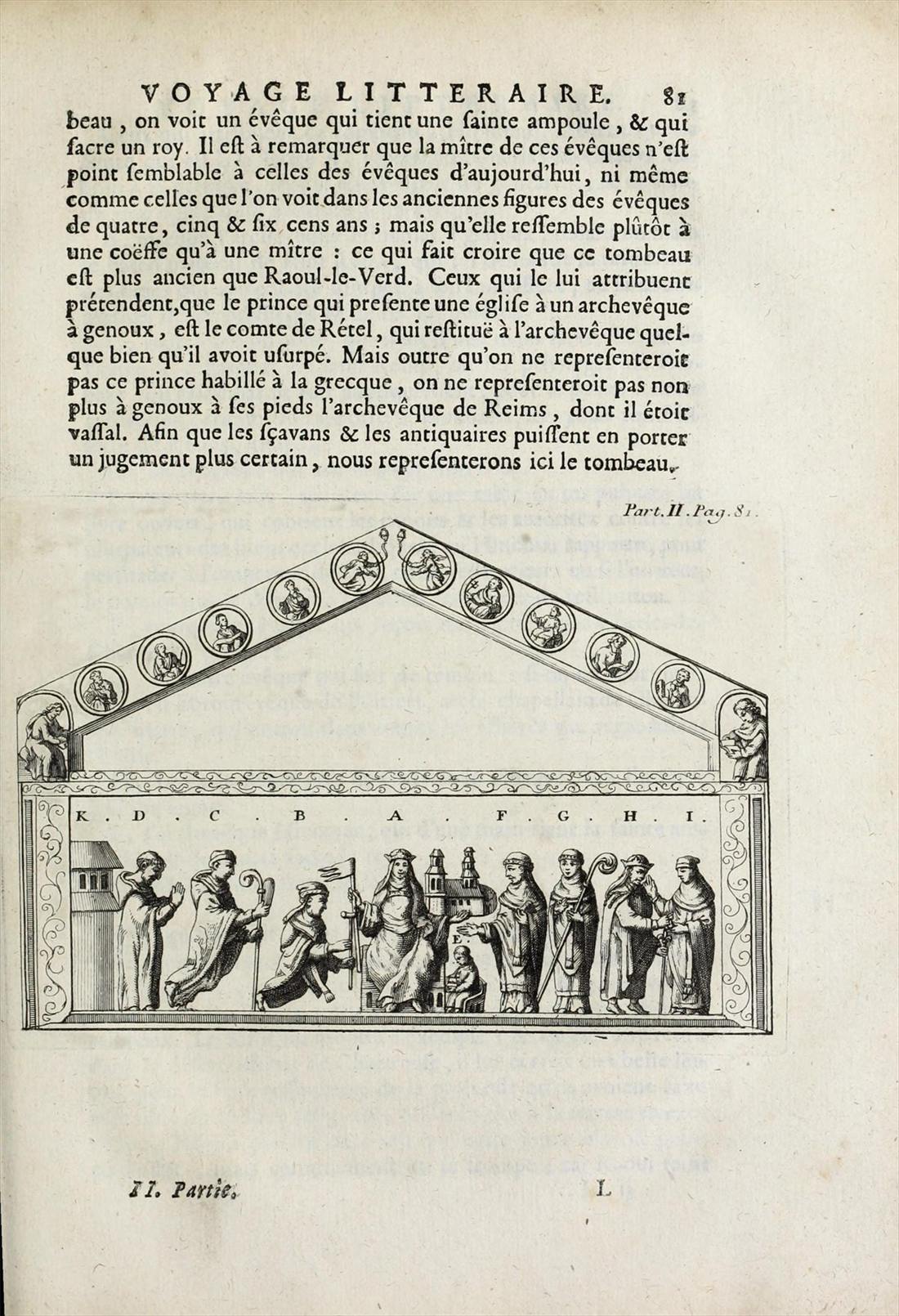
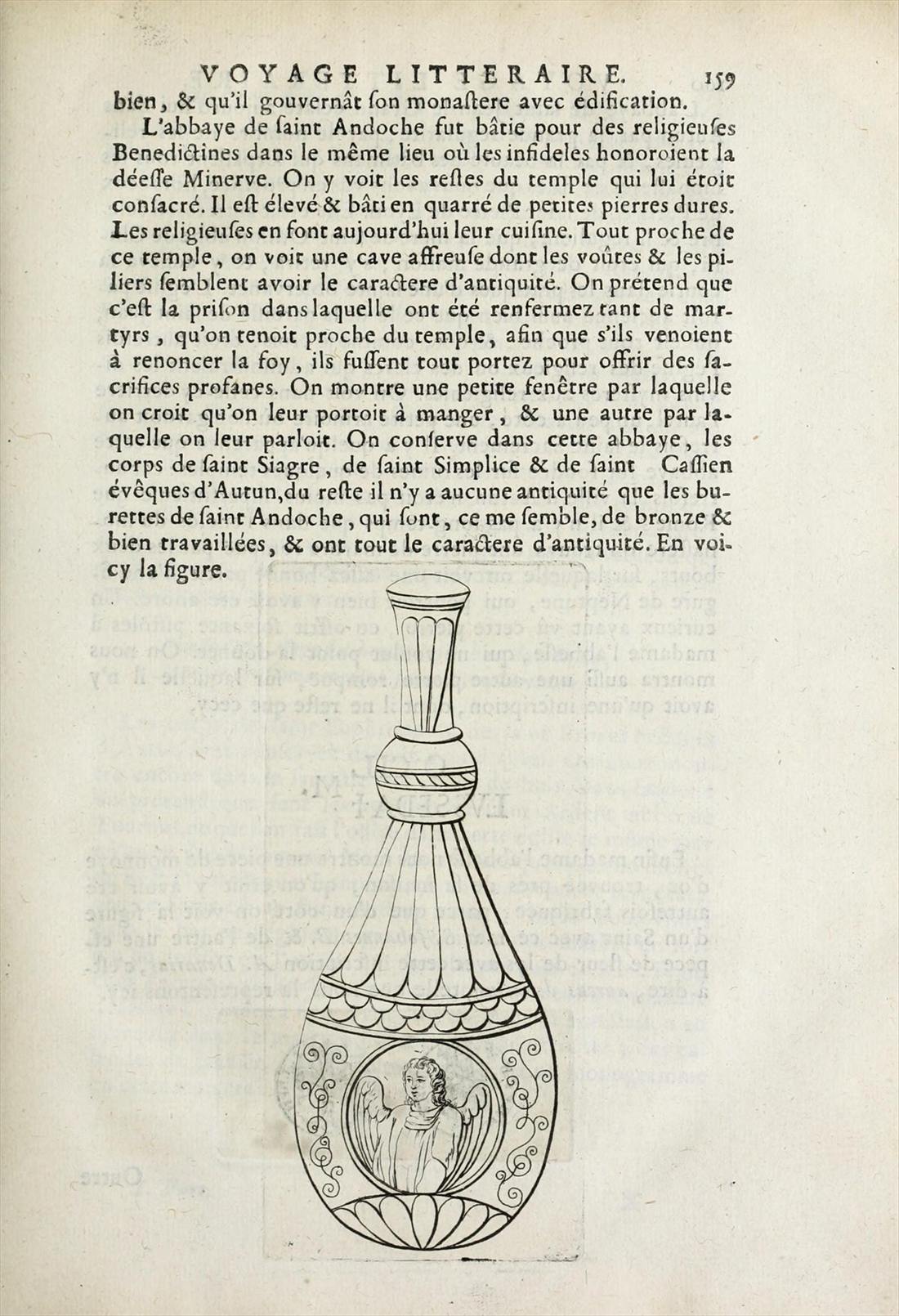
The title page promises figures, and they work. The Reims plate above is the method: a disputed tomb engraved, its figures lettered, each letter explained “afin que les sçavans & les antiquaires puissent en porter un jugement plus certain” (second part, pp. 81-83). At Saint-Irénée in Lyon an inscription lay half buried before the church: “nous fîmes apporter un pic & une besche, & nous la découvrîmes entierement” (first part, p. 234). At Autun they thought nothing ancient survived of Saint-Andoche but the cruets, of bronze “ce me semble”, and one is cut into p. 159 where the sentence ends.
Some of what they describe cannot be checked against the thing itself. The rotunda of Saint-Bénigne at Dijon, “une église à trois étages, faite en rond … & ouverte par le haut” (first part, pp. 142-143), was pulled down in 1792; its crypt was found again by accident in 1844.
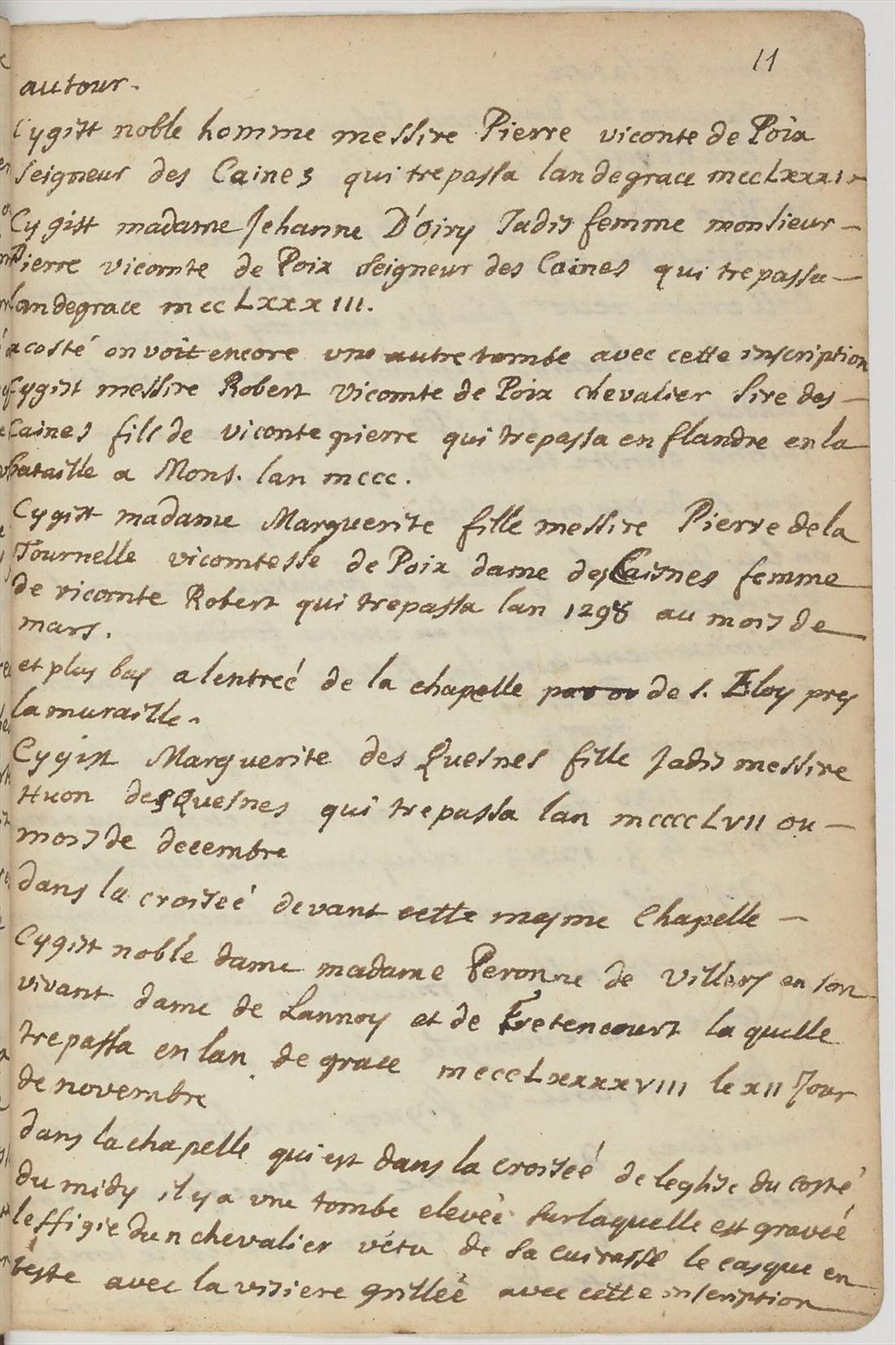
A notebook survives: Paris, Bibliothèque nationale de France, Français 15254 — 107 leaves, 160 by 107 millimetres, half-bound, catalogued only as a “Ms. autographe”, struck through and rewritten between the lines. The library does not name the hand; Hurel takes the surviving manuscript relations to be Durand’s, and cites a second, Français 20941.
The second volume came from Montalant on the quai des Augustins in 1724; its title page repeats that of 1717, and the name Second voyage littéraire, by which it is always cited, appears only in the preliminaries. Behind the travels it prints three older texts: an embassy to England in 1381, the Iter Indicum of Balthasar Springer, and a Latin account of Charles VIII’s army in Italy. The Gallia christiana they were feeding began to appear in 1715, stood at thirteen volumes in 1785, and was finished by other hands in 1865.
Why it is here
The Conservatoire’s work here is of the same kind at a smaller scale: reading what survives of one Benedictine house and saying where each statement comes from. Martène and Durand are useful for an unglamorous reason: they wrote down what they saw when they saw it, named the abbey and the page, and left their guesses marked as guesses. That is the standard of the research programme and of the library assembled to support it.
SourcesThe three engravings reproduced here are from the Getty Research Institute copy of the 1717 edition on the Internet Archive, where the whole volume may be read; the notebook leaf is Paris, Bibliothèque nationale de France, Département des Manuscrits, Français 15254, published on Wikimedia Commons. All are in the public domain. The collation of 1717 follows the Bibliothèque nationale de France record for its copy RES4-L45-35. No library collation of the plates has been seen here: a bookseller’s description of the three parts records ten engraved plates, two of them folding, and no engraver is named anywhere. Hurel’s critical edition was a doctoral thesis of 1991, and the catalogues disagree about the university: theses.fr gives Tours, a record of the Institut national d’histoire de l’art gives Lille-III.