
Saint-Maur · 1719–1724
L’Antiquité expliquée et représentée en figures
dom Bernard de Montfaucon · Paris, Florentin Delaulne and six other booksellers · five tomes in ten folio volumes
An encyclopaedia of the ancient world made chiefly of pictures: statues, coins, lamps, armour and tombs engraved on copper and keyed page by page to a text set in French and in Latin. Nobody now opens it to learn what antiquity looked like; it is read for what a Benedictine could assemble in Paris by 1719, and from whom.
Sold before it was printed
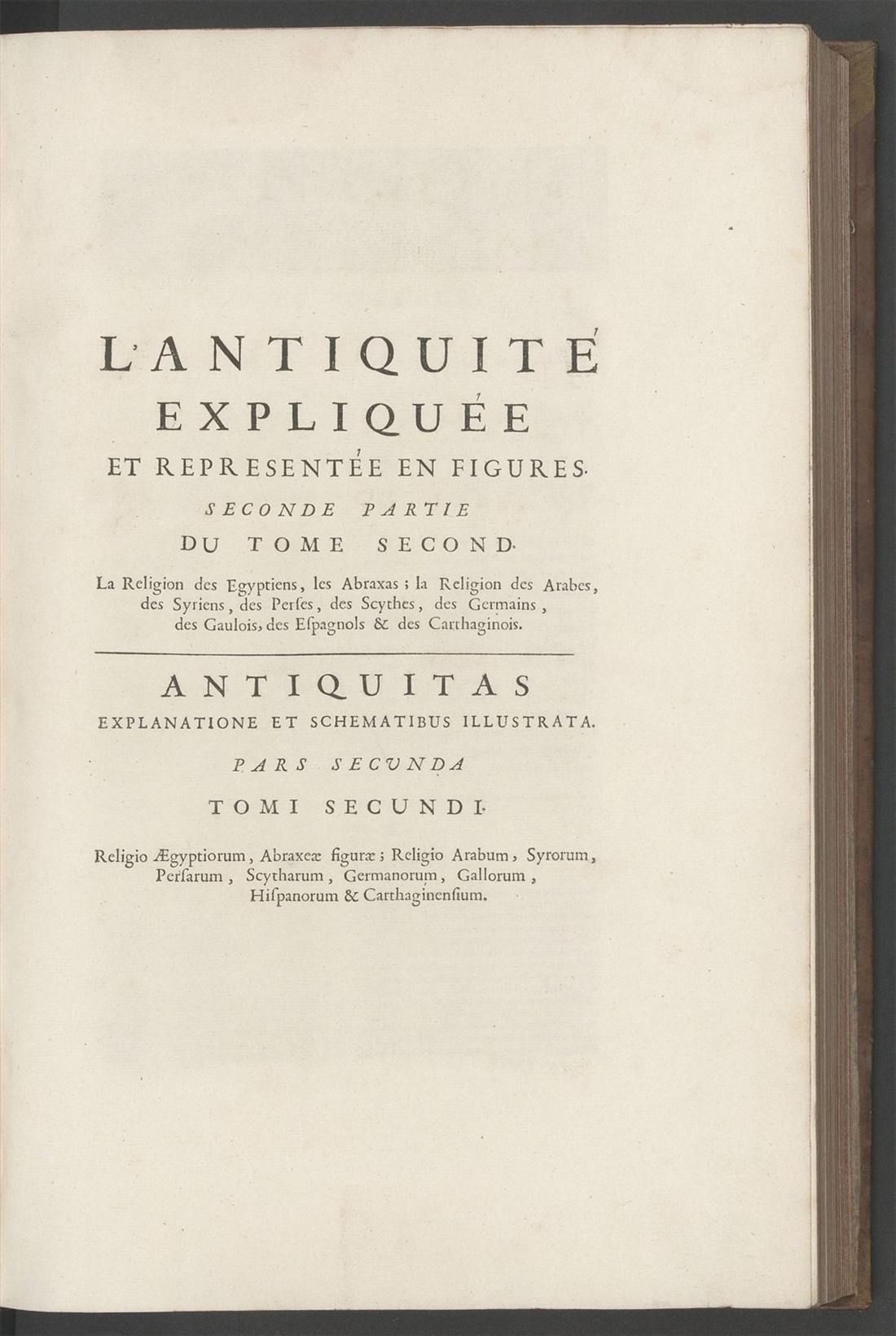
A prospectus survives at the Bibliothèque nationale de France, among the French manuscripts as Français 18817. It announces a work in French and Latin, of nearly twelve hundred plates, divided into five tomes; the sheet carries no date, and the catalogue assigns it to 1717. To pay for it Montfaucon had to ask the houses of his congregation to contribute and to treat with a company of seven Paris booksellers, who opened a subscription on the English model. The promise of two languages was kept to the letter: the leaf above is one divisional title doing the work of two — the religion of the Egyptians, the Abraxas, then the Arabs, Syrians, Persians, Scythians, Germans, Gauls, Spaniards and Carthaginians — and beneath the rule the same list in Latin.
Montfaucon was sixty-four when the ten volumes came out. Born in the Corbières in 1655 — the authority files divide between the 13th and the 16th of January — he had commanded grenadiers in the Languedoc regiment during the Dutch war before taking the Benedictine habit at La Daurade in Toulouse in 1675, and had spent three years in Italy after manuscripts, 1698 to 1701.
Names under every figure
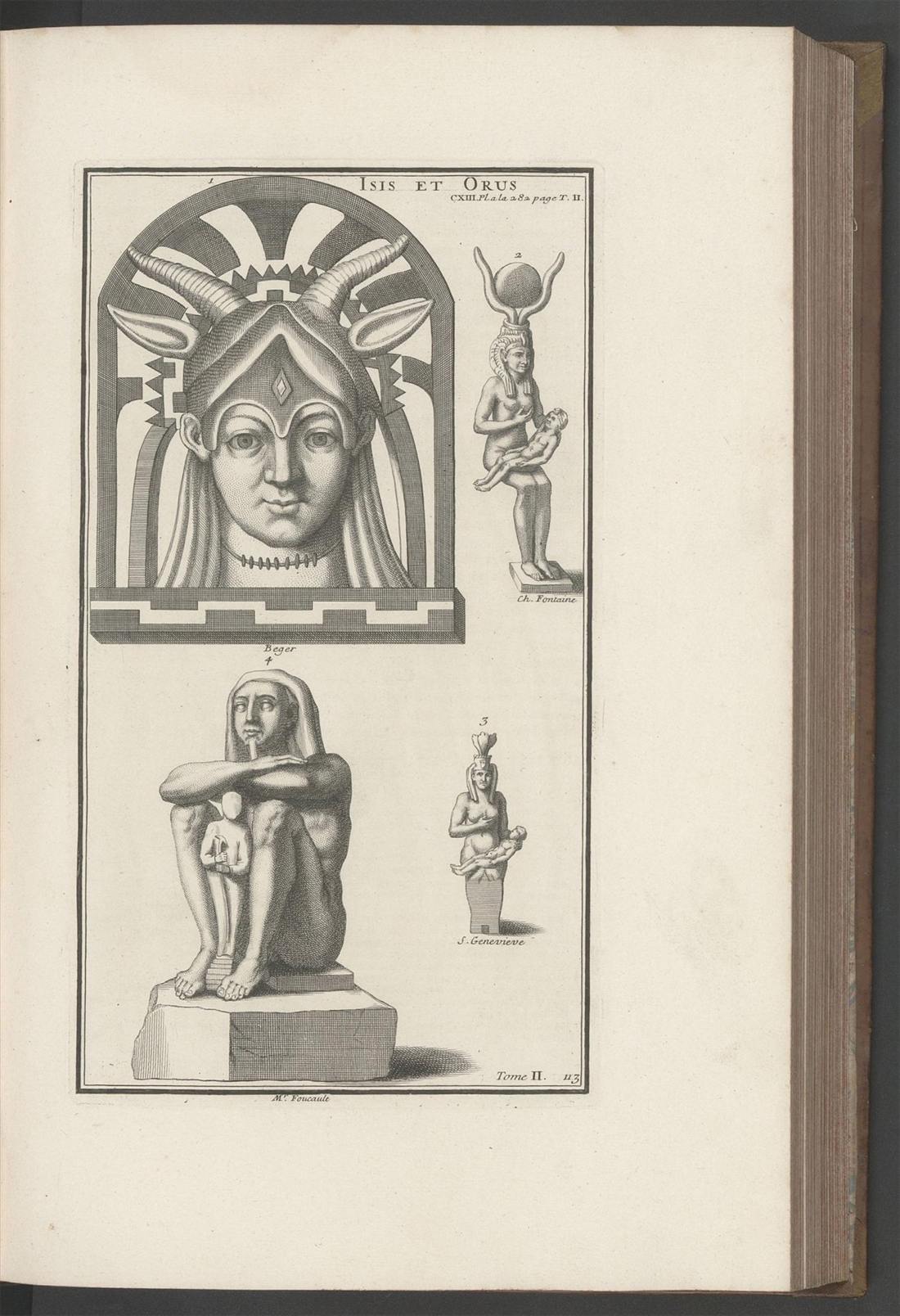
Each plate is keyed to a page of the text; this one is lettered at the upper right CXIII. Pl. a la 282 page T. II. It has four numbered figures: a great frontal head in a niche, horned and veiled; two standing statues of the goddess with the child across her arms; and a squatting figure, one finger at the lips, a small figure between its knees. The names printed beneath them are not the draughtsmen’s: they are the cabinets and earlier books the drawings were taken from, and no engraver has signed the plate. That is the method of the whole work — Montfaucon was gathering, ordering and crediting what other men had already seen.
The five tomes divide antiquity by subject rather than by date or style — the gods of the Greeks and Romans; worship, Egyptian and other; civil life, with dress, vessels, coins, weights and measures; war, with roads, bridges, aqueducts and navigation; and funerals. The Supplément of 1724 takes the same five headings with fresh material. How many plates a complete set holds is not settled: one account gives 1,120, another more than 1,300, a collated copy 1,394, of which 256 are double-page and four fold out beyond the leaf; the counts differ from copy to copy and from census to census.
What became of it
It sold. Eighteen hundred copies went quickly enough that two thousand more were printed the same year, and on 30 November 1719 a fellow Maurist, dom Claude de Vic, wrote that the price of the book was climbing like shares in the Compagnie des Indes — this in the autumn of Law’s System. He was named that year to the Académie des inscriptions et belles-lettres, on the Regent’s nomination; an English translation appeared in London, 1721 to 1725. He went on to the Monumens de la monarchie françoise, 1729 to 1733, and died at Saint-Germain-des-Prés on 21 December 1741.
As a description of antiquity the book was overtaken long ago. What survives is the evidence it holds of how such a description was put together: in 2021 Véronique Krings and her collaborators gave the making and reception of this one work two volumes and a cahier, 717 pages.
Why it is here
The habit of printing the owner’s name under the figure is the one the Conservatoire keeps under much smaller objects: a photograph, a lease, a floor tile from this abbey is of little use until it is said where it came from and who holds it. That is how the research programme records what survives at Mas-Grenier, and why the library works from facsimiles rather than accounts of them. This page is held to the same rule, and says above what it could not establish.
SourcesThe two leaves reproduced here are photographs of a copy of the 1719 edition whose holder we have not been able to identify; both are in the public domain, the work being printed in 1719 and its author dead in 1741. Two complete sets of the edition may be read freely on the Internet Archive, the Getty Research Institute’s and the Wellcome Collection’s; the link above opens the first part of tome I. The printing figures and the remark of dom Claude de Vic are taken from Claudine Poulouin in Dix-Huitième Siècle 27 (1995); the collation of 1,394 plates follows Cohen 731-732 as quoted by booksellers; the prospectus is BnF, Manuscrits, Français 18817. Véronique Krings (ed.), L’Antiquité expliquée et représentée en figures de Bernard de Montfaucon. Histoire d’un livre, Bordeaux, Ausonius, 2021.