
Saint-Maur · 1729-1733
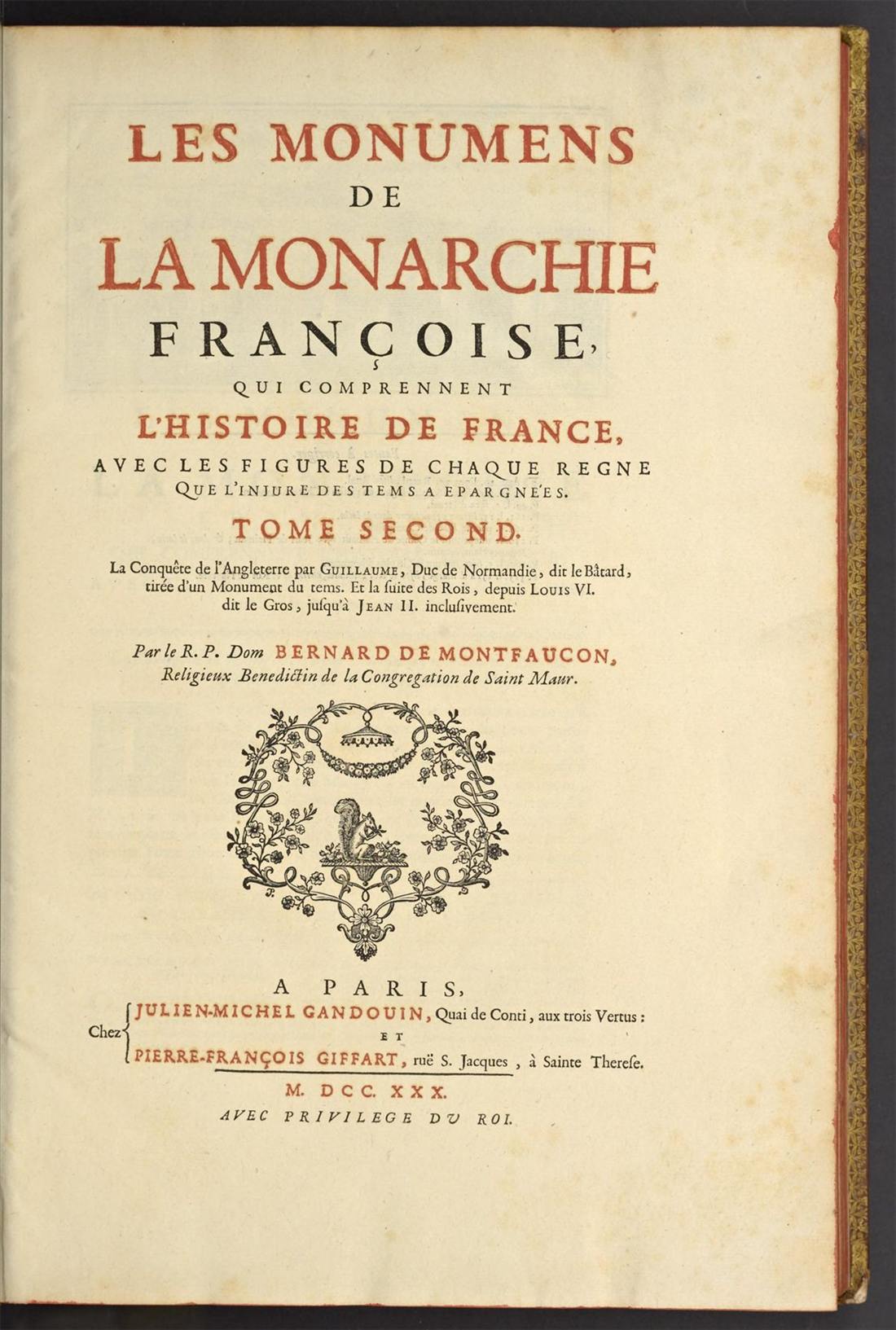
Les Monumens de la monarchie françoise
dom Bernard de Montfaucon · Paris, Gandouin and Giffart · five folio volumes
Five folio volumes telling the history of France from what had outlived it: tomb effigies, seals, wall paintings, carved portals, and a long embroidered hanging at Bayeux. Montfaucon printed what he could get drawn and named the source of each drawing. He was wrong about much of it, and left enough of his method on the page for the mistakes to be traced.
Sold before it existed
Montfaucon had lived at Saint-Germain-des-Prés since 1687 and coined the word palaeography in 1708. The preface of 1729 admits that the plan, announced more than two years earlier by prospectuses spread through the kingdom, had changed: the monuments, meant at first to stand on their own, would now be carried by the whole history of each reign. Each page prints the French above, the same text in Latin below. The work is dedicated to Louis XV.
A printed subscription ticket survives among Montfaucon’s papers at the Bibliothèque nationale de France: Paris, 7 June 1727, signed by four booksellers, Giffart among them. It promises four folio volumes with more than four hundred plates for eighty livres in sheets, half down, half on delivery, during 1729. Ticket number 40 went to the prior of Saint-Lucien de Beauvais. What came was five volumes, some three hundred plates, and the year 1733.
The hanging at Bayeux
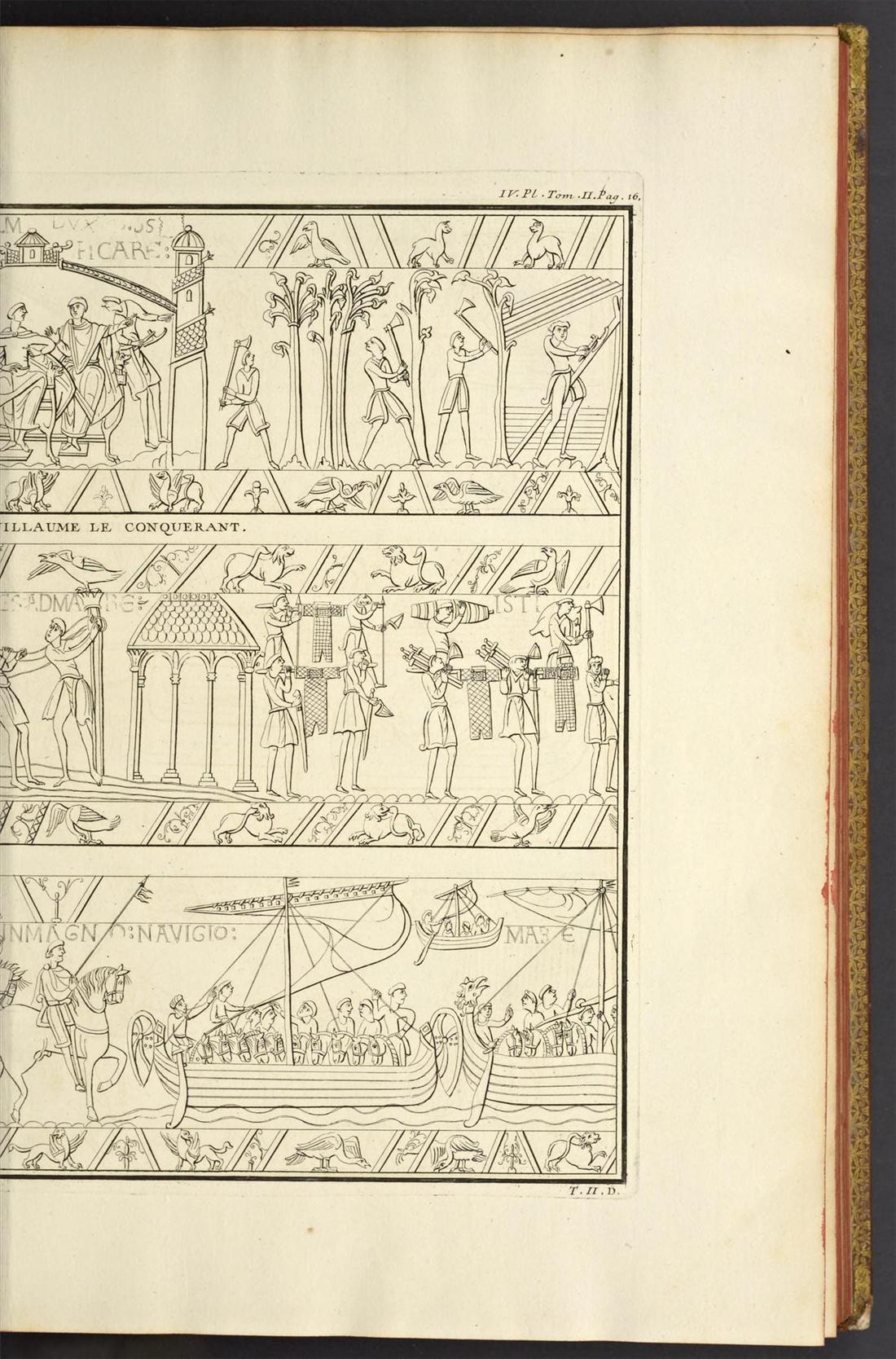
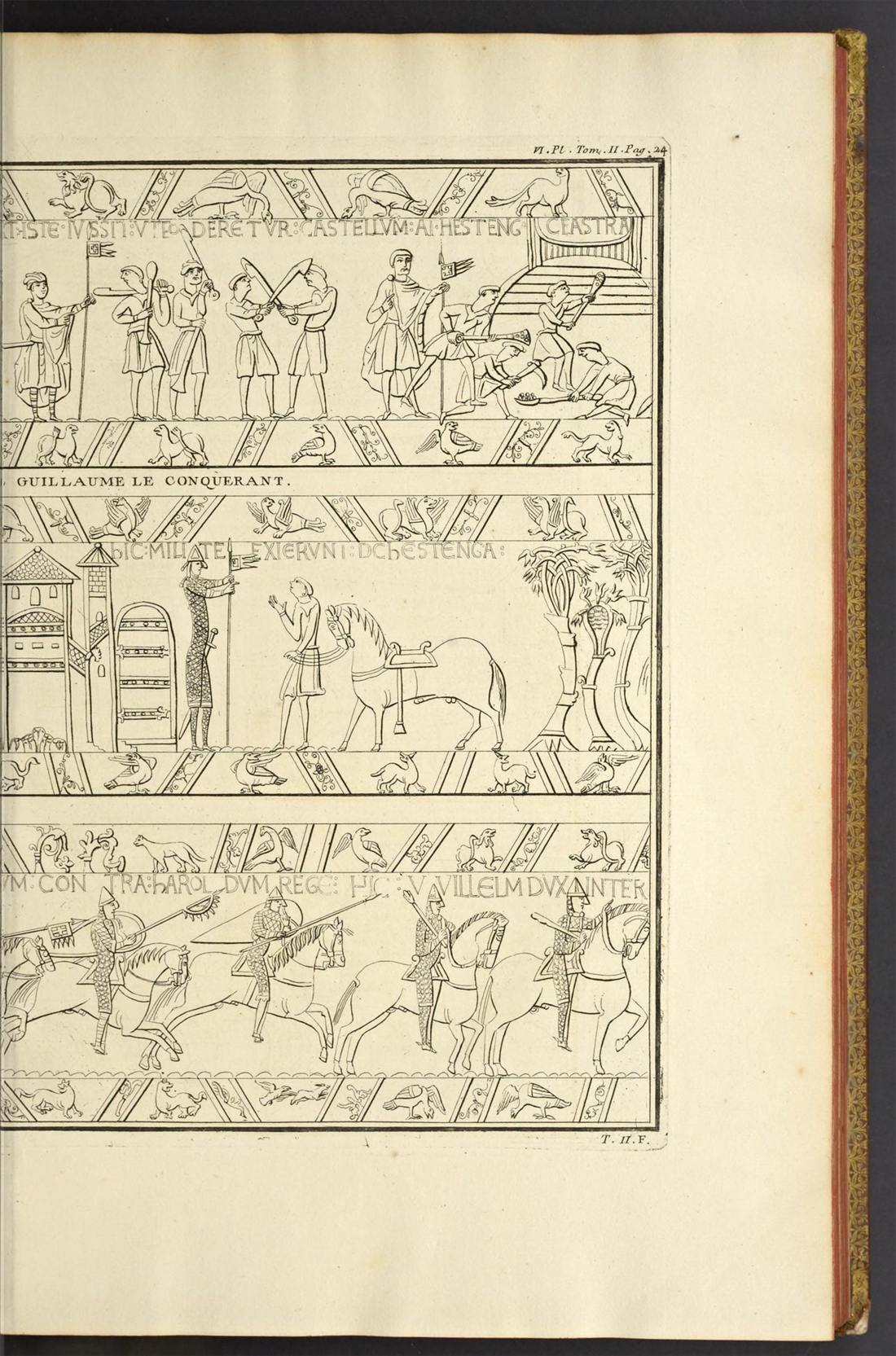
In 1724 Antoine Lancelot showed the Académie royale des inscriptions a drawing of part of a monument he could not place, found among the papers of Nicolas-Joseph Foucault, intendant of Normandy. Lancelot and Claude Gros de Boze passed it to Montfaucon, who engraved it in volume one as fifteen double plates, numbered XXXV to XLIX and headed Histoire d’Harold. His own confreres knew it: the Benedictines of Saint-Vigor at Bayeux described an old strip of tapestry shown in the cathedral on certain days of the year, and their prior, dom l’Archer, copied out its inscriptions for him. The whole hanging was 212 feet long, the fragment about thirty. Montfaucon sent the draughtsman Antoine Benoît to Bayeux to draw the rest, ordered to bring the figures to a set size and to alter nothing in the taste of the painting of those times. The nine plates of volume two begin where volume one stops, at Guy of Ponthieu handing Harold to Duke William, and end at Hastings.
What the plates are, and are not
They are engravings after drawings, and not a facsimile. Benoît’s copy is bare outline at a size not the hanging’s own, the figures redrawn by a hand of the 1720s. Where the embroidery gives out the plates thin to a broken line: Montfaucon read those gaps not as loss but as canvas never filled, by people who had not time to finish. Apart from the equestrian Louis XV signed C. Mathey, his plates carry no engraver’s name. The Society of Antiquaries commissioned Charles Stothard in 1816 to copy the hanging in colour; James Basire the younger engraved his drawings, 1819-1823. Montfaucon’s plates are the earlier record, not the closer one.
The same dependence on drawings produced a durable mistake. Plate VII of volume one, captioned Monument de Clovis et de ses fils, engraves the column figures of the west doorway of his own abbey, under its Last Supper lintel. He read those, and others on the third portal of Notre-Dame de Paris and in the cloister of Saint-Denis, as the earliest Frankish kings. They are medieval statues, and crowned figures of that kind are now read as kings and queens of the Old Testament.
Why it is here
The Conservatoire keeps a Maurist house at Mas-Grenier, and the lesson of the Monumens is one Montfaucon did not mean to leave: the record outlives both the object and the reading of it. What is drawn, measured and photographed here before the masons begin carries the name of whoever made it and its date, so a later reader may correct us as we now correct him. That is the research method here, and much of what the workshops leave behind.
SourcesThe title page and the two plates come from volume two (Paris, 1730) in the Getty Research Institute copy digitised by the Internet Archive, where the volume may be read entire. The BnF set is Réserve des livres rares FOL-LJ1-28, on Gallica under the arks bpt6k1232775 and bpt6k123278j; the subscription ticket is Latin 11915, folio 161.