
Saint-Maur · 1715-1785
Gallia christiana
dom Denis de Sainte-Marthe and the monks of Saint-Maur · Paris, Jean-Baptiste Coignard, later the royal press · sixteen folio volumes
A catalogue of the dioceses and abbeys of ancient Gaul, set out province by province: under each metropolitan see its suffragan bishoprics, under each bishopric the abbeys within it, and under every name the series of those who held it. The Maurists reached the thirteenth volume in seventy years; the Revolution stopped them, and a layman added three more in the century that followed. Historians still begin here, and still argue with it.
A bargain struck in 1710
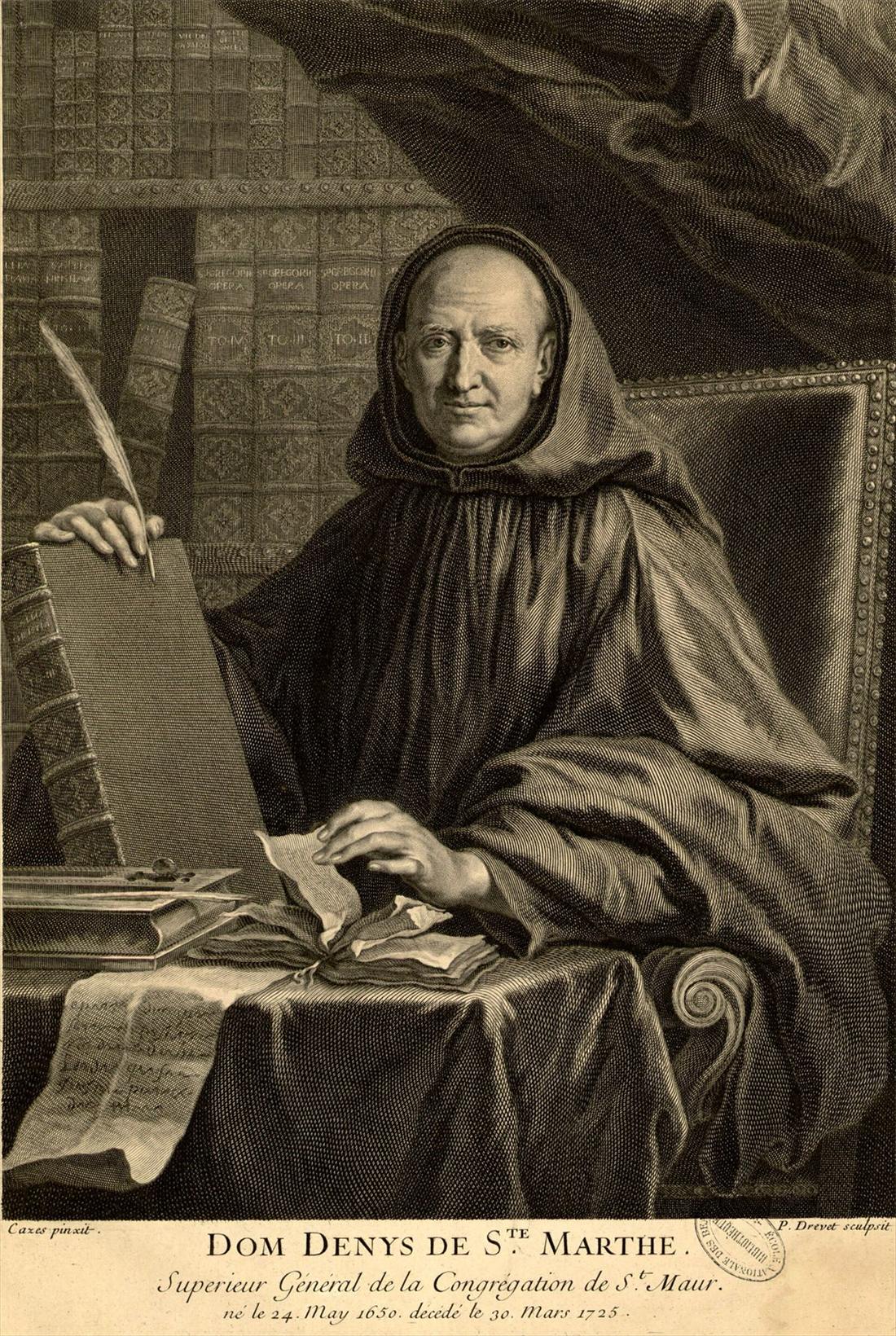
In 1710 the Assembly of the French Clergy offered dom Denis de Sainte-Marthe four thousand livres to remake the Gallia christiana his great-uncles Scévole and Louis de Sainte-Marthe had published in four folio volumes in 1656. Three conditions came with the money: that he bring the revision to an end, that the first volume appear within four years, and that his congregation carry the work on after his death. The third condition assumed that the author would die before the book was finished, and it was right.
The ground had been broken the year before. From April 1709 dom Edmond Martène and dom Ursin Durand travelled for the Congregation, searching the archives of more than eight hundred abbeys and a hundred cathedral churches, and came back to Saint-Germain-des-Prés in 1713; their account of the road, the Voyage littéraire, appeared in 1717 and 1724. Three volumes went out under the name of Sainte-Marthe: Albi, Aix, Arles, Avignon and Auch in 1715; Bourges and Bordeaux in 1720; Cambrai, Cologne and Embrun in 1725, the year he died, on 30 March.
Columns, charters, a folded map
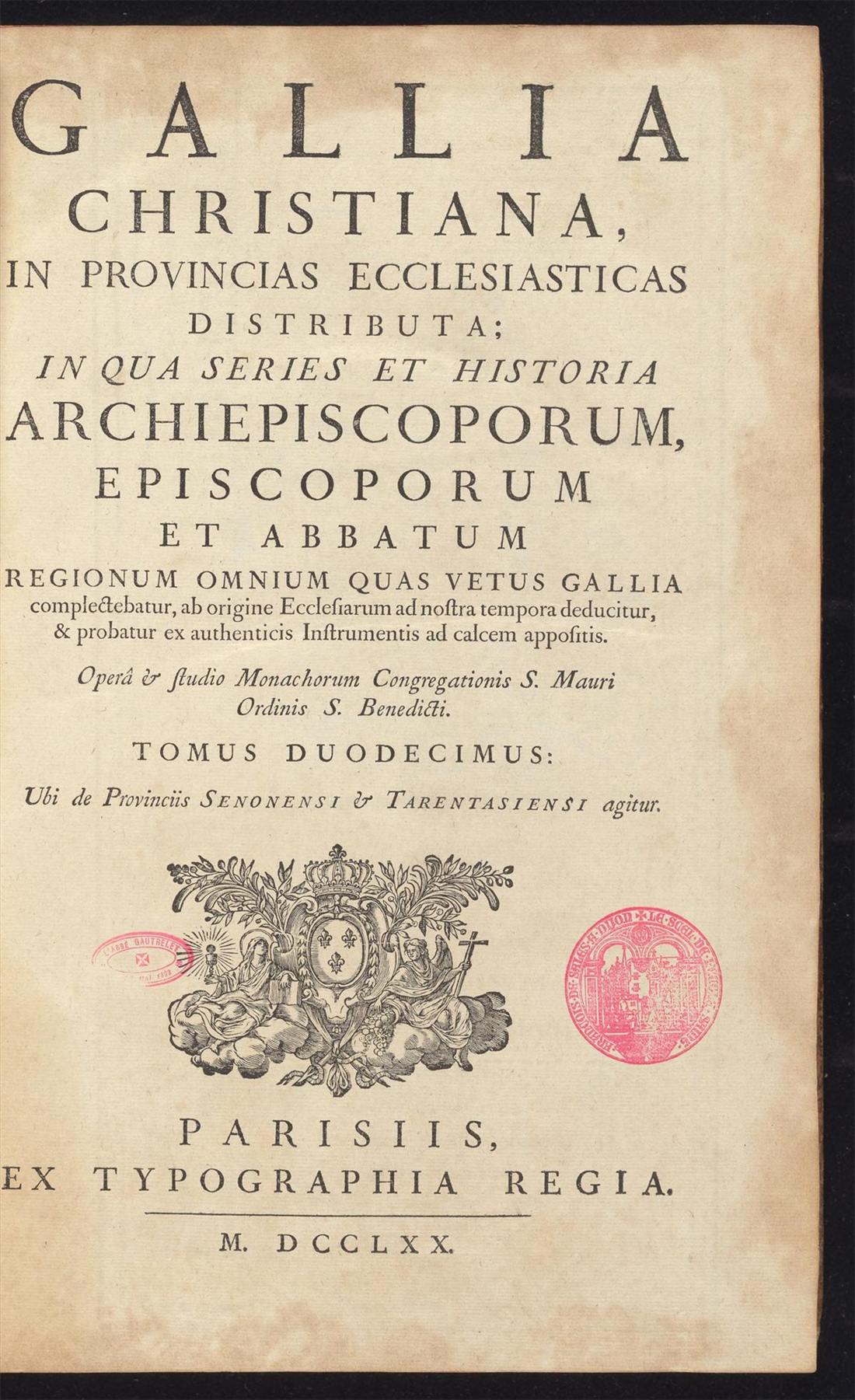
The volumes are folios of about thirty-five centimetres, set in double columns and numbered by column: the body of the book carries no page numbers at all, and the church of Bourges is cited at column 164. The title page undertakes that all of it is proved ex authenticis Instrumentis ad calcem appositis, from authentic documents appended at the end; the charters behind the notices are duly printed at length, in separately numbered sections headed Instrumenta, where a reader can hold the compilers to their own evidence.
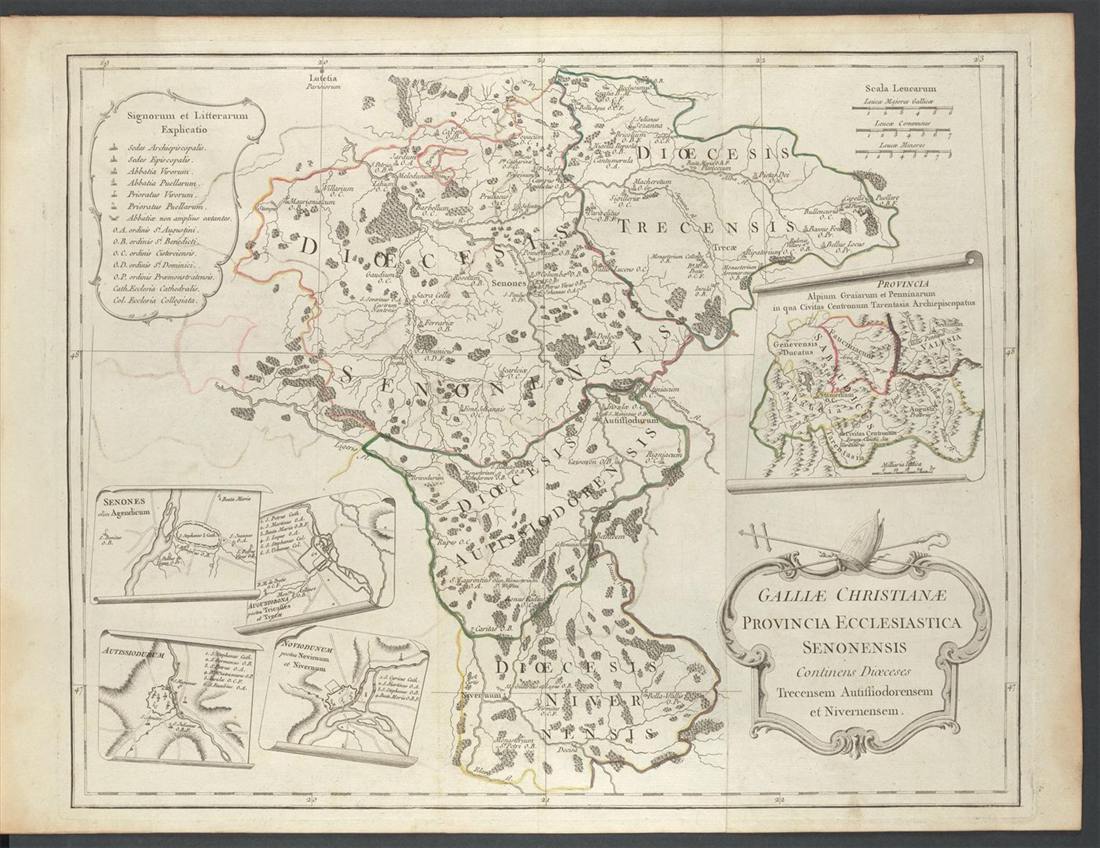
By 1770 the title page names no author. It gives the work to the monks of the Congregation of Saint-Maur and sets its ground as regionum omnium quas vetus Gallia complectebatur, all the regions ancient Gaul once comprised — which is why Cologne, Mainz and Trier stand in the set beside Bourges and Toulouse. Maps were engraved for some of the provinces and folded in: Avignon in volume one, and in volume twelve the sheet below.
Carried on, broken off, taken up again
The brethren went on without Sainte-Marthe at about a volume every five or six years, the names changing from one title page to the next: dom Félix Hodin and dom Étienne Brice for volumes six to eight, joined by père Duplessis for the ninth and tenth, then père Pierre Henri and dom Jacques Taschereau for the eleventh, in 1759. The twelfth, Sens and Tarentaise, came out in 1770; the thirteenth, Toulouse and Trier, in 1785. Five years later the religious orders in France were suppressed and the work stopped, with four provinces undone: Tours, Besançon, Vienne and Utrecht.
Three of them were supplied by a layman. Barthélemy Hauréau, 1812-1896, who had run the manuscripts department of the Bibliothèque nationale, kept to Latin and to the Maurist plan and published volumes fourteen to sixteen from 1856, drawing on the archives the Revolution had gathered into Paris; the catalogues disagree about the dates of the last two. Utrecht was never treated at all. The set has since been reprinted rather than replaced — by dom Piolin between 1870 and 1877, by H. Welter, by Gregg at Farnborough in 1970. In 1933, in the Revue d’histoire de l’Église de France, Victor Carrière asked for the whole thing to be made again on another plan: a diocese, he argued, cannot be written as a string of episcopal lives.
Why it is here
The thirteenth volume covers the province of Toulouse, in which the abbey of Saint-Pierre de Mas-Grenier lies — Toulouse raised to an archbishopric by John XXII on 11 July 1317, with Montauban among the four suffragan sees he created for it. Whether the abbey has a notice of its own there is not established: no source we have consulted names it, and we have not read the columns ourselves. Settling that, against the charters printed in the Instrumenta, is ordinary work for the research programme and the library and archive; the habit behind it — the document set down beside the claim — is what the workshops and the courses pass on.
SourcesThe title page and the map of the province of Sens are from a digitised copy of the twelfth volume, Paris, ex Typographia Regia, 1770, whose two red stamps record later owners; we cannot name the library that holds it. The portrait comes from the Bibliothèque numérique de l’INHA (NUM EST 7839) by way of Wikimedia Commons, which publishes the digitisation under CC BY-SA 4.0. The frontispiece is the first plate of the digitised volume one of 1715 on Wikimedia Commons, in the public domain. Catalogue records give Jean-Baptiste Coignard as printer of the early volumes; the imprint quoted above is read from the title page shown. The dates of volumes fifteen and sixteen differ between catalogues and are left open here. Volume one may be read at the Internet Archive.