
Saint-Maur · 1708
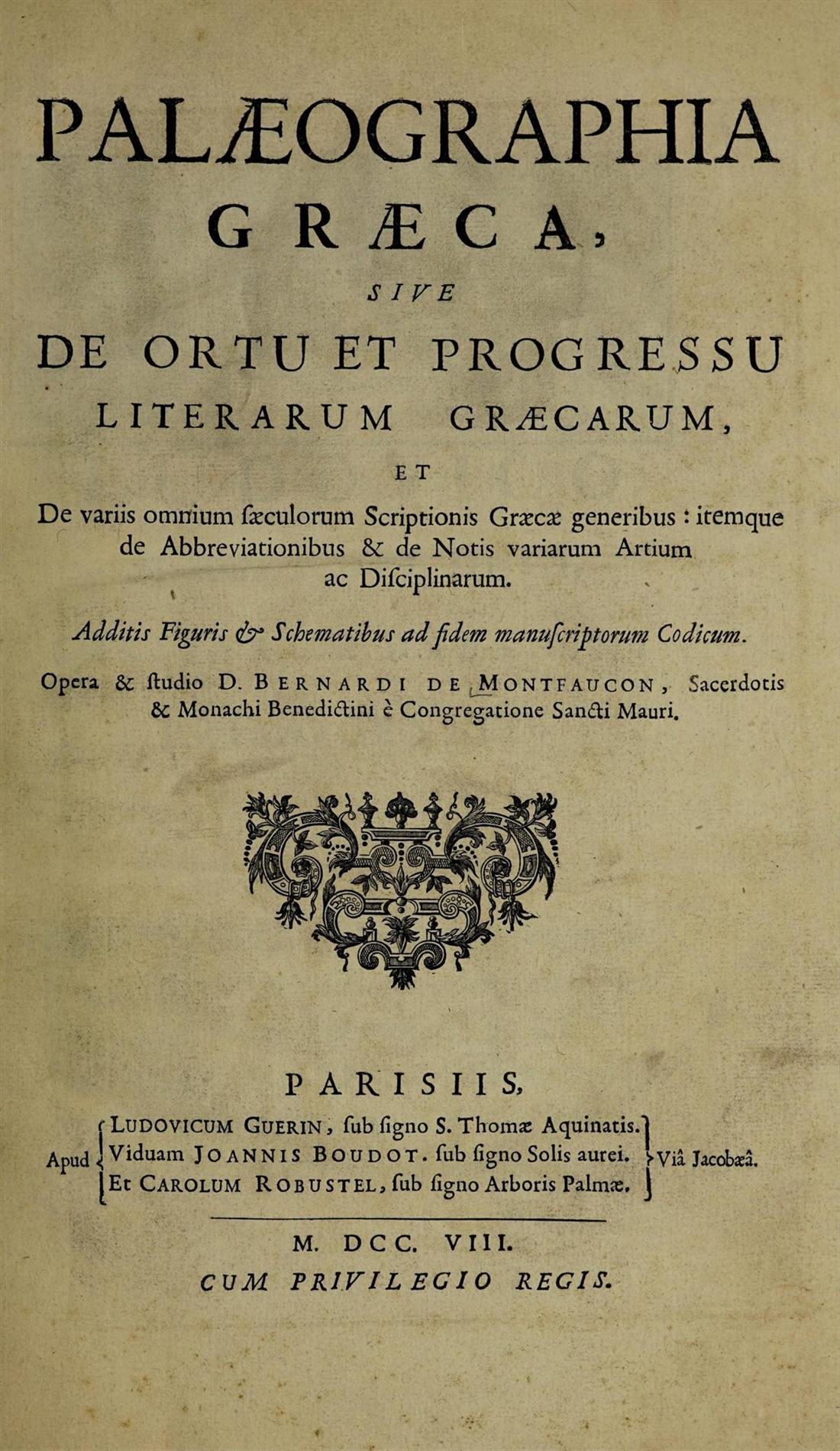
Palaeographia graeca
dom Bernard de Montfaucon · Paris, Louis Guérin, the widow of Jean Boudot and Charles Robustel · one folio volume, seven books
Bernard de Montfaucon set out to make Greek handwriting datable. He took specimens from manuscripts that gave both a year and a scribe’s name, described the letter-forms of each century against them, and printed the evidence with the conclusion. The name of the study is generally traced to this book.
A test made with dated books
Montfaucon had lived at Saint-Germain-des-Prés since 1687. For more than twenty years, he writes in the preface, he had given Greek exemplars almost daily attention. In 1693 he began the trial: from codices in the king’s and the Colbert libraries that carried both the year and the scribe’s name he took specimens, then measured undated books against them. He tried the method in Italy, staying nearly two months at Venice, fixing a date before witnesses and then turning to the colophon to see whether he had been right. In 1706 he decided to publish. The model he names is Mabillon’s De re diplomatica of 1681; Mabillon died on 27 December 1707, a year before the folio appeared, and the preface speaks of him as departed.
Seven books
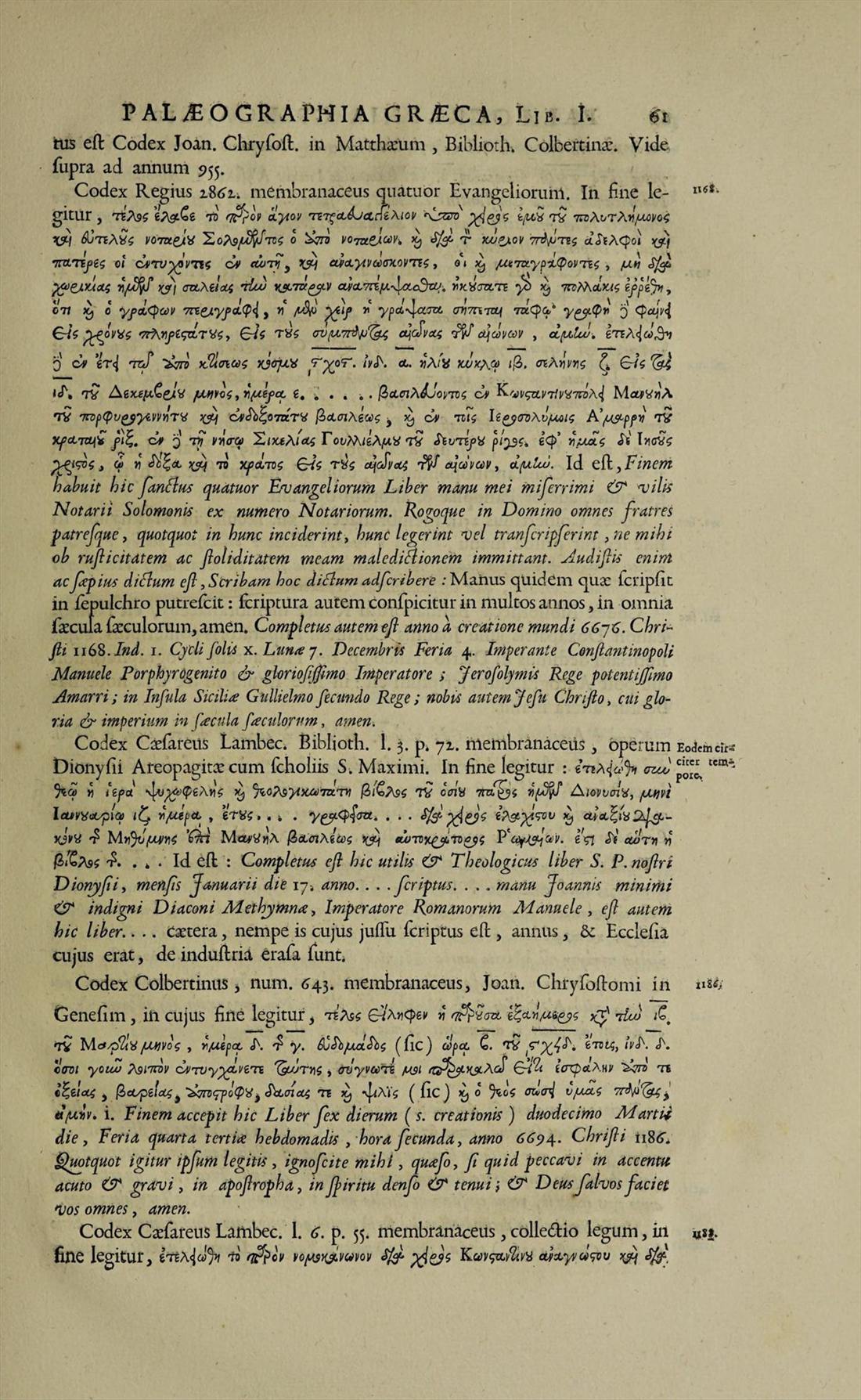
The first book is about the making of books: ink, the surfaces written on from papyrus to wax tablets, the reed and the pen, the form and binding of a codex, and the scribes — about three hundred calligraphers, listed first by date and then alphabetically, their subscriptions quoted word for word. The second traces Greek letters back to their Phoenician origin; everything written before the fourth century after Christ had perished, Montfaucon says, so its forms are taken from bronze, marble and old coins. The third gives specimens of uncial manuscripts, the fourth of ligatured and cursive hands, with a chapter on codices where an older text was scraped away for a newer. The fifth sets out abbreviations and the signs used in rhetoric, music, coinage, astronomy and medicine. The sixth prints nine Greek documents from southern Italy and Sicily, dated between 1099 and about 1230; King Roger’s diploma declaring Christodoulos Amiras protonobilissimus takes three engraved tables at page 408.
Two further texts are not announced on the title page. Book VII is a Latin version, made from modern Greek, of John Comnenus’s description of Mount Athos and its twenty-two monasteries. At the end, pages 553 to 574, is a dissertation on the oldest Greek and Latin letters; the letter to Montfaucon that precedes it is signed with initials only and asks that its author’s name not be mentioned. The Bibliothèque nationale de France identifies him as Jean Bouhier, a magistrate of the parlement of Burgundy at Dijon.
The word, and what a copy cannot carry
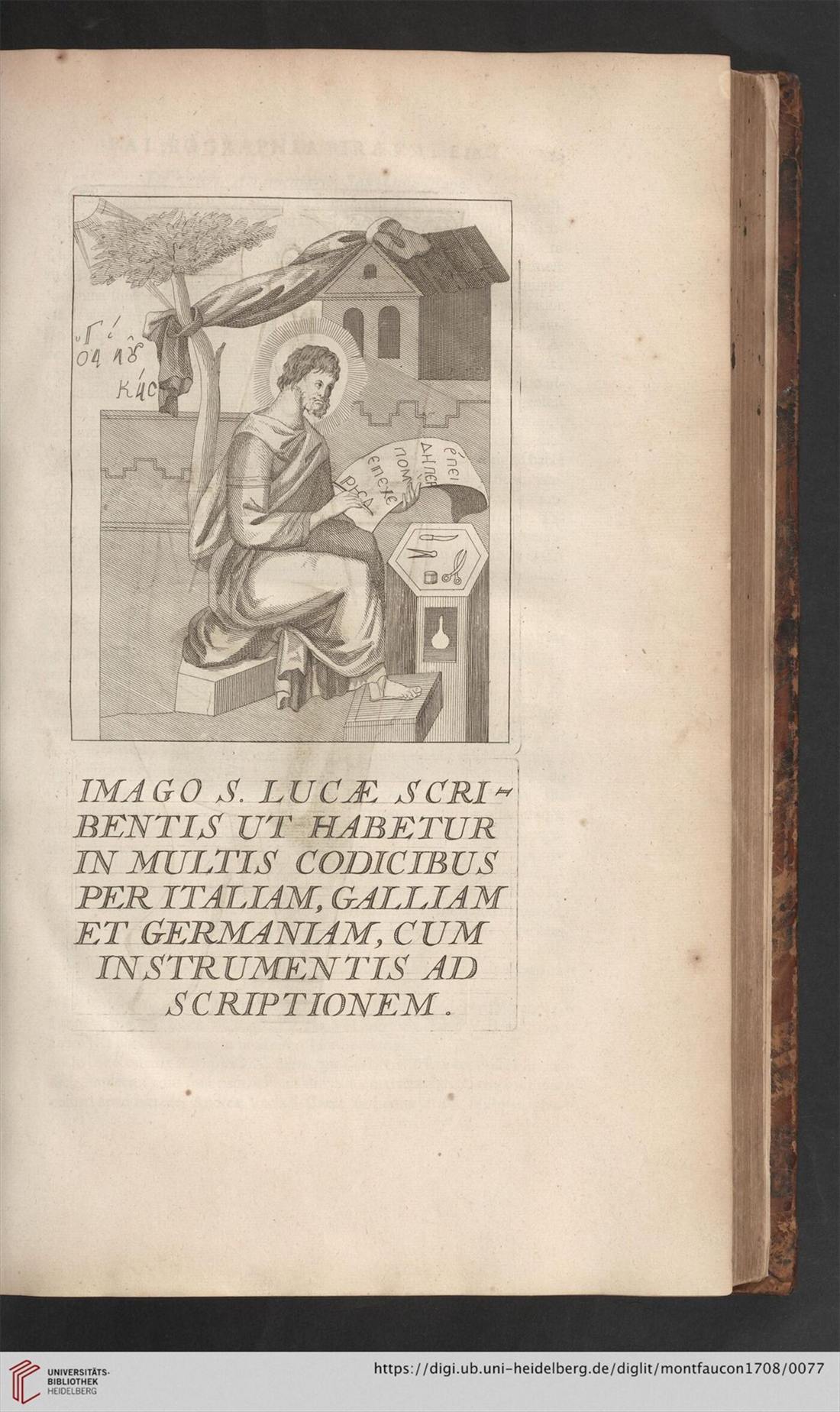
Explaining why he had gone to marble, bronze and coins, Montfaucon writes that he wished to leave out nothing belonging ad Palaeographiam, sive antiquam scripturam — to palaeography, that is, to ancient writing. The word is generally traced to this book. He was exact about the limits of his plates: however much care is spent on reproducing old writing, he warns, an engraving always departs somewhat from the manuscript forms, and the ink’s condition and colour and the other marks of age cannot be carried over at all. The method still decided cases: a learned man who held Quintus Curtius to be a fifteenth-century forgery was answered by a Colbert manuscript of it more than eight hundred years old.
The royal privilege was given at Versailles on 1 March 1707; on 17 March Montfaucon signed it over to his three booksellers. Henri Omont published in 1891 the contract he made with his engraver, Pierre-François Giffart, for the plates; it lies among the seventeen volumes of his papers at the Bibliothèque nationale de France, Latin manuscripts 11904-11920. Montfaucon catalogued the Coislin Greek manuscripts in 1715 and died in 1741. The next comprehensive account of Greek script was Victor Gardthausen’s Griechische Palaeographie, Leipzig 1879.
Why it is here
The Conservatoire has no Greek manuscripts to read. What the book leaves behind is a procedure: date a thing by comparison with things whose date is known, publish the witness beside the conclusion, and say what a reproduction cannot show. That is the rule of the research programme for this abbey’s own papers, and of the workshops, where a copy is expected to say what it is a copy of.
SourcesThe title page and page 61 are photographed from the London copy digitised by the Internet Archive as item b30455601, contributed by the Wellcome Library and marked public domain; the plate of Saint Luke from the copy of the Universitätsbibliothek Heidelberg, under the Public Domain Mark; the frontispiece from the copy of the Biblioteca Nazionale di Napoli, also on the Internet Archive. Page references and the contents of the seven books follow the volume’s own Syllabus and index. The whole text may be read at the Internet Archive; the Bibliothèque nationale de France has digitised its own copy in Gallica, ark:/12148/bpt6k1041709q.