
Saint-Maur · 1733–1763
Histoire littéraire de la France
dom Antoine Rivet de La Grange and two brethren · Paris, for Huart, Osmont, Gissey, David and Clousier · twelve tomes in quarto
An inventory of everyone who wrote in or for France, taken century by century from the Gauls onwards. The Benedictines of Saint-Maur published twelve tomes between 1733 and 1763, getting as far as the twelfth century; the Institut de France took the work up again, and the Académie des Inscriptions et Belles-Lettres has conducted it since 1816. Tome 47 appeared in 2021; the survey is not finished.
A plan, and a contract
Dom Antoine Rivet de La Grange drew up the plan. On 28 April 1732 dom Joseph Doussot, acting for him — Rivet was then at Saint-Vincent du Mans — concluded a contract with five Paris booksellers, Pierre Michel Huart, Charles Osmont, Pierre Gissey, Guillaume David and Jacques Clousier, who undertook to pay ten livres for each sheet of printing. The first quarto tome appeared in 1733, on the ages before Christ and the first three centuries of the Church.
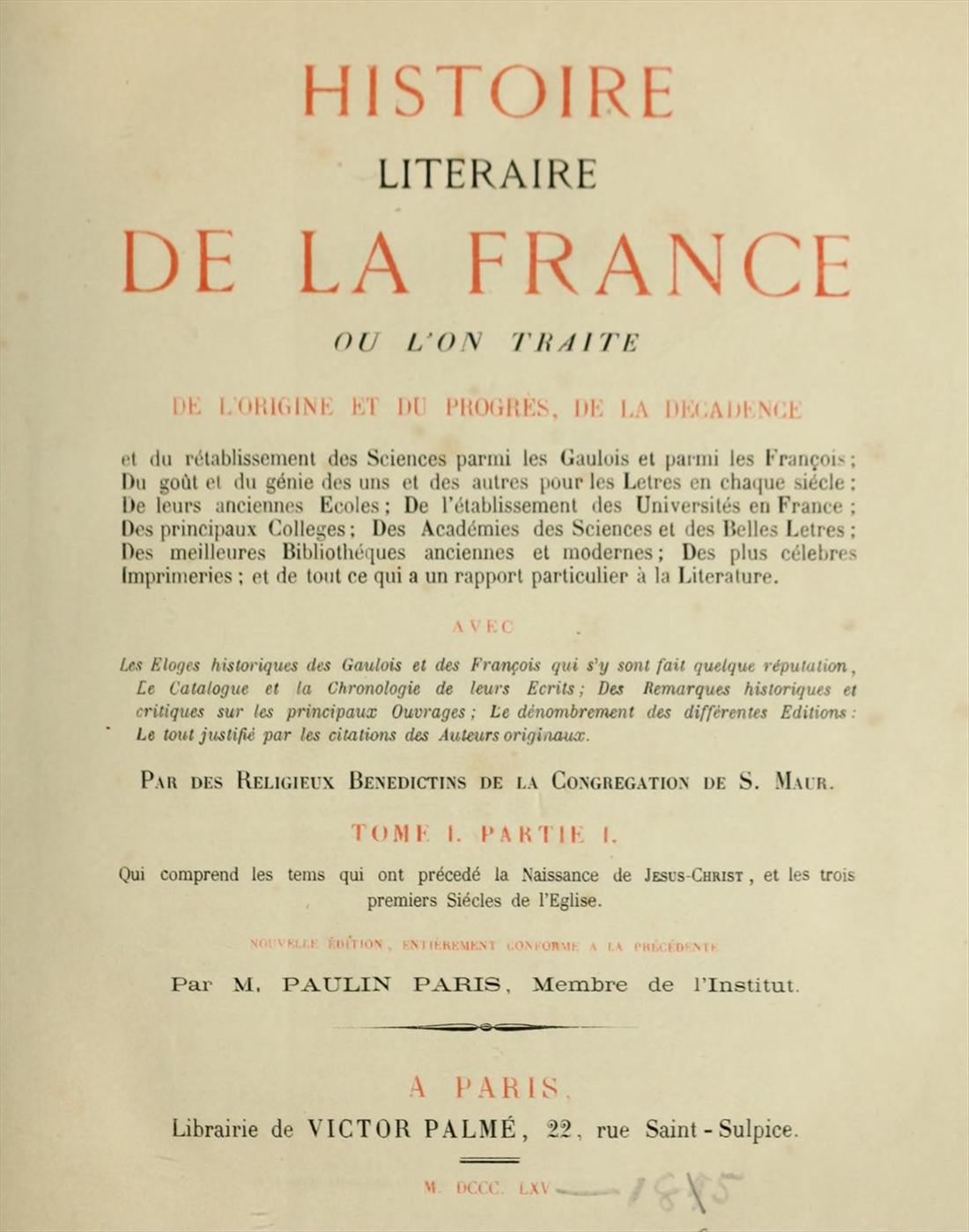
Its preface fixes the method: the history goes by century, and the writers of each century take their rank by the date of their death, or, where that is unknown, by the period in which they flourished. A notice gives the man, then the catalogue and chronology of his writings, critical remarks on the principal works and a count of their editions, the sources keyed in the margin. The title page promises the schools, libraries and printing houses as well as the authors, and spells the word with a single t: Histoire literaire.
How the notes were made
Rivet had been sent to Le Mans for refusing the bull Unigenitus, and spent his last thirty years there. He chose two collaborators, dom Poncet and dom Colomb. Colomb took literature, historiography, anonymous works and translations; Poncet theology, law and the sciences; Rivet corrected the notes, drafted the final notices and drew up the tables. They worked mostly from printed books, and sometimes cut a reference work — père Lelong’s Bibliothèque historique among them — into strips pasted onto separate leaves. The library of Saint-Germain-des-Prés, guardian of Maurist orthodoxy, stayed shut to men suspected of Jansenism; Rivet had to ask more than once before Fabricius’s Bibliotheca was sent to Le Mans.
The raw material survives. Forty-one portfolios of notes taken between 1730 and 1760 are in the archives of the Institut de France, nineteen of them some 450 leaves apiece; the manuscript of the first seven volumes is Le Mans, ms. 423. François Fossier, who worked through the portfolios for his study of 1976, calls the writing of thirteen imposing quarto volumes a tour de force.
Put down, and taken up
Rivet died at Le Mans on 7 February 1749, tome IX ready for press. Dom Clémencet and dom Clément, of the Blancs-Manteaux in Paris, brought out tomes X, XI and XII in 1756, 1759 and 1763; then the series stopped. Taillandier, named as Rivet’s successor, asked in writing what need there had been to drag out of the tomb a crowd of obscure, unknown and barbarous authors. Colomb’s notes stayed at Le Mans with the abbé Renouard of the departmental library until the Minister of the Interior ordered them given to the Institut.
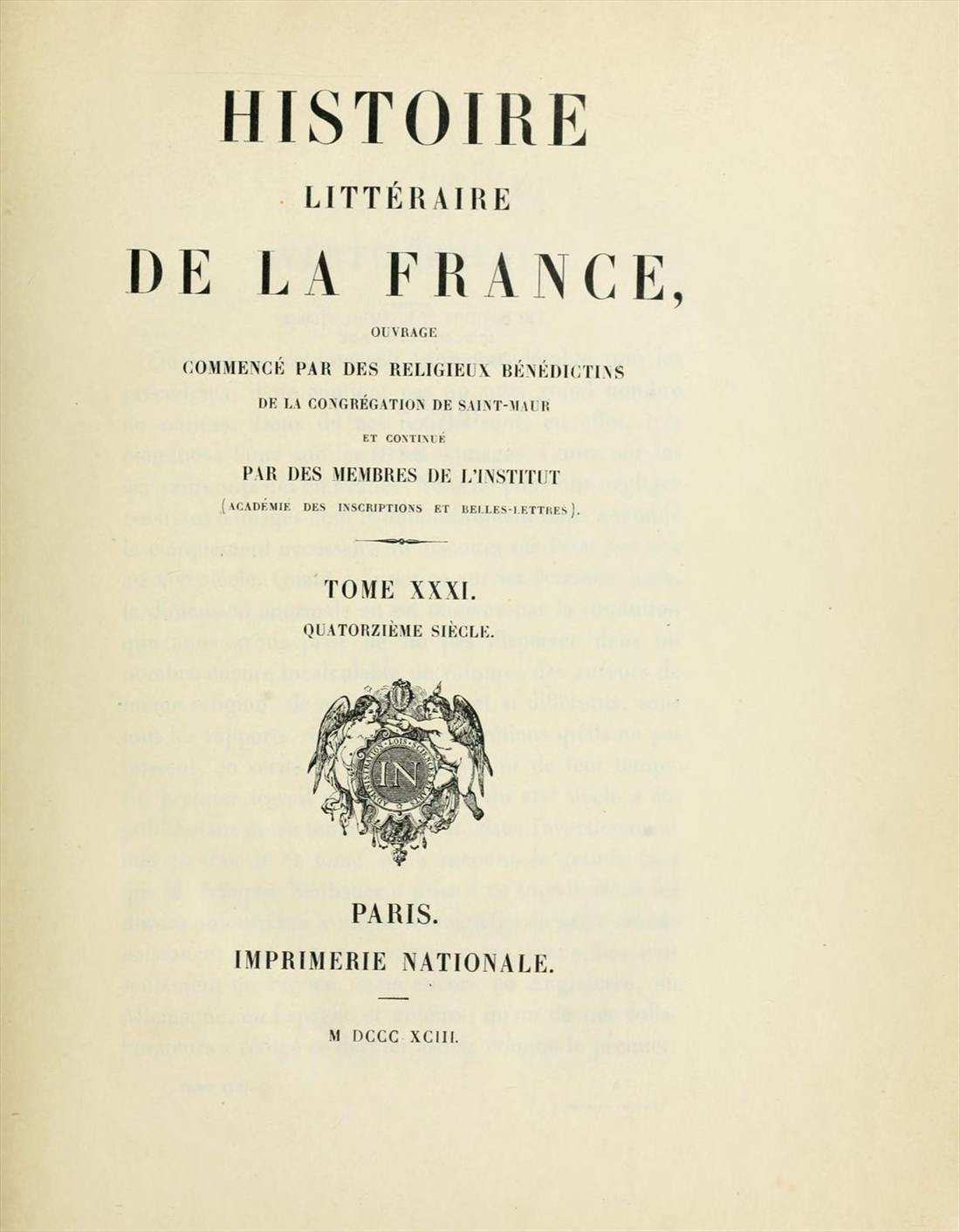
The Institut’s Classe d’histoire et de littérature ancienne was then charged with resuming the work, its commission instructed to follow the plan and method of the first authors to the end of the twelfth century. Tome XIII, dated 1814, was the work of Pastoret, dom Brial, Ginguené and Daunou. The Classe became the Académie des Inscriptions et Belles-Lettres in 1816 and has conducted the series since; the title page above, printed in 1893, still divides the credit. The Academy no longer follows the strict order of centuries, publishes the notices for which scholars can be found, and has fixed the survey’s end at about 1630.
Why it is here
The Conservatoire’s first research programme is a monograph on this abbey: a prosopography of its priors and religious, and a charter collection reassembled from national, departmental and diocesan archives for its library. The second inventories the Maurist houses of the province of Toulouse, to be handed on to other scholars. The Histoire littéraire measures what such work costs and what becomes of it: begun by men who did not live to finish it, continued because the plan was written down and the notes kept.
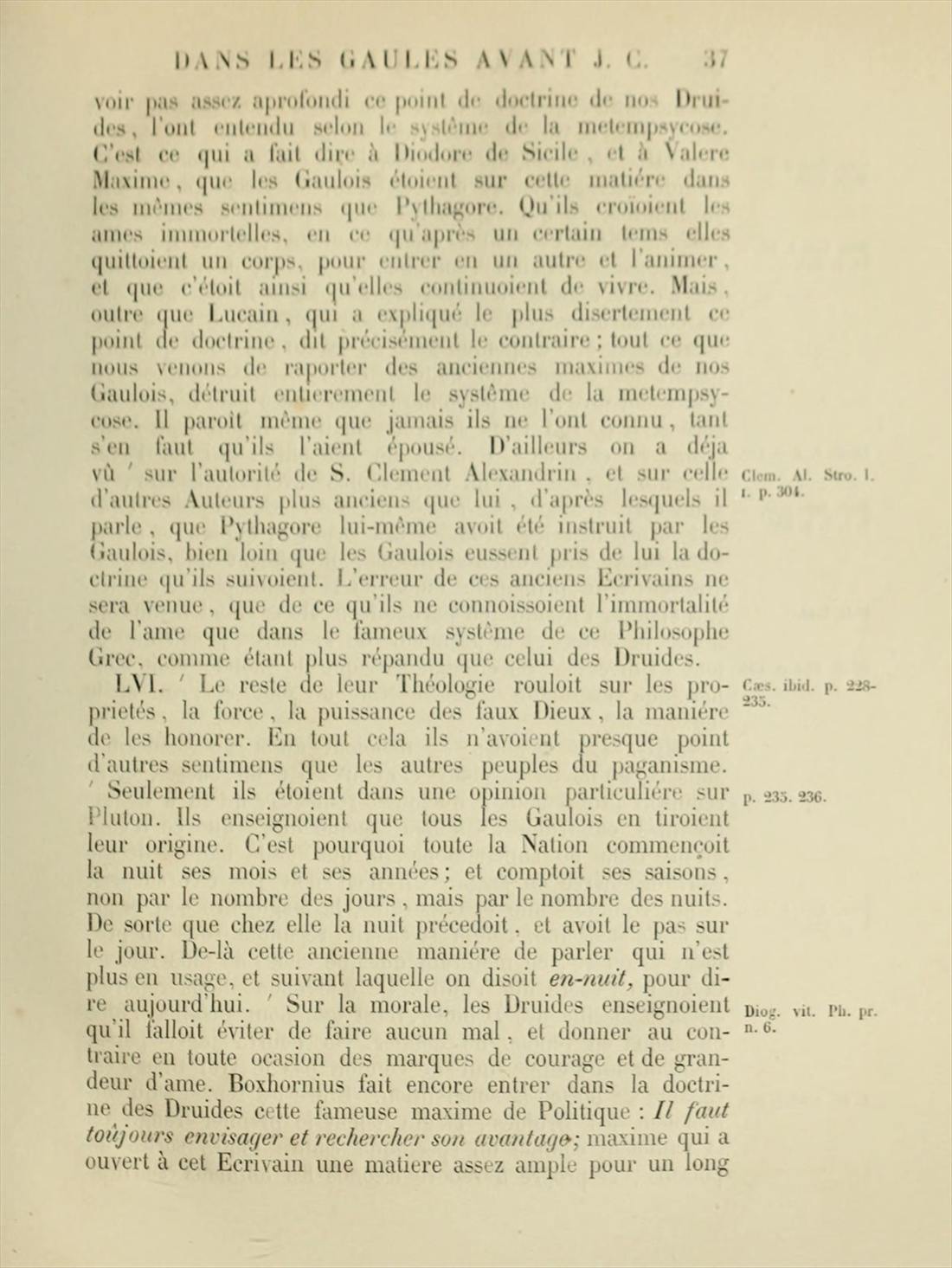
SourcesNo copy of the original printing of 1733–1763 was consulted for this page. The title page at the head is tome XXXI, Paris, Imprimerie nationale, 1893; the two plates are from tome I in Victor Palmé’s reissue of 1865, whose title page claims to conform entirely to the preceding edition. Both volumes were digitised from copies of the Pontifical Institute of Mediaeval Studies, University of Toronto, and may be read at the Internet Archive: tome I and tome XXXI; the catalogue records for these scans date the whole series to 1733, which is the date of the first tome only. The working method of Rivet, Poncet and Colomb, the portfolios in the archives of the Institut de France and Taillandier’s remark follow François Fossier, “L’Histoire littéraire de la France au dix-huitième siècle, d’après les archives des Bénédictins de Saint-Maur”, Journal des Savants, 1976; the contract of 1732, H. Omont in the Bibliothèque de l’École des chartes, 84 (1923), pp. 431–433, from the original in BnF ms. français 16859, pages 423–426; the events after Rivet’s death, the Avertissement to tome XIII; the present state of the work, the Académie des Inscriptions et Belles-Lettres.