
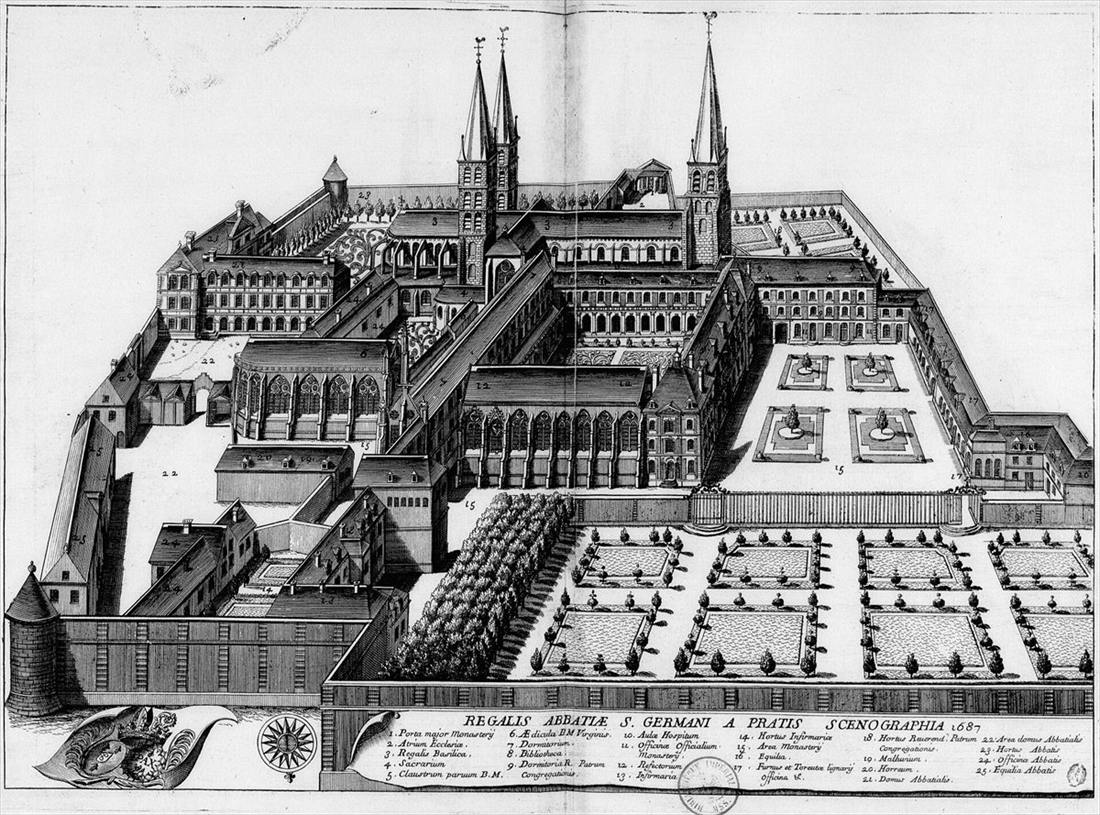
Saint-Maur · 1655-1677
Spicilegium
dom Luc d’Achery · Paris, Charles Savreux and others · thirteen volumes in quarto
A gleaning of old writers who had lain hidden in the libraries of France, chiefly the Benedictine ones: councils, chronicles, charters, wills and sermons, printed volume by volume across twenty-two years. The monk whose name stands on the title pages found almost none of it himself. Ill health held him in one Paris cloister, and he assembled the thirteen volumes by writing letters.
Thirteen volumes, assembled by letter
The title says what the books are: Veterum aliquot scriptorum qui in Galliae bibliothecis, maxime Benedictinorum, latuerant, spicilegium — a gleaning of certain old writers who had lain hidden in the libraries of France, and above all in the Benedictine ones. Every title page carries the formula prodeunt nunc primum in lucem, now first brought to light: a claim made for the volumes as a whole, and never tested text by text.
Luc d’Achery was born at Saint-Quentin in Picardy in 1609 and professed at the abbey of the Trinity at Vendôme on 4 October 1632. Ill health obliged him to move to Paris in 1637; he entered Saint-Germain-des-Prés, stayed forty-eight years, and died there on 29 April 1685. He had charge of the abbey’s library, and his authority was built out of correspondence — letters to monks and scholars across France and beyond, asking them to copy what their shelves held. That correspondence survives at the Bibliothèque nationale de France; his exchanges with Pierre-François Chifflet and Jean Mabillon, 1668 to 1675, were edited by Jeannine Fohlen in 1968.
Tome nine, and the copy shown here
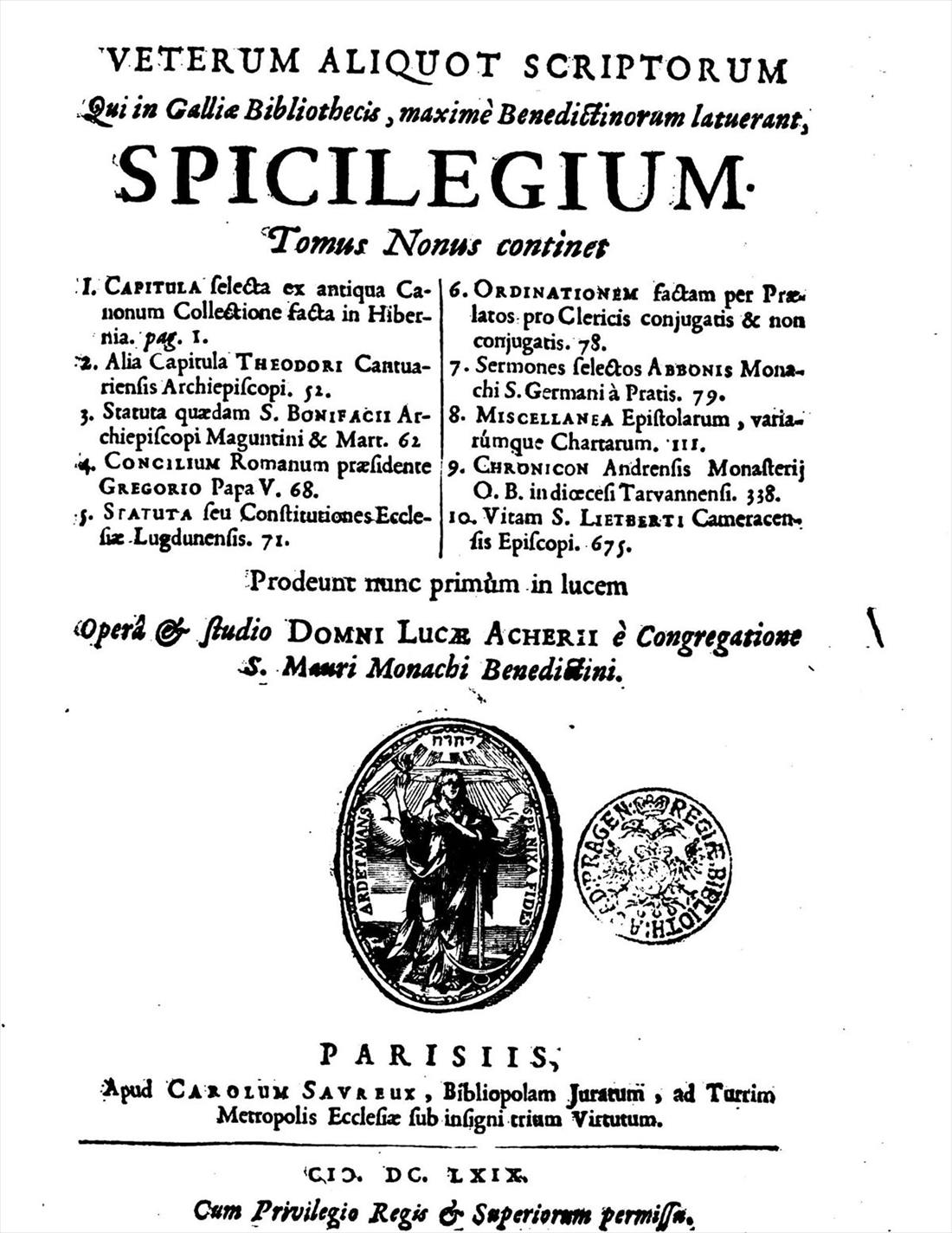
The title page above belongs to the ninth volume, of 1669, and sets out ten texts with the page on which each begins. Chapters of an old canon-law collection made in Ireland; further chapters of Theodore of Canterbury; statutes of Saint Boniface of Mainz; a Roman council under Gregory V; the statutes of the church of Lyon; an ordinance for married and unmarried clerks; the sermons of Abbo, a monk of Saint-Germain-des-Prés and so of d’Achery’s own house; letters and charters; the chronicle of the Benedictine abbey of Andres, in the diocese of Thérouanne; and the life of Saint Lietbert, bishop of Cambrai, closing the volume at page 675.
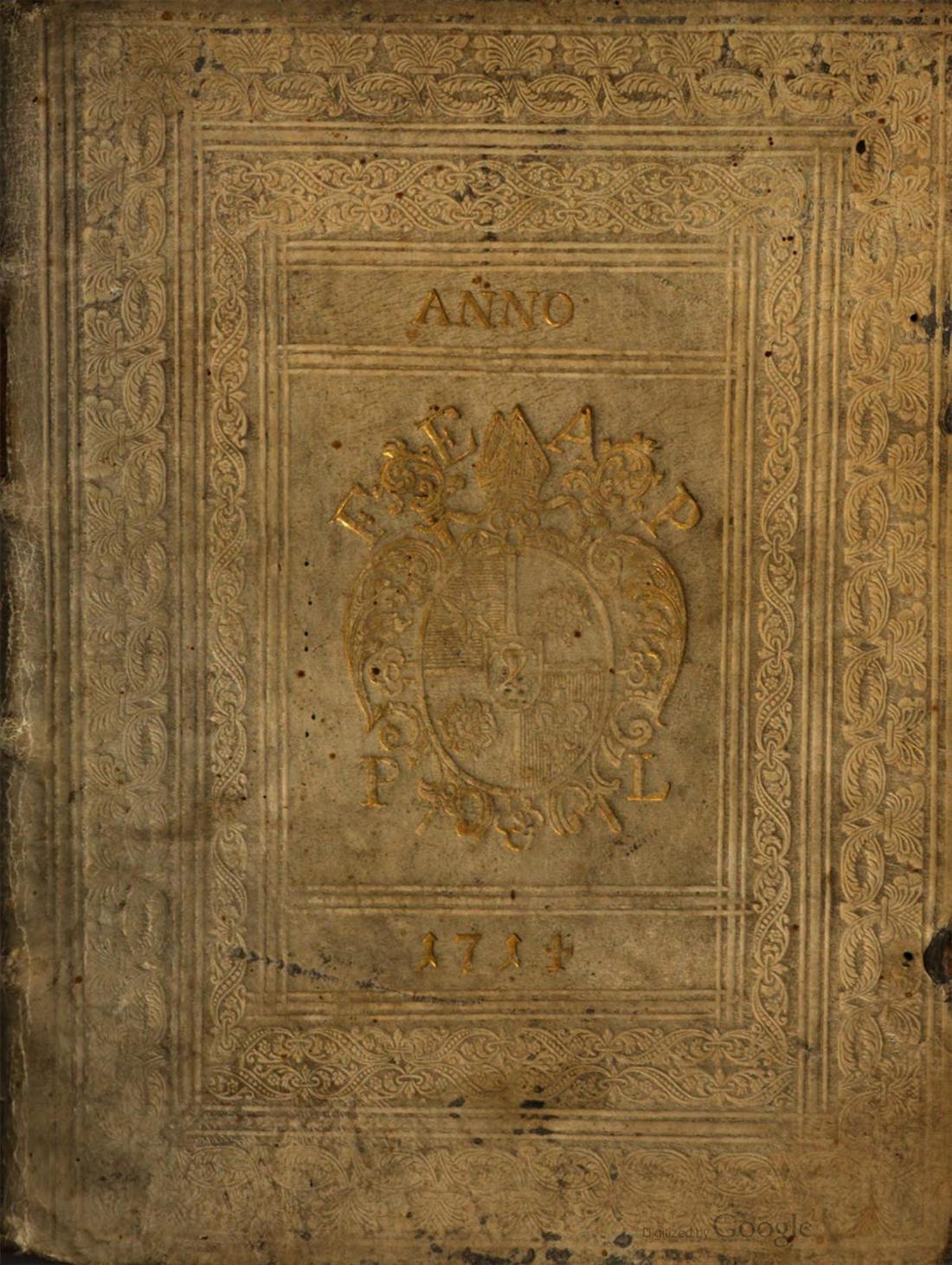
At the foot stands the imprint: Parisiis, apud Carolum Savreux, bibliopolam juratum, ad turrim Metropolis Ecclesiae sub insigni trium Virtutum — Charles Savreux, sworn bookseller, by the cathedral tower, at the sign of the three Virtues. Above it sits the device those virtues named: a woman beneath the divine name in Hebrew, an anchor at her feet, and the motto ardet amans spe nixa fides running round the oval — faith, resting on hope, burns with love. The copy reproduced here travelled: the same page carries the round stamp of the royal library at Prague, and in 1714 its cover was tooled with arms beneath a mitre.
After d’Achery
In 1664 Jean Mabillon joined the community, where d’Achery had long been the senior man and the librarian; together they began the Acta sanctorum ordinis sancti Benedicti, nine volumes between 1668 and 1701. In 1672 the eleventh volume of the Spicilegium carried, across two hundred pages, a systematic canon-law collection of the early ninth century, compiled in southern France and usually assigned to Lyon, in three books: penance; accusers, accused and judges; holy orders. Scholars have called it the Collectio Dacheriana ever since, after the man who printed it. The Clavis Canonum of the Monumenta Germaniae Historica catalogues twenty-three manuscripts of it and notes that a new edition is in preparation; until it appears, d’Achery’s is the only one ever published.
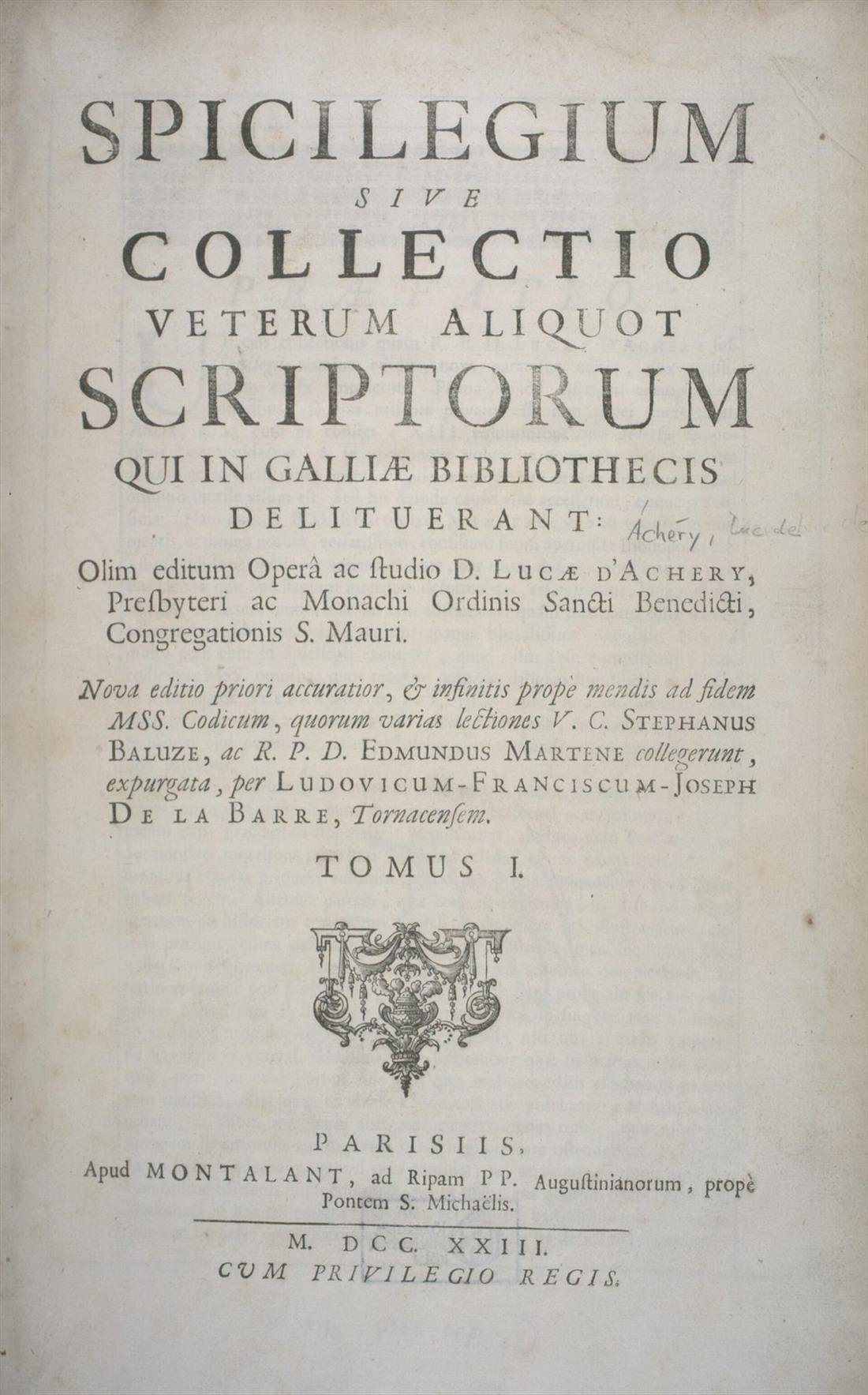
In time the first edition was judged faulty, and in 1723 the Paris bookseller Montalant, by the Augustinians’ quay near the Pont Saint-Michel, reissued the whole in folio as Spicilegium sive collectio veterum aliquot scriptorum qui in Galliae bibliothecis delituerant. The new title page says so plainly: an edition more accurate than the first, cleared of almost countless faults against the manuscripts, whose variant readings Étienne Baluze and Edmond Martène had gathered, corrected by Louis-François-Joseph de La Barre of Tournai. It is the 1723 text that reference works cite for the Dacheriana, at pages 509 to 564 of its first volume.
Why it is here
D’Achery’s method was not discovery but asking, copying and printing, with the shelf it came from named. The Conservatoire’s library and archive work the same way on a much smaller scale: the leases, plans and accounts of this abbey survive in several hands and several places, and the research programme exists to gather them and to say of each where it came from. The thirteen volumes measure what the Congregation undertook, and how much of it rested on one man’s letters.
SourcesThe title page and the binding are two leaves of a single copy of tome nine (Paris, Charles Savreux, 1669), digitised by Google and published by the Internet Archive; the Latin quoted here is transcribed from that image. The 1723 title page is the Cologne CEEC scan on Wikimedia Commons; the view of Saint-Germain-des-Prés is the 1687 plate of the Monasticon Gallicanum, Bibliothèque nationale de France, also via Wikimedia Commons. All are in the public domain. Tome six of 1664 and tome two of the 1723 folio may be read page by page at the Internet Archive.